A damp patch on your ceiling isn’t just a minor annoyance. It’s often the final warning from a flat roof system that has reached its limit. Most homeowners feel a sense of dread when they see water ingress, fearing that a small drip will inevitably lead to a massive bill. It’s a common worry, especially when you’re staring at a flat surface and can’t figure out where the water is actually getting in. Understanding how to fix a leaking flat roof starts with a bit of detective work and a clear, honest plan.
We’ve seen how stressful this can be, but you don’t have to face it without the right facts. This guide will help you accurately locate the source of the trouble, apply reliable temporary patches, and choose a permanent solution that keeps your home dry for years. We’ll explore whether your current bitumen or EPDM surface is salvageable or if a seamless GRP fibreglass upgrade is the best way to stop the cycle of repairs. From navigating UK Building Regulations to choosing compatible materials, you’ll gain the confidence to protect your property whilst ensuring your roof remains resilient for the long term.
Key Takeaways
- Learn why water often tracks along internal joists, meaning the drip on your ceiling is rarely directly beneath the actual hole in the roof.
- Discover how to fix a leaking flat roof by distinguishing between temporary emergency patches and the methodical preparation needed for a permanent result.
- Understand the common failure points of felt and EPDM systems in the UK climate and why “quick-fix” sealants can often complicate professional repairs later.
- Identify when your roof is truly salvageable and why GRP fibreglass has become the gold standard for long-term, hassle-free protection.
Finding the Source: Why Flat Roof Leaks Are Difficult to Trace
Finding the source of a leak on a flat surface is rarely straightforward. Unlike a pitched roof where water generally follows gravity straight down, flat roofs are prone to “tracking.” This means water enters through a tiny split in the membrane, travels along a timber joist or the underside of the decking, and eventually drips onto your ceiling several metres away. If you want to learn how to fix a leaking flat roof, you must first accept that the drip isn’t the destination; it’s just the exit point.
Internal signs are your first clues. Look for “tide marks,” which are those brownish rings on the plaster. Bubbling paint or a persistent musty odour usually suggests water has been sitting in the ceiling void for some time. If the plaster feels soft or spongy, the leak is likely active and requires immediate attention to prevent structural rot.
Tracing the Leak from the Inside Out
Start your investigation by measuring the distance from the internal drip to the nearest external walls. Take these measurements up onto the roof to narrow your search area. Be aware of damp insulation; materials like glass wool act like a sponge, holding moisture long after the rain stops. This often causes “phantom leaks” where you see a drip on a perfectly dry day. Also, check if the issue is actually condensation. In cold UK winters, poor ventilation in the roof void can cause moisture to bead on the underside of the deck, mimicking a structural failure.
The Visual Inspection: What to Look for on the Surface
Once you’re outside, look for “ponding”—areas where water stands for more than 48 hours after rain. This indicates a sag in the joists or a lack of proper fall. Different flat roof materials and construction methods show age in different ways. Older bitumen felt often exhibits “alligatoring,” which looks like cracked, scaly skin. This happens as the oils in the bitumen dry out from UV exposure. During dry weather, use this checklist to spot vulnerabilities:
- Upstands: Inspect where the roof meets the house wall or a chimney stack. Flashings often pull away or crack here.
- Seams: Look for lifting edges in EPDM rubber or gaps in felt joins.
- Punctures: Check for tears caused by fallen branches or foot traffic.
- Drains and Gutters: Blocked outlets cause water to back up and find the weakest point in the membrane.
Identifying these faults is the essential first step in deciding how to fix a leaking flat roof permanently. Only once you’ve found the true entry point can you choose between a temporary patch or a full system replacement.
Common Culprits: Why Your Flat Roof is Leaking
Understanding the common failure points is the only way to determine how to fix a leaking flat roof effectively. Traditional multi-layer felt roofs are particularly susceptible to the UK’s freeze-thaw cycles. Over time, the bitumen becomes brittle. It loses its ability to flex. When the temperature drops, the material contracts and develops hairline fractures. Even modern EPDM rubber systems aren’t immune. Inconsistent installation can lead to “shrinkage,” where the membrane pulls away from the edges, creating a direct path for water. Identifying these culprits early prevents a minor drip from becoming a structural nightmare.
Blocked guttering plays a surprisingly large role. When autumn leaves or debris clog your outlets, water pools at the roof’s edge. This standing water eventually finds its way under the flashing or through the fascia boards. For those living in historic properties, it’s worth consulting official guidance on roof maintenance to understand how these issues can impact older structural timbers. Thermal expansion is another factor. Older asphalt or GRP systems that lack modern flexibility can crack during intense summer heat, leaving the substrate vulnerable to the next downpour.
Failed Seams and Joins
Heat-welded seams in traditional felt roofs are often the first point of failure. As the building settles or the roof expands, these joins are under constant stress. They eventually pull apart. With EPDM, the issue is usually the adhesive. If the substrate wasn’t bone-dry during installation, the bond will eventually lift. You can see a detailed comparison of these materials in our guide on Fiberglass Roof vs Felt Roof: Which is Best for Your London Home in 2026? to help you decide which system suits your property.
Flashing and Parapet Wall Issues
In London, the architecture presents unique challenges. Many terrace houses feature shared parapet walls where the mortar often fails over several decades. Water seeps into the brickwork and bypasses the roof membrane entirely. Lead flashing can also perish or pull away from the masonry. We often find that expert roof repairs London homeowners require actually involve chimney repointing as much as membrane work. If your chimney stack is crumbling, no amount of roof sealant will stop the damp from entering your home.
If you’re unsure whether your leak is a simple seam failure or a deeper structural issue, getting a professional opinion can save you thousands in future damage. We specialise in flat roof repair services that address these root causes directly rather than just covering them up.
Emergency vs. Permanent Fixes: What You Can Actually Do
A genuine emergency is when water is actively entering your living space, risking electrical systems or causing ceiling plaster to sag. A cosmetic fix, by contrast, is simply painting over a dry stain. When considering how to fix a leaking flat roof, you must distinguish between a temporary bandage and a long-term cure. While a £50 tin of emergency sealant from a DIY shop is tempting, “slathering” thick bitumen over a problem often does more harm than good. These heavy compounds can make it nearly impossible for a professional to apply a proper bond later, often forcing a full deck replacement that could have been avoided.
Safety is the most critical factor in any DIY attempt. Falls from height remain a significant risk in the UK, accounting for 53% of all construction fatalities in 2023/24. Never attempt to walk on a wet roof or work from a standard domestic ladder. Professional roofers use specialised crawling boards to distribute weight and prevent falling through weakened timber. A DIY patch might offer a sense of relief, but it lacks the security of a professional 15-year guarantee that protects your home through every winter storm.
When a DIY Patch is Appropriate
A quick patch is only suitable as a temporary measure whilst you wait for a professional flat roof repair London service to arrive. If you spot a small, visible puncture in an otherwise healthy EPDM rubber membrane, an “instant leak” sealant can stop immediate internal damage during a downpour. These products are designed to be applied in the rain, but they are stop-gaps. They are not designed to endure the constant expansion and contraction of a UK roof over several seasons.
The Limitations of Temporary Coatings
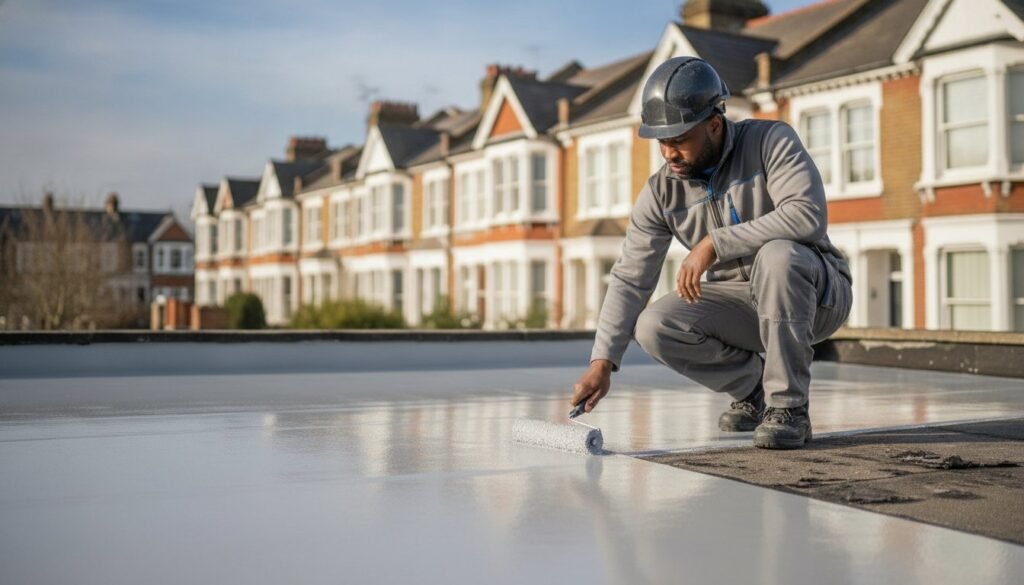
Many homeowners mistake solar reflective paint for a waterproofing solution. It is not. Its primary job is to reflect UV rays to prevent older bitumen from drying out and cracking. Using it to stop an active leak is ineffective. These coatings often trap moisture within the roof structure, leading to “wet rot” in the timber decking. For a truly permanent result, professional GRP (Glass Reinforced Polyester) solutions provide a seamless, monolithic layer. Unlike DIY patches, GRP has no joins or seams to fail, ensuring your home remains dry for decades rather than just a few months.
How to Fix a Flat Roof Leak: Step-by-Step for Minor Repairs
Once you’ve identified the source of the ingress, the actual repair requires a methodical approach. Most DIY attempts fail because the surface wasn’t prepared correctly. Moisture is the ultimate enemy here; even a microscopic amount of dampness trapped under a patch will cause the adhesive to fail within weeks. If you want to know how to fix a leaking flat roof so it stays fixed, you must treat the preparation with as much care as the application itself. This isn’t a task to rush between rain showers.
Preparing the Surface
Start by clearing the work area of all debris. Use a stiff brush to remove moss, algae, and loose stone chippings. Be careful to sweep away from the outlets to ensure no grit enters your guttering system. If your felt roof has “blisters” or bubbles, you must carefully slit them with a sharp knife to release trapped air or water. This is a step many guides miss, but it’s vital for a flat finish. After cleaning, use a heat gun or a hairdryer to ensure the substrate is bone dry. Finally, wipe the area with a degreasing agent or specialist roof cleaner to ensure the new patch can form a chemical bond with the old surface.
Applying the Patch
The method depends on your roof type, but the “50mm rule” applies to all. Your patch must overlap the damaged area by at least 50mm on all sides to prevent water from seeping under the edges. Follow these steps for the most common materials:
- For Felt Roofs: Apply a thick layer of cold-applied bitumen adhesive over the split. Press a piece of matching roofing felt into the adhesive, ensuring there are no air pockets. Apply a second coat of bitumen over the edges of the patch to seal them completely.
- For EPDM Rubber: Clean the area with a specialist EPDM primer. Once tacky, apply a piece of self-adhesive flashing tape or a dedicated EPDM patch. These materials are designed to “fuse” with the existing membrane.
After applying any patch, use a weighted roller or a heavy smooth object to press the material firmly into the substrate. This ensures a permanent bond and removes any hidden air bubbles that could expand in the sun. If you’re unsure about tackling these technical steps yourself, our team provides professional flat roof repair services with a 15-year guarantee, giving you the peace of mind that a DIY patch simply can’t offer.
The Permanent Solution: When to Invest in GRP Fiberglass
If you find yourself searching for how to fix a leaking flat roof every time the seasons change, you are likely trapped in the “patching cycle.” This is a common and frustrating situation for many UK homeowners. You spend £150 on a minor repair in autumn, only for a new drip to appear in February. Recurring leaks are a clear signal that your roof’s membrane has reached the end of its functional life. In 2026, GRP (Glass Reinforced Polyester) fiberglass has emerged as the gold-standard solution for those looking to end this cycle for good. It moves the conversation from temporary maintenance to long-term property protection.
Unlike traditional materials that rely on heat-welded joins or adhesives, GRP creates a completely seamless surface. There are no seams to pull apart and no weak points for water to exploit. It’s also fire-retardant and incredibly durable, easily withstanding the weight of window cleaners or maintenance foot traffic. For a deeper look at why this material is replacing older systems, see our guide on Professional Fiberglass Roof Installation London.
Why Fiberglass Outlasts Felt and EPDM
London properties face a specific environmental challenge known as the urban heat island effect. Built-up areas often stay several degrees warmer than the surrounding countryside. This constant heat accelerates the degradation of bitumen and EPDM, causing them to become brittle and crack prematurely. GRP is different. It’s a monolithic system. It forms one single, unbreakable sheet that is chemically bonded to the roof deck. It doesn’t shrink, melt, or rot. While the initial outlay is higher than a quick patch, you should consult our Fibreglass Flat Roof Cost UK guide to see how the long-term ROI outweighs the cost of endless, failed repairs.
The Atlas Guarantee: Peace of Mind for 15 Years
As a family-run organisation with over 20 years of local experience, Atlas Roofing Solutions Ltd prioritises durability over quick fixes. We understand that your home is your most valuable asset and seeing water damage on a fresh ceiling is incredibly stressful. That’s why we provide a 15-year guarantee on our workmanship. This isn’t just a marketing claim. It’s our commitment that your roof will remain watertight, protecting your structural timbers and interior décor through the worst of the British weather. We believe in transparency and quiet confidence. We don’t use high-pressure tactics; we simply provide a solution that works for the long haul.
If you’re tired of the stress and uncertainty of a failing roof, we’re here to help. Contact Atlas Roofing Solutions Ltd for a free site visit and no-obligation quote today. Let’s ensure your home stays dry for the next winter and many more to come.
Securing Your Home for the Long Term
Identifying the true source of water ingress is the first step toward a dry home. We’ve explored how water tracks along internal timbers, meaning the visible damage is often far from the actual entry point. Whilst temporary patches can offer short-term relief during a downpour, they rarely address the underlying structural failure. Understanding how to fix a leaking flat roof effectively means looking beyond the “quick fix” and choosing materials that can withstand the UK’s unpredictable weather cycles.
If your roof has reached the end of its life, investing in a seamless GRP fiberglass system provides the durability your property deserves. At Atlas Roofing Solutions Ltd, we bring over 20 years of family-run expertise to every project, specialising in permanent solutions that end the cycle of recurring repairs. We provide a 15-year guarantee on all workmanship, giving you total peace of mind that your home is protected. Request your free London flat roof survey and transparent quote today. You don’t have to face the next storm with a bucket in hand; let’s get your roof back to its best.
Frequently Asked Questions
How do I find a leak on a flat roof when there are no obvious holes?
Start by measuring the distance from the internal drip to the nearest external walls. Water often tracks along joists, so the entry point is rarely directly above the stain. Look for ponding water or failed seams near the measured area. A controlled water test, where you soak sections of the roof one at a time, can also help narrow down the search in dry weather.
Can I fix a leaking flat roof in the rain?
You can use emergency instant leak sealants during active rainfall, but these are only temporary measures. Most permanent adhesives and GRP resins require a bone-dry substrate to bond correctly. If you apply a permanent fix to a wet surface, you’ll trap moisture inside the structure, which eventually leads to rot. It’s best to use a temporary patch whilst waiting for a dry window to perform a professional repair.
Is it worth repairing a 20-year-old felt roof?
It’s generally more cost-effective to replace a 20-year-old felt roof rather than repairing it. Traditional bitumen felt has an average lifespan of 15 to 20 years, meaning the entire membrane is likely brittle and prone to new failures. Spending money on how to fix a leaking flat roof that has reached its life expectancy often leads to a cycle of endless repairs. Upgrading to GRP fiberglass offers much better long-term value.
How much does a professional flat roof repair cost in London?
Professional repair costs vary significantly based on the extent of the damage and the materials required. Minor patch repairs are relatively inexpensive, whilst larger structural issues or chimney-related leaks require more labour and specialist equipment. In London, prices also reflect the complexity of terrace properties and shared parapet walls. For an accurate figure that reflects your specific roof condition, we recommend requesting a transparent survey rather than relying on generic estimates.
What is the best product to stop a flat roof leak instantly?
Emergency bitumen-based sealants or reinforced flashing tapes are the most effective products for stopping a leak instantly. These are designed to be applied in wet conditions to prevent immediate internal damage. However, these “goop” products are not a permanent way how to fix a leaking flat roof. They can make professional repairs harder later because they leave a residue that prevents new membranes from bonding. Use them only as a stop-gap.
Can I walk on my flat roof to inspect it for leaks?
You should only walk on a flat roof if you are certain the underlying structure is sound. Many older roofs develop soft spots where the timber decking has rotted due to hidden leaks. If you must inspect it, use crawling boards to distribute your weight across the joists. Falls from height are a major risk in the UK, so if you have any doubts about the roof’s integrity, it’s safer to call a professional.
Why does my flat roof leak only during heavy rain?
Leaks that appear only during heavy downpours are often caused by blocked drainage or failing upstands. When gutters or outlets are overwhelmed, water backs up and rises above the waterproof membrane’s edge. This forces water behind the flashing or into shared parapet walls. It’s a common issue in London terrace homes where shared drainage systems can’t cope with intense rainfall. Regular gutter maintenance often resolves these specific heavy rain leaks.
Does home insurance cover a leaking flat roof?
Most home insurance policies cover resultant damage from a leak, such as ruined ceilings or carpets, but they rarely pay for the roof repair itself. Insurers typically view a leaking roof as a maintenance issue caused by wear and tear or age. However, if the leak was caused by a specific peril like a fallen tree or storm damage, you might be covered. Always check your policy wording regarding flat roof maintenance requirements.