Why does that small damp patch on your ceiling keep returning despite three different ‘fixes’ in as many years? It’s a common frustration for many homeowners seeking flat roof repair London wide. You want a home that stays dry, but instead, you’re stuck in a cycle of temporary patches and unreliable tradespeople. We understand that anxiety. A leaking roof isn’t just a maintenance chore. It’s a threat to your family’s comfort and your property’s value.
This guide cuts through the confusion to help you secure a permanent solution for your property in 2026. We’ll show you how to identify the real cause of a leak before it becomes a structural disaster. You’ll discover the practical differences between high-performance GRP fibreglass and modern felt systems, helping you choose a material that actually lasts. From understanding the latest thermal efficiency standards to knowing what to look for in a professional quote, we’ve laid out everything you need for a leak-free future. Durable materials. Expert installation. Total peace of mind.
Key Takeaways
- Understand how London’s urban heat and pollution accelerate roof wear and how to identify early signs of membrane failure.
- Compare GRP fibreglass and traditional felt to choose the most durable solution for your flat roof repair London needs.
- Apply the ‘25% Rule’ to decide if a localised repair is viable or if a full replacement offers better long-term value.
- Learn the importance of a professional site survey and surface preparation in ensuring a completely seamless, waterproof finish.
- Gain peace of mind by choosing a family-owned specialist that provides a 15-year guarantee on all workmanship.
Common Causes of Flat Roof Failure in London Properties
Flat roof failure occurs when the external waterproof membrane is breached, allowing moisture to seep into the underlying deck and insulation. This isn’t always a dramatic event. Often, it starts as a slow infiltration that compromises the structural integrity of your home before a single drop hits the floor. Understanding flat roof construction and materials is vital because different systems fail for different reasons. In the capital, these issues are often compounded by specific environmental pressures that homeowners elsewhere might not face.
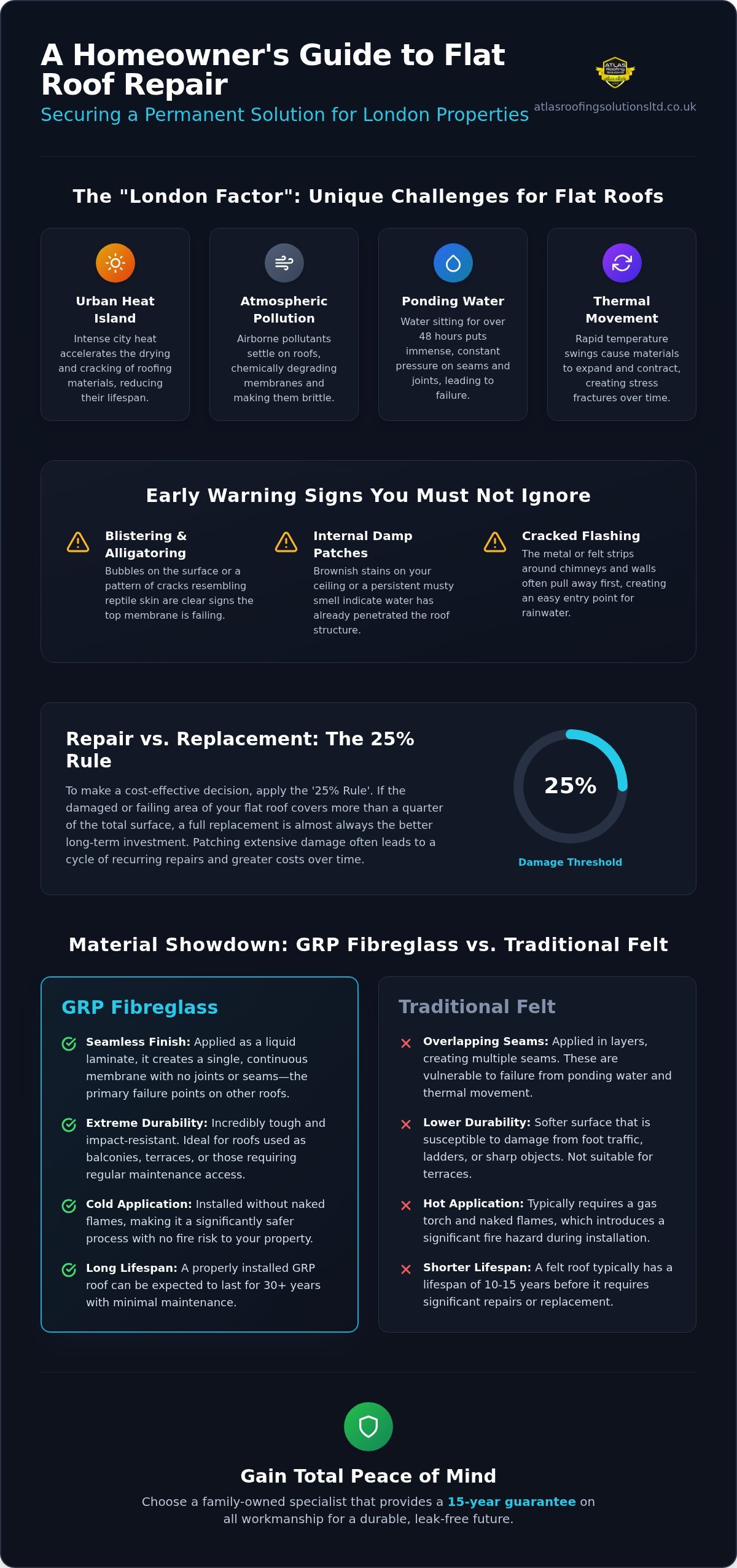
The “London Factor” plays a significant role in roof degradation. London experiences higher average temperatures than surrounding rural areas due to the urban heat island effect. This intense heat, combined with high levels of atmospheric pollution, accelerates the drying out of traditional bitumen felt. The material loses its flexibility. It becomes brittle. It cracks. Eventually, it fails. This is a primary reason why many residents require professional flat roof repair London services much sooner than they anticipated.
Standing water, known as “ponding,” is the number one enemy of London extensions and balconies. If water sits on the surface for more than 48 hours without draining, it puts immense pressure on the seams and joints. When you add thermal movement into the mix, the risk increases. London’s fluctuating temperatures cause materials to expand in the midday sun and contract rapidly at night. This constant movement creates stress fractures, particularly in older felt roofs that lack the elasticity of modern GRP systems.
Early Warning Signs You Should Not Ignore
You don’t need to wait for a major leak to know there’s a problem. Keep an eye out for these red flags:
- Blistering and alligatoring: Bubbles on the surface or a pattern of cracks that looks like reptile skin indicate the membrane is failing.
- Internal damp patches: Brown stains on the ceiling or a persistent musty smell in upper rooms suggest water is already trapped in the roof structure.
- Cracked flashing: The metal or felt strips around chimneys and parapet walls often pull away first, creating an easy entry point for rain. If you notice perished mortar or leaning brickwork alongside flashing failures, our guide to chimney repair London homeowners rely on explains how to address stack deterioration before it compounds your flat roof problems.
The Impact of London Architecture on Flat Roofs
London’s unique building stock presents specific challenges for maintenance. Many Victorian terrace extensions have narrow access, making it difficult for some contractors to bring in heavy equipment. Shared parapet walls are another common headache. A leak originating on a neighbour’s side of the wall can easily migrate across the boundary, making detection a complex task. Furthermore, high-density boroughs see a significant build-up of urban debris. Leaves, moss, and even wind-blown litter can block gutters quickly. This leads to water backing up onto the flat roof, which is a frequent cause of flat roof repair London calls during the autumn and winter months. A complete roofline inspection, including your soffit and fascia boards, can help identify blocked drainage and decay before they contribute to flat roof problems.
Comparing Modern Flat Roof Repair Materials: GRP vs. Felt
Selecting the right material for your flat roof repair London project is a decision that balances upfront costs against long-term resilience. Whilst traditional bitumen felt remains a popular choice for many, modern advancements like GRP fibreglass have redefined what homeowners can expect from a flat roof. The best solution for your property depends entirely on how you intend to use the space. For example, a roof that doubles as a balcony requires a far tougher surface than a simple kitchen extension roof that is never walked upon. If you’re weighing up the critical differences in cost, durability, and long-term performance, our in-depth guide to the fiberglass roof vs felt roof debate will help you make a fully informed decision for your London home.
Compliance is also a factor. When planning significant work, it’s essential to understand the UK Building Regulations for roofing to ensure your repair or replacement meets current safety and thermal standards. If you’re unsure which material fits your specific structure, you can arrange a no-obligation site visit to get an expert assessment of your roof’s condition.
The Benefits of GRP Fiberglass for London Homes
GRP, or Glass Reinforced Polyester, is frequently considered the gold standard for residential flat roofing. Its greatest strength lies in its seamless application. Because it’s applied as a liquid laminate, it creates a single, continuous membrane over the entire surface. There are no joints. There are no seams. These are the areas where traditional roofs typically fail first. GRP is also incredibly durable, making it the ideal choice for London homes where a flat roof might be used as a terrace or for regular maintenance access. If you’re considering upgrading from an older felt system, our guide to professional fiberglass roof installation London homeowners rely on explains the full structural benefits of switching to a seamless GRP membrane.
Safety is another major advantage. GRP is a cold-applied system. This means we don’t need to use naked flames or gas torches on your property. For the many timber-framed extensions found across London, this significantly reduces the risk of fire during the installation process. It’s a clean, efficient, and exceptionally tough solution that provides decades of protection.
When to Choose High-Performance Felt
Modern bitumen felt is a significant upgrade from the outdated “pour and roll” methods of the past. Today, we use high-performance torch-on felts that incorporate polyester reinforcement for added strength and flexibility. Felt is often the most cost-effective choice for larger commercial spans or for homeowners who need a reliable, budget-conscious repair for a garage or shed. It handles structural movement well, which is useful for larger buildings that may settle over time.
Whilst it may not offer the same 30-year lifespan as a GRP system, a well-installed felt roof is a dependable mid-term solution. It’s particularly suitable for properties where the roof won’t be subjected to foot traffic. If you’re planning to move house in the next few years, a high-quality felt repair provides a solid, waterproof result without the higher investment of a full fibreglass installation.
Flat Roof Repair vs. Replacement: Making the Right Call
Deciding whether to patch a leak or invest in a full overhaul is often the most stressful part of home maintenance. At Atlas Roofing Solutions Ltd, we believe in a transparent, straight-talking approach to help you make this choice. One of the most reliable benchmarks we use is the ‘25% Rule’. If more than a quarter of your roof surface is showing signs of significant damage, blistering, or previous failed patches, a localised flat roof repair London is usually a false economy. In these cases, the cost of multiple visits and ongoing repairs will quickly exceed the investment of a professional replacement.
Age is another critical factor. A traditional bitumen felt roof that has reached the 20-year mark has likely lost its essential oils and elasticity. Patching one area often puts stress on another, leading to a domino effect of new leaks. We also look closely at the structural deck. If the boards feel ‘spongy’ underfoot, it’s a clear sign that water has bypassed the membrane and begun rotting the timber joists. In this scenario, a simple cover-up won’t solve the underlying safety issue. Structural integrity is paramount for any long-term solution.
Modern replacements also offer a significant benefit: energy efficiency. Under the latest 2026 standards, a new installation allows us to incorporate high-performance ‘warm roof’ insulation. This ensures the structure achieves the required U-value of 0.15 W/m²K. This keeps your home warmer in winter and cooler in summer, helping you meet current UK building requirements whilst reducing your monthly energy bills. It’s a proactive step that adds genuine value to your property.
Factors That Favour a Professional Repair
A repair is often the most sensible route if the damage is isolated and the rest of the structure is sound. For instance, a fallen branch or a slipped tile from a neighbouring pitched roof can cause localised mechanical damage. If the main membrane is in good condition, we can perform a targeted fix that restores the seal. Similarly, if the leak originates from cracked flashing around a chimney or parapet wall, we can replace the leadwork without disturbing the main roof surface. In many cases, deteriorating mortar joints and failed leadwork around the stack are the true source of the water ingress, making professional chimney repair London specialists recommend an essential first step before any flat roof work begins. Following guidelines from the National Federation of Roofing Contractors (NFRC), we always prioritise the most durable, cost-effective solution for the specific situation.
When a Full Replacement is Unavoidable
There are times when a patch simply won’t work. If the underlying insulation is saturated, it will continue to rot the structure from the inside out, regardless of what we put on top. We also see many properties with multiple ‘bodge’ repairs from previous years. These layers of mismatched materials eventually become too heavy and unstable to support further work. If your roof has reached this point, you can read our guide on professional new roof installation London to understand the full process and the long-term benefits of starting fresh with a guaranteed system.
The Atlas Approach: Professional Flat Roof Repair Process
Our methodology at Atlas Roofing Solutions Ltd is built on over 20 years of practical experience in the capital. We don’t believe in guesswork. When you arrange a flat roof repair London service with our team, we follow a linear, four-step process designed to eliminate the root cause of your leak. We begin with a comprehensive site survey. This isn’t a quick glance from a ladder. We investigate the entire roof structure to understand why the failure occurred. Whether it’s a blocked internal drain or a failing shared parapet wall, we identify the source before proposing a fix.
The second stage is surface preparation. This is the most critical part of the job. We meticulously clean the area and ensure it is completely dry. Without a pristine surface, even the highest quality GRP or felt system will fail to adhere correctly. Third, we apply the materials using industry-leading techniques. We use high-performance laminates for GRP or reinforced torch-on membranes for felt repairs. Finally, we conduct a rigorous post-installation inspection. Only when we are satisfied that the seal is perfect do we issue our 15-year workmanship guarantee. This gives you long-term security and total peace of mind.
What to Look for in a London Roofing Specialist
Finding a trustworthy tradesperson in a city as large as London can be daunting. To protect your property, always verify that your roofer has full public liability insurance and can provide genuine local references. Transparency is vital. A professional should offer a clear, no-obligation quote that details every part of the work. No hidden extras. No sudden price hikes halfway through the job. As a family-owned business, Atlas Roofing Solutions Ltd relies on its reputation. We treat every home with the same care and accountability we would our own. If you value honest, straight-talking advice, you can book your free site visit here.
Preparation Tips for Homeowners
You can help us ensure the project runs smoothly by following a few simple steps. Before we arrive, please clear the area directly beneath the roof or balcony. This keeps your garden furniture and planters safe from any falling debris. We will also need clear access to the property and a standard external power point for our equipment. Most flat roof repair London projects are completed within 1 to 2 days, depending on the weather and the size of the area. We work efficiently to minimise disruption, leaving your home watertight, clean, and tidy.
Why London Homeowners Trust Atlas Roofing Solutions Ltd
Choosing a roofer in a city as competitive as London requires more than just looking at a price tag. It requires finding a partner who understands the specific environmental stresses we’ve discussed, from urban heat to high pollution levels. Atlas Roofing Solutions Ltd brings over 20 years of hands-on experience to every project. We’ve seen every type of failure on every type of property, from Victorian terraces to modern apartment blocks. This deep local knowledge ensures that your flat roof repair London isn’t just a temporary fix. It’s a long-term investment in your home’s security.
Our 15-year workmanship guarantee isn’t just a piece of paper. It’s our personal promise to you. As a family-owned and operated business, our reputation is our most valuable asset. We don’t hide behind corporate layers or detached customer service teams. When you work with us, you get transparent, straight-talking communication from start to finish. We specialise in both traditional high-performance felt and modern GRP fiberglass systems, ensuring we always recommend the material that best suits your specific needs and budget.
Our Commitment to Quality Workmanship
Accountability is the cornerstone of our service. This is why Atlas Roofing Solutions Ltd never uses sub-contractors for our core roofing repairs. Every technician on your roof is a trained member of our own team, working to our exacting standards. We don’t cut corners. We don’t use inferior materials. We only use high-grade products that are proven to withstand the unpredictable UK climate. From heavy-duty laminates to reinforced membranes, we select products designed for resilience and longevity. You can read more about our expert roof repairs London to see how this commitment to quality extends across our full range of roofing services, including the soffit and fascia components that protect your roofline from structural damp and decay.
Get Your Free, No-Obligation London Site Visit
We believe in making home maintenance as hassle-free as possible. That’s why we offer a comprehensive, no-obligation site visit for all London residents. During this assessment, our experts don’t just look for leaks. They evaluate the structural integrity of the deck, check for thermal efficiency gaps, and inspect the drainage systems. We provide a clear, detailed breakdown of our findings and a transparent quote with no hidden extras. It’s a simple, honest way to get the answers you need about your roof’s condition. Contact Atlas Roofing Solutions Ltd for a free flat roof repair quote today and take the first step toward a leak-free home.
Secure Your Home with a Permanent Solution
A leaking roof shouldn’t be a source of constant stress. By understanding the specific challenges of flat roof repair London properties face, you’re now better equipped to protect your investment. Whether you opt for the seamless durability of GRP or the reliable flexibility of modern felt, the most important factor is a professional installation that addresses the root cause of the leak. Don’t wait for a small damp patch to become a major structural failure.
At Atlas Roofing Solutions Ltd, we bring over 20 years of local experience to every project. As a family-run business, we value our reputation and your peace of mind above all else. That’s why we provide a 15-year workmanship guarantee and maintain total transparency in our pricing. You deserve a dry, secure home without the anxiety of recurring leaks or hidden costs. We’re here to provide that security with quiet confidence and expert skill.
Book your free flat roof inspection and no-obligation quote today. Let’s ensure your London home stays watertight and protected for many years to come.
Frequently Asked Questions
How much does flat roof repair cost in London?
The cost of your project depends on the extent of the damage and the material chosen, such as high-performance felt or GRP fibreglass. Whilst minor fixes are more affordable, the final price is influenced by London’s specific logistical challenges, including narrow access and the disposal of old materials. We recommend a professional site survey to get an accurate, transparent quote tailored to your property. This ensures you only pay for the work actually required to make your home watertight.
Can you repair a flat roof in the rain?
It is not advisable to carry out permanent repairs during active rainfall. Both GRP fibreglass and high-performance felt require a completely dry surface to ensure maximum adhesion and a waterproof seal. If we apply materials to a damp deck, moisture gets trapped, leading to future blisters and failure. In an emergency, we can provide temporary weatherproofing to protect your home until the London weather clears enough for a permanent solution.
How long does a GRP fiberglass roof repair last?
A professionally installed GRP fibreglass repair can last for 30 years or more. This material is incredibly resilient and does not suffer from the same UV degradation as older bitumen products. Because it is a seamless system, there are no joints to fail over time. Choosing GRP for your flat roof repair London project is often the most cost-effective long-term choice due to its exceptional lifespan and minimal maintenance requirements.
Is a 15-year guarantee standard for flat roof repairs?
A 15-year guarantee is not standard across the industry, but it is a core part of our commitment to quality. Many local contractors only offer short-term cover for minor patches. At Atlas Roofing Solutions, we provide a 15-year workmanship guarantee on our repairs because we have total confidence in our materials and our team’s skill. This ensures your investment is protected and gives you long-term security for your London home.
Do I need planning permission for a flat roof repair in London?
You generally don’t need planning permission for like-for-like repairs or minor maintenance in London. However, building regulations approval is required if you are replacing more than 50% of the roof surface. This is to ensure the new structure meets modern thermal performance and safety standards. If your property is a listed building or located in a conservation area, it’s always best to check with your local council before starting work.
What is the best material for a flat roof extension in the UK?
GRP fibreglass is widely considered the best material for flat roof extensions in the UK. Its seamless finish and incredible durability make it perfect for the fluctuating British climate. It handles the urban heat of London better than traditional bitumen and is tough enough to be used as a balcony or terrace. For budget-conscious projects, high-performance torch-on felt remains a reliable and cost-effective alternative for smaller extensions and garages.
Can I walk on my flat roof after it has been repaired?
Whether you can walk on your roof depends on the material used for the repair. GRP fibreglass is naturally very strong and can easily handle regular foot traffic for maintenance or use as a balcony. Traditional felt is more susceptible to damage from sharp heels or heavy furniture and should generally only be walked on for essential maintenance. We can advise on the best material if you intend to use your roof as a functional outdoor space.
How do I know if my flat roof leak is an emergency?
A leak becomes an emergency if water is entering your home near electrical fittings or causing a visible bulge in the ceiling. These signs suggest a significant volume of water is trapped and could lead to a ceiling collapse. If you notice structural damp or a sudden increase in water ingress during a storm, it’s vital to act quickly. A professional flat roof repair London specialist can provide urgent assistance to prevent further internal damage to your property.