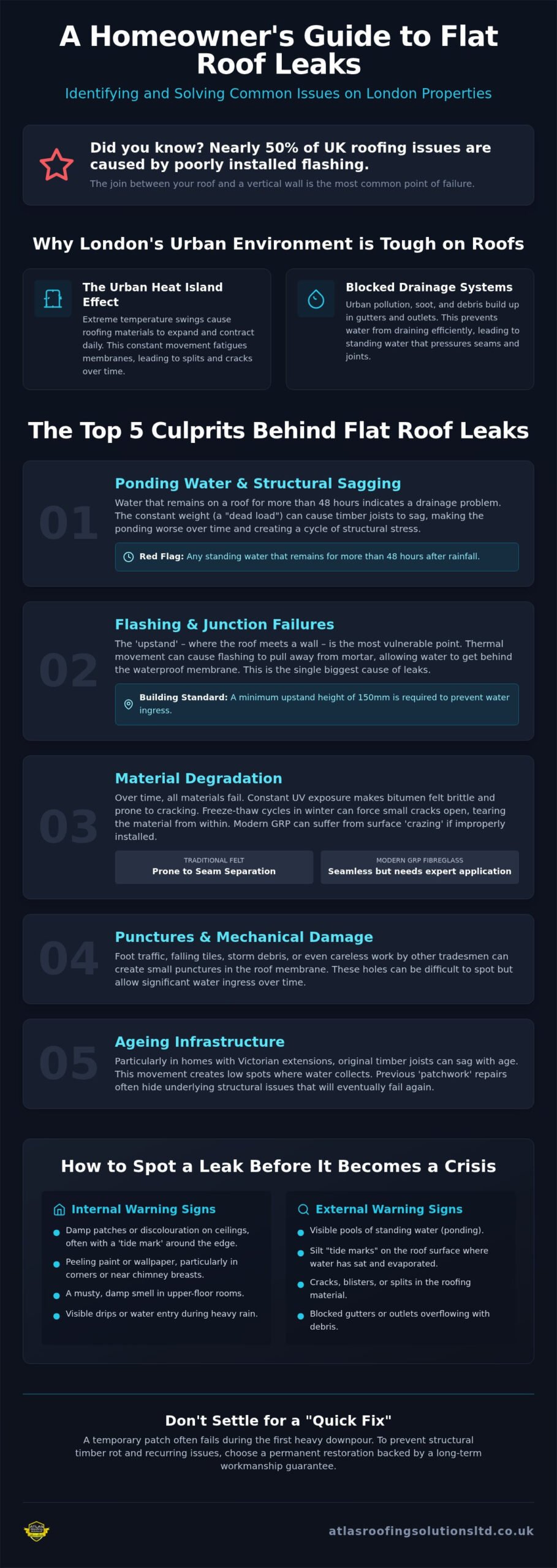
Did you know that nearly 50% of UK roofing issues are caused by poorly installed flashing? For London homeowners, a damp patch on the ceiling often feels like the start of a frustrating cycle of expensive call-outs and temporary patches. It’s stressful to watch a “quick fix” fail during the first heavy downpour, leaving you worried about structural timber rot and the difficulty of finding a tradesman who won’t disappear. You deserve a dry home and a roofer who treats your property with genuine care.
This guide will help you identify the common flat roof leak causes London properties experience, from urban temperature fluctuations to blocked drainage systems. We’ll show you exactly how to pinpoint the source of the ingress and, more importantly, how to secure a permanent, weather-resistant fix. You will learn about the latest 2026 building standards and why modern materials like GRP fibreglass offer the long-term security your home needs. We’re here to provide the clear, honest advice you need to move from a recurring headache to a leak-free future.
Key Takeaways
- Understand how London’s unique urban environment and thermal expansion contribute to the most common flat roof leak causes London homeowners face.
- Learn to identify early warning signs like silt “tide marks” and internal damp spots to prevent costly structural timber rot.
- Discover why traditional bitumen felt and modern GRP fibreglass fail in different ways, from seam separation to surface crazing.
- Recognise why standing water that remains for more than 48 hours is a red flag for your roof’s structural health and drainage.
- Gain the confidence to choose a permanent restoration over a “quick fix” by looking for long-term workmanship guarantees.
Common Flat Roof Leak Causes in London: Why Urban Roofs Fail
A flat roof leak is essentially a breach in the waterproof membrane. It happens when structural movement or environmental stress creates a path for water to enter your home. In our experience across the city, the most common flat roof leak causes London homeowners face are often tied to the capital’s unique microclimate and building stock. It isn’t just about the age of the materials; it’s about how those materials interact with the city around them.
London suffers from the “Urban Heat Island” effect. This means the city stays significantly warmer than surrounding rural areas due to the density of brick and concrete. For your roof, this results in extreme thermal expansion and contraction. Materials stretch in the midday sun and shrink rapidly at night. Over time, this constant movement fatigues the membrane, leading to splits. Understanding the basics of Flat roof design and construction helps illustrate why these stresses eventually cause even high-quality systems to fail.
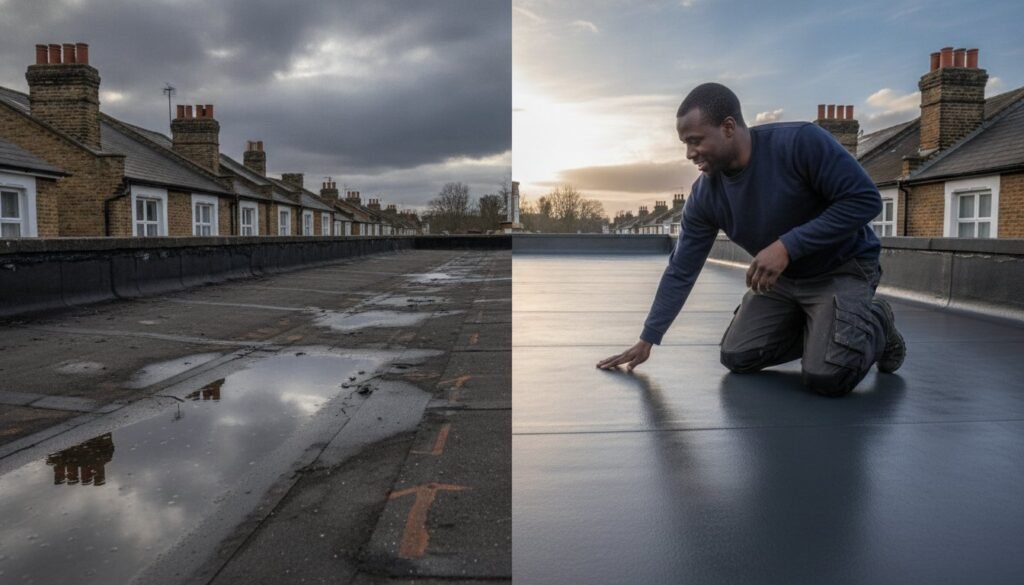
Urban pollution also plays a silent but destructive part. High-density areas collect soot, acidic grime, and city debris. This muck builds up in gutters and outlets, drastically reducing drainage efficiency. When water can’t get away, it sits. This “ponding” water puts immense pressure on every seam and joint. If a roof wasn’t designed with a perfect fall, these pools of water become the primary catalyst for a leak.
The Impact of London Weather Patterns
Heavy flash floods have become more frequent in London. These sudden downpours quickly overwhelm older, narrow guttering systems. If your gutters can’t cope, water backs up under the roof’s edge or overflows into the fascias. We also see the damage caused by freeze-thaw cycles. Water enters tiny micro-cracks in felt roofing, freezes, and expands. This physically tears the material from the inside out. For those with south-facing balconies, UV degradation is a major factor. Constant sun exposure makes bitumen brittle, leading to cracks that appear long before the roof’s expected lifespan.
Ageing Infrastructure and Victorian Extensions
Many London homes feature Victorian-era extensions. These present a specific challenge where modern roofing membranes meet traditional, porous brickwork. Junction failures are incredibly common here. Over decades, original timber joists often begin to sag under the weight of previous repairs. This creates low spots where water naturally gathers. We frequently encounter “patchwork” repairs done by previous owners. These quick fixes might look okay in summer, but they almost always fail during the first proper London winter. Addressing the common flat roof leak causes London properties endure requires looking at the building as a whole. A permanent fix requires addressing these structural shifts rather than just sticking a temporary patch on the problem.
The Top 5 Culprits Behind Your Leaking Flat Roof
Every leak has a signature. Some appear as a slow drip after hours of drizzle, whilst others arrive as a sudden deluge during a storm. Pinpointing the source requires a methodical approach. Identifying the specific reason for water ingress is the first step toward a permanent fix. These five issues represent the most common flat roof leak causes London residents encounter in 2026.
Ponding Water and Structural Sagging
Ponding water is defined as any standing water that remains on the roof surface for more than 48 hours after rain has stopped. It’s a major red flag for structural health. This creates a “dead load” on the roof deck, which can cause timber joists to sag over time. As the roof dips, the pool gets deeper, creating a vicious cycle of weight and pressure. This standing water also acts as a magnifying glass, accelerating UV degradation of the membrane beneath. Expert surveyors often focus on these low spots when diagnosing flat roof problems that aren’t immediately obvious from ground level.
Flashing and Junction Failures
The upstand, where your roof meets a vertical surface like a wall or chimney, is the most vulnerable point of any installation. Building Regulations require a minimum upstand height of 150mm to prevent water ingress during heavy rain. With nearly 50% of UK roofing issues caused by poor flashing installation, this area requires precision. Lead flashing can pull away from mortar joints due to thermal movement, allowing water to seep behind the membrane. Often, what looks like a membrane failure is actually chimney stack issues disguised as a flat roof leak. If the pointing on your chimney has failed, water travels down the inside of the brickwork and emerges on your ceiling.
Punctures, Silt, and Poor Workmanship
Invisible damage is more common than you might think. We often find punctures caused by window cleaners’ ladders or heavy furniture on roof terraces. Similarly, London plane tree seeds and urban silt are silent killers of drainage systems. When outlets block, the water has nowhere to go but up and over the waterproof boundaries. Finally, poor initial installation remains a leading cause of failure. Choosing uncertified contractors for a “cheap” fix usually leads to seam separation or poor resin application. It’s a false economy that often results in the roofer disappearing when the leaks return. If you suspect your roof is failing, identifying these common flat roof leak causes London homes suffer from and getting a professional flat roof repair assessment can save you from a total replacement later.
Material Matters: How Different Flat Roof Systems Fail
Not all roofs fail in the same way. The material protecting your home often dictates the specific symptoms you’ll see when things go wrong. Identifying whether you have a material failure or a structural one is essential for choosing the right fix. In our two decades of local experience, we’ve seen how the common flat roof leak causes London properties suffer from vary wildly between traditional and modern systems. Each material has its own “breaking point” when faced with the city’s unique environmental stresses.
Felt Roofing: The Blistering Problem
Traditional torch-on felt is common across London conversions, but it’s prone to “alligatoring.” This is when the bitumen surface cracks into a pattern resembling a reptile’s skin. These cracks allow water to seep into the layers beneath. You might also notice “pillows” or blisters on the surface. These form when moisture gets trapped between layers and expands in the heat of the sun. Brittle seams are the #1 cause of felt roof leaks we encounter. Over time, the adhesive fails, and the seams simply pop open. Don’t be tempted by DIY solar paint. Whilst it looks like a cheap way to protect ageing felt, it often hides deeper structural issues that lead to a sudden, catastrophic failure during the first frost.
GRP Fibreglass: Cracking and Delamination
GRP is incredibly durable, but it isn’t invincible. The most frequent issue is “crazing,” which looks like fine hairline cracks on the surface. This usually happens if the resin was applied too thickly or without proper expansion joints to handle London’s temperature swings. If you hear a “crunching” sound when walking on the roof, it’s a sign of delamination. This means the fibreglass has pulled away from the timber deck below. When done correctly, Fibreglass roof installation provides a seamless, leak-proof finish that outlasts felt by decades. It’s our preferred choice for permanent repairs because it eliminates the weak points found in seamed systems.
EPDM rubber systems face different challenges. Whilst rubber is flexible, it can suffer from “shrinkage” over decades. The membrane pulls away from the roof edges, a process known as tenting. This creates a gap at the upstands where water can pour straight into your walls. EPDM typically lasts 30-50 years, but only if the perimeter fixings remain secure. In the high-density environment of London, where roofs are often used as balconies, these materials are under constant pressure. Understanding these specific failure points and the common flat roof leak causes London homes face helps you move past temporary patches toward a solution that actually lasts.
How to Spot a Leak Before It Becomes a Crisis
Prevention is always cheaper than cure. Many common flat roof leak causes London properties suffer from remain hidden until the first heavy downpour of autumn. Identifying these issues early prevents water from reaching your structural timbers, where it can cause rot and expensive damage. By the time a drip hits your floor, the problem has likely been developing for months. You deserve the peace of mind that comes with a proactive approach to home maintenance.
Internal warning signs are your first line of defence. Look for tell-tale brown circles on your ceilings. These stains are the classic signature of slow water ingress. You might also notice wallpaper peeling away at the top of the wall or a persistent, musty odour that doesn’t go away with ventilation. These symptoms suggest that water has already bypassed your waterproof membrane and is saturating the plasterboard or insulation beneath.
External visual checks are equally important. When the weather is dry, look for “tide marks” on the roof surface. These are rings of dried silt, dirt, and debris that show exactly where water has been ponding. Even if the roof looks clear now, these marks highlight the low spots where pressure is highest during a storm. Spotting these areas early allows for targeted repairs before a full breach occurs.
The 10-Minute Homeowner Inspection
You don’t always need to climb onto the roof to check its health. Often, you can spot trouble from an upstairs window or by safely using a ladder to look at the perimeter. Check your gutters and downpipes after a typical London storm. If they are overflowing or water is cascading down the brickwork, it’s likely backing up onto the roof deck. If you can safely access the surface, feel for “spongy” areas. A soft, bouncy sensation underfoot usually means the timber deck is damp. This is a critical warning sign that requires immediate attention. Booking a seasonal roof survey is a simple, cost-effective way to catch these issues before they turn into an emergency.
Distinguishing Condensation from Leaks
Not every damp patch is a roof breach. In many London flats, poor ventilation mimics the signs of a leak. This is particularly common in “Cold Roof” constructions where moisture from cooking or showering gets trapped in the roof void and condenses on the cold underside of the deck. Modern “Warm Roof” designs, which are now the standard for 2026 renovations, avoid this by placing insulation above the deck. A professional damp meter is the only way to be 100% certain of the source. If you’re worried about a damp patch, our team at Atlas Roofing Solutions can provide a clear, honest assessment to help you find the right fix.
Professional Flat Roof Repair in London: Ensuring a Permanent Fix
Once you’ve identified the common flat roof leak causes London properties endure, the next step is deciding how to fix them for good. There’s a world of difference between a temporary patch and a professional restoration. A “quick fix” from a general handyman might stop the drip today, but it won’t address the underlying issue, such as structural sagging or membrane fatigue. Addressing the common flat roof leak causes London homeowners deal with requires a methodical approach and the right materials for the job.
Atlas Roofing Solutions uses specific techniques tailored to the capital’s unique building stock. For our GRP fibreglass roofs, we ensure the resin is applied with precision and includes the necessary expansion joints to handle thermal movement. For felt repairs, we use high-performance torch-on systems that create a robust, multi-layer defence. We don’t believe in “one size fits all” because a Victorian extension requires a different approach to a modern apartment balcony. We focus on providing a permanent, weather-resistant fix that secures your home for decades.
Why a Family-Run Specialist Matters
Choosing a roofer is often about trust and accountability. As a family-owned business with over 20 years of local experience, we’ve built our reputation on being a dependable partner. We provide straight-talking advice, meaning we’ll only recommend the work that’s actually necessary. If your roof only needs a specific repair rather than a full replacement, that’s exactly what we’ll tell you. We also pride ourselves on providing reliable roof repairs without the hassle of unneeded scaffolding where possible. Our goal is to make the experience as simple and stress-free as we can.
The 15-Year Guarantee: Your Long-Term Security
A “cheap” quote often ends up being the most expensive option when the roofer disappears and the leak returns. We provide a 15-year guarantee on our workmanship to give you complete peace of mind. This isn’t just about the waterproof membrane; it’s about the entire roofline. We ensure that your uPVC fascias, soffits, and guttering are all working together to support the repair and keep water away from your walls. This holistic approach is why we’re seen as a reliable guardian for London homes.
When you book a free site visit, you’ll receive a clear, no-obligation quote. We take the time to explain the root cause of the problem and the steps we’ll take to fix it. It’s an open-book approach that builds quiet confidence. You can book your free London roof survey today and take the first step toward a dry, secure home.
Secure Your Home Against the Elements
Understanding the common flat roof leak causes London properties face is the first step toward protecting your investment. Whether it’s the thermal expansion of the “Urban Heat Island” or the gradual fatigue of traditional felt seams, early detection is vital. By recognising signs like silt tide marks or internal damp spots, you can act before structural timber rot sets in. You don’t have to settle for a cycle of temporary patches that fail at the first sign of rain.
At Atlas Roofing Solutions, we bring over 20 years of local experience to every project. We’re a family-run team that values honesty and pride in our workmanship. We specialise in durable GRP fibreglass solutions that eliminate the weak points of older systems. Every repair we undertake comes with a 15-year guarantee, giving you long-term security and peace of mind. Our straight-talking advice ensures you only pay for what’s necessary to keep your home dry.
It’s time to move past the worry of recurring leaks. Book Your Free London Flat Roof Survey & Quote today. We’re here to help you secure a permanent, weather-resistant fix for your home.
Frequently Asked Questions
How do I find where a flat roof is leaking?
Finding a leak starts with looking for the “tide mark” where water has pooled. You should trace internal damp patches to their highest point, then inspect the roof for punctures or cracks. Check the flashing around chimneys and parapet walls, as these are frequent failure points. A professional survey is the most reliable way to identify the common flat roof leak causes London properties experience, ensuring the source is found before it causes structural damage.
Can you patch a leaking flat roof or does it need a full replacement?
A localised puncture or a small split in a seam can often be patched to extend the roof’s life. However, if the membrane shows widespread “alligatoring” or the timber deck feels spongy, a professional restoration is usually necessary. Patching an old, failing roof is often a false economy. We assess the overall condition of your roof to provide an honest recommendation on whether a repair or a full replacement is the most durable solution.
How much does it cost to fix a leaking flat roof in London?
Repair costs in the capital depend on the material and the complexity of the access. Minor fixes for small punctures are generally affordable, whilst larger structural repairs or chimney work will increase the total. Because every London property is unique, we offer free site visits and no-obligation quotes. This allows us to provide a transparent price based on the specific needs of your home rather than using generic industry averages that might be misleading.
Is a leaking flat roof an emergency?
You should treat any water ingress as an urgent matter. Even a small drip can indicate that the insulation and timber joists are already saturated. If left alone, moisture leads to structural timber rot and mould growth, which are much more expensive to fix than a simple membrane repair. Addressing the issue quickly protects your home’s integrity and prevents a minor leak from turning into a major internal renovation project.
Why does my flat roof leak only during heavy rain?
Leaks that only appear during downpours are often caused by drainage failures or “ponding” water. When rain is intense, blocked gutters or narrow downpipes can’t cope, causing water to back up under the roof’s waterproof boundaries. This is one of the common flat roof leak causes London residents deal with due to urban silt. It can also suggest that your upstands are too low, allowing water to overtop the flashing when it pools on the surface.
Will my home insurance cover a leaking flat roof?
Insurance typically covers damage caused by “perils” like storms, fire, or falling trees. It’s unlikely to cover leaks resulting from gradual degradation, ageing, or a lack of routine maintenance. Most insurers expect homeowners to keep their roofs in a good state of repair. It’s important to review your policy documents and keep records of any professional maintenance or surveys to support your case if you ever need to make a claim for storm damage.
How long should a flat roof repair last?
The longevity of a repair depends entirely on the quality of the materials and the skill of the installer. A “quick fix” might only last a few months, but a professional restoration should last for decades. We provide a 15-year guarantee on our workmanship to ensure your peace of mind. Modern GRP systems can last over 30 years, whilst high-performance felt repairs typically provide 15 to 25 years of reliable, weather-resistant protection.
What is the best material for a flat roof in London?
GRP fibreglass is widely considered the best material for London’s residential flat roofs. It is completely seamless, which eliminates the risk of seam failure that affects felt or rubber. It also handles the city’s extreme thermal expansion and contraction without cracking. Whilst it is a premium option, its durability and low maintenance requirements make it a cost-effective choice over its long lifespan. High-performance felt remains a solid, dependable alternative for many traditional London extensions.