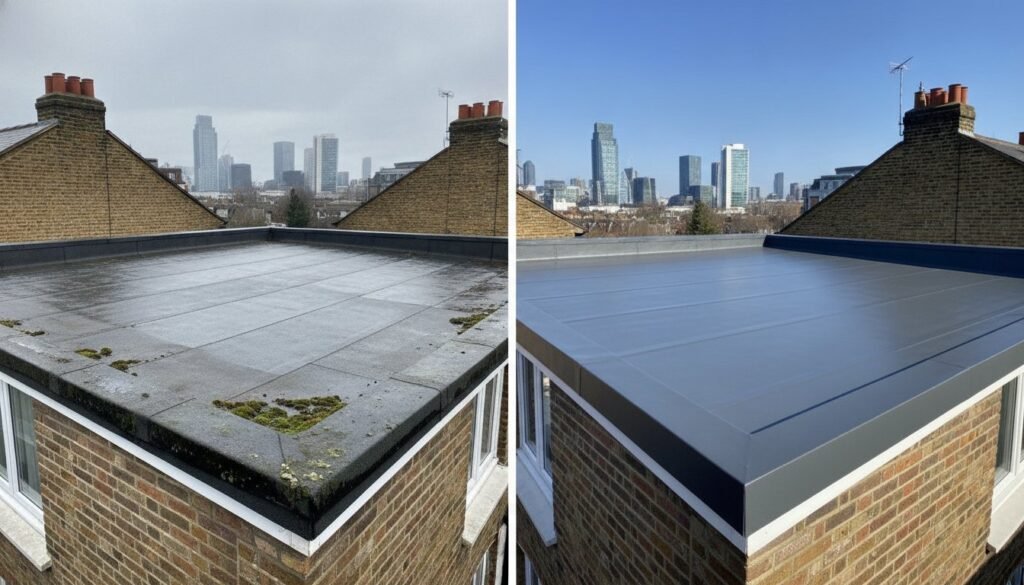
Is the cheapest quote today actually the most expensive mistake you’ll make this decade? Most London homeowners feel the same frustration when they spot that tell-tale damp patch on the ceiling, usually right where the old felt joints have failed again. Whether you are scrubbing unsightly moss or trying to settle the fiberglass roof vs felt roof debate, the conflicting advice from local roofers can be exhausting. You just want a roof that works without the constant worry of the next heavy downpour.
We understand that frustration. In this guide, we’ll settle the argument for 2026. You’ll discover the critical differences in cost, durability, and performance between modern GRP fibreglass and traditional bitumen felt. We’ll look at why fibreglass is often called the “fit and forget” solution, compare it to the budget-friendly appeal of high-performance felt, and show you how to choose a system that adds real value to your property. By the end, you’ll have the clarity needed to secure a dry, attractive home for at least twenty years.
Key Takeaways
- Understand why a GRP fibreglass roof can last up to 30 years, nearly doubling the expected lifespan of traditional bitumen felt membranes.
- Compare the total cost of ownership in the fiberglass roof vs felt roof debate to see which material offers the best long-term value for your property.
- Learn how the seamless, monolithic structure of fibreglass eliminates the recurring joint leaks and moss growth often found on older felt systems.
- Discover why a high-quality installation requires a fresh OSB3 deck and how this foundation ensures your new roof remains leak-free for decades.
- Identify the essential standards for a professional installation to avoid common pitfalls like delamination or cracking.
Understanding the Basics: Fiberglass Roof vs Felt Roof
Choosing between a fiberglass roof vs felt roof is the most common dilemma for London homeowners planning a kitchen extension or a garage repair. Both systems have evolved significantly over the last decade. While traditional bitumen was once the only choice, GRP (Glass Reinforced Polyester) has become a popular alternative for those tired of recurring maintenance. Both are valid options. The right one depends on your budget, the shape of your roof, and how long you plan to stay in your property.
What is a GRP Fibreglass Roof?
A GRP roof is a cold-applied liquid resin system. It’s essentially the same material used to build boat hulls, which makes it incredibly tough and entirely waterproof. We lay specialised glass fibre matting over a fresh timber deck and saturate it with liquid polyester resin. Once it cures, it forms a single, monolithic skin. There are no joints. For a London terrace where roof shapes are often awkward or cramped, this lack of seams is a massive advantage. A final topcoat provides UV protection and a clean, modern finish in your choice of colour. It’s a durable, “fit and forget” solution.
Modern Torch-on Felt Systems
Felt has a bit of an unfair reputation because of old, brittle versions from forty years ago. Modern high-performance felt is a different beast entirely. Technically known as Asphalt roll roofing, today’s systems use SBS-modified bitumen. This keeps the material flexible even in freezing temperatures, preventing the cracks that used to plague older roofs. We install it as a three-layer system. This includes a vapour control layer, a reinforced underlay, and a tough mineral cap sheet. It’s still the most cost-effective way to protect a large area. When handled by experts, it remains a reliable barrier that can withstand the British weather.
In our 20 years of family-run experience, we’ve seen that the best material is only as good as the person fitting it. A GRP roof requires a perfectly dry deck and precise resin mixing to prevent delamination. A felt roof needs expert torching to ensure the seams are fused correctly without damaging the underlying structure. We focus on getting these details right every time. Whether you’re leaning toward the sleek look of fibreglass or the proven reliability of felt, the goal is a leak-free home. Settling the fiberglass roof vs felt roof debate comes down to balancing that initial investment against your long-term peace of mind.
Comparing Lifespan and Durability in the UK Climate
London’s weather puts immense pressure on a building’s exterior. Our city experiences a distinct urban heat island effect, where buildings and roads trap heat. This causes traditional bitumen felt to expand and contract more aggressively than in rural areas. Over several summers, this cycle can bake the oils out of the felt. This leads to the cracking and “alligatoring” often seen on older extensions. When comparing a fiberglass roof vs felt roof, the GRP option wins on thermal stability. It doesn’t soften in the sun or become brittle during a London frost.
The most common point of failure for any flat roof is the joint. Felt is applied in rolls. This means it relies on heat-welded seams. Even a tiny gap in a seam can allow water to creep in. GRP is a monolithic structure. Because it’s applied as a liquid, it forms a single, continuous barrier. This is particularly useful if your roof has standing water. While ponding water can eventually rot the surface of a felt membrane, a fibreglass roof is essentially a waterproof tray that remains unaffected by puddles. If you are already dealing with water ingress, understanding how to fix a leaking flat roof before it causes structural damage is a critical first step.
Lifespan Expectations: 15 vs 30 Years
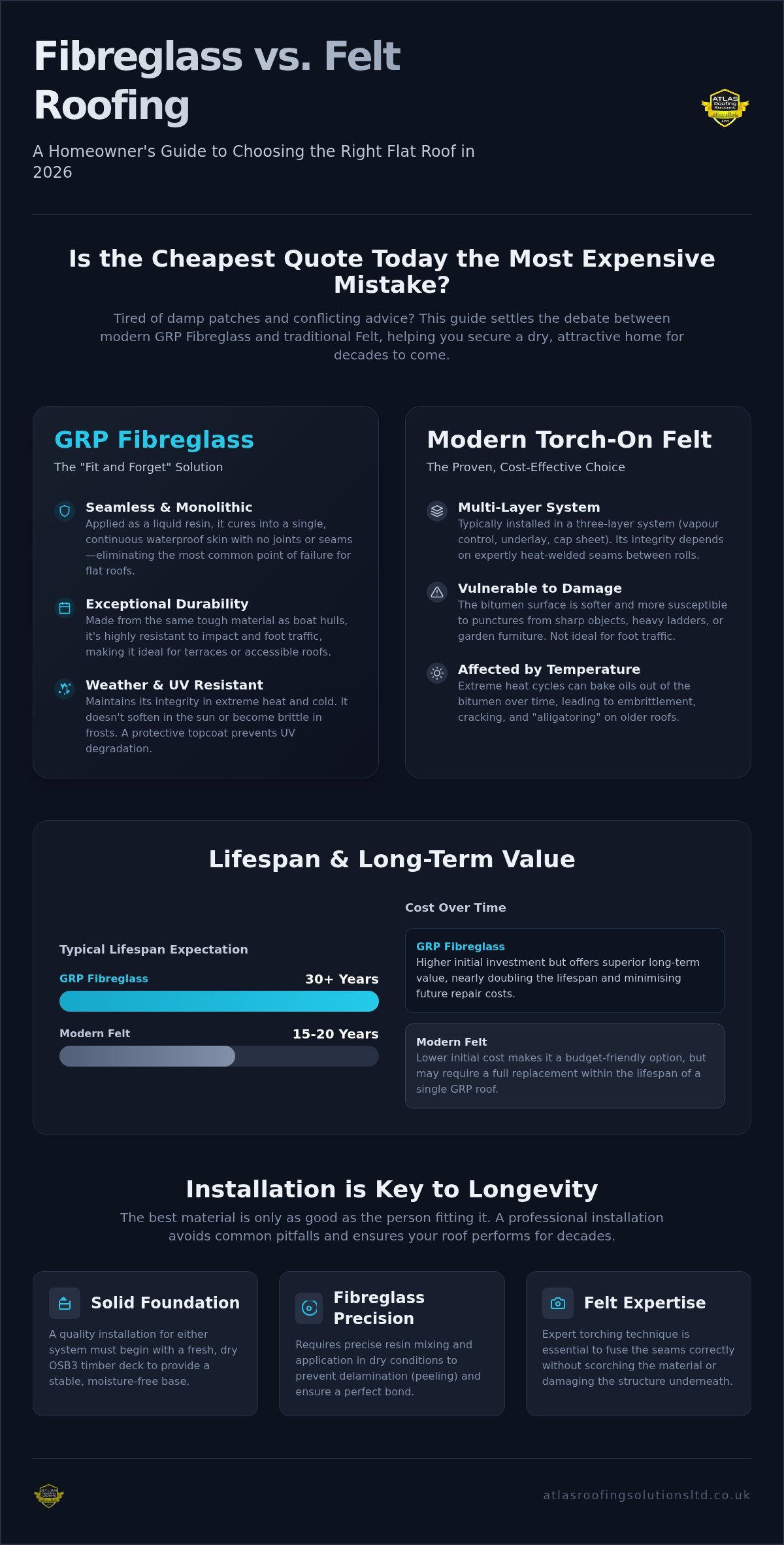
A high-quality felt roof typically lasts between 15 and 20 years in the UK. It’s a solid, reliable choice for many homeowners. However, GRP fibreglass is in a different league of longevity. A professionally installed system can easily reach 30 years. Some even push toward 40. Regular maintenance, like clearing gutters and removing moss, helps both systems. But the base material of GRP simply lasts longer. If you need advice on your specific property, a chat about London flat roof repairs can clarify which option suits your timeline.
Resistance to Foot Traffic and Impact
Durability isn’t just about the weather. It’s also about how you use the space. If you need to access your roof for window cleaning or want to create a terrace, GRP is the superior choice. It is a hard, impact-resistant surface. It handles foot traffic with ease. We can even apply a slip-resistant finish for added safety. Felt is much more vulnerable. A heavy ladder or sharp garden furniture can easily puncture the bitumen layers. Once the surface is breached, water will inevitably follow. For high-traffic areas, the resilience of GRP is well worth the extra investment.
Practical Considerations: Installation and Maintenance
When you weigh up a fiberglass roof vs felt roof, the installation method is a major deciding factor for your home’s long-term security. GRP is not a simple “slap it on” coating. It is a structural system. It requires a completely new deck made of OSB3 tongue-and-groove boards. We fix these boards directly to your joists to create a stable, flat surface. This foundation is vital. Without a fresh timber deck, the resin cannot bond correctly, which leads to the cracking and delamination often seen in poor-quality DIY jobs. It’s a methodical, multi-stage process that rewards patience with decades of protection.
Felt uses a different approach. The modern “torch-on” method involves using a gas torch to melt the bitumen backing of the membrane, fusing it to the surface below. Safety is our priority here. We follow strict fire safety protocols, including the use of heat shields and a mandatory fire watch period after the work is finished. It’s a faster, tried-and-tested method that provides an immediate watertight seal. It remains a reliable choice for homeowners who need a high-quality finish without the structural overhaul required for GRP.
One common myth we hear from London homeowners is that GRP roofs are loud during a downpour. In reality, once the fibreglass is bonded to the thick OSB3 decking and the void is properly insulated, the “drumming” effect is non-existent. It feels as solid and quiet as a traditional tiled roof. Maintenance is equally straightforward. A GRP roof is incredibly low-maintenance, requiring little more than an occasional sweep to keep it looking new.
The Installation Process: What to Expect
Timing is everything. GRP is highly weather-dependent. The resin needs a dry window and temperatures above 5°C to cure properly. We won’t start a fibreglass job if rain is forecast. Felt is more versatile. Because it’s a dry material that we heat-bond, we can often install it in tighter weather windows. This makes felt a practical option for Professional flat roof repair London when an urgent fix is needed to stop a leak before the next storm hits.
Maintenance and Repairability
Both systems benefit from a little care. We recommend a quick wash once a year to prevent moss and algae from taking hold on the surface. If a GRP roof ever suffers a deep scratch, we can usually recoat the top layer to restore its integrity. Felt is also easy to patch, though these repairs are more visible. During any maintenance check, we always inspect your guttering and uPVC fascias. A clear gutter is the simplest way to prevent standing water from testing the limits of your new roof. We take a straight-talking approach to these checks, only recommending work that is truly necessary for your home’s protection.
Cost Analysis: Initial Investment vs Long-Term Value
Thinking about the budget is usually where the fiberglass roof vs felt roof decision gets difficult. There is no hiding it; a GRP installation costs significantly more upfront. This isn’t just a markup. It’s because we aren’t simply rolling out a membrane. We are building a new structural deck and applying high-grade resins that cure into a single, seamless skin. However, looking at the price tag in isolation is a mistake. You have to consider the “cost per year” of protection to see the true value of your investment.
In the competitive London property market, a GRP roof is a badge of quality. Surveyors and savvy buyers recognise the durability of a “fit and forget” system. When you come to sell, a transferable guarantee for a leak-free roof is a powerful closing tool. Even insurance companies often look more favourably on fibreglass. Its impact resistance makes it incredibly difficult to puncture, which adds a layer of security to your home that traditional felt simply cannot match.
The “Cheap” Trap: Why Felt Costs More Over Time
Calculating the long-term math reveals why the lowest quote can be a trap. If a modern felt roof lasts 15 to 20 years, you will likely be paying for a full replacement twice in the time it takes for a single GRP roof to reach the end of its life. When you factor in the rising cost of labour and materials over the next two decades, the premium choice today often becomes the bargain of the future. You can explore more about the fiberglass flat roof cost UK homeowners face in 2026 to see how this investment scales for your specific property.
When is Felt the Right Choice?
Felt isn’t always the “wrong” choice. It remains a very popular and sensible option in specific scenarios. If you are refurbishing a rental property, a simple outbuilding, or only plan to stay in your home for a few more years, high-performance felt is perfectly viable. It provides excellent protection without the higher entry price of GRP. We always provide straight-talking, honest advice based on your 5-year or 20-year plan for the house. If you want a clear breakdown for your specific project, contact us today for a transparent quote.
Choosing Your Solution: Why Professional Installation is Key
Choosing between a fiberglass roof vs felt roof is a big decision, but it’s only half the battle. The quality of the installation is what determines whether your home stays dry or becomes a recurring headache. We’ve seen far too many “cowboy” GRP jobs fail within months because the installer ignored the basics. If the resin is mixed poorly or applied during a damp London morning, it will eventually crack or peel away from the deck. This delamination is a nightmare to fix and usually requires a total strip-back. It’s a stressful, expensive cycle that we want to help you avoid from the start.
We believe in doing things properly. That’s why we provide a 15-year guarantee on our workmanship. This isn’t a vague promise; it’s a solid commitment from a family-run business with deep roots in the community. Our reputation is built on accountability and pride in our craft. If you have an issue, you know exactly who to call. We don’t use high-pressure sales tactics or hide behind complex contracts. We just provide a reliable, long-term shield for your property.
The Atlas Roofing Solutions Ltd Difference
With over 20 years of experience in the London roofing landscape, we’ve seen every type of flat roof failure imaginable. This history allows us to provide a “straight-talking” service that prioritises your home’s safety. We don’t guess; we use our practical knowledge to recommend the system that actually fits your building’s structure and your long-term plans. If you are looking for Expert roof repairs London homeowners can depend on, our team provides the expert touch needed for a “fit and forget” result.
Next Steps for Your Flat Roof
The best way to settle the fiberglass roof vs felt roof debate for your specific home is with a professional assessment. We offer a free, no-obligation site survey to take the guesswork out of the process. During this visit, we don’t just look at the surface. We check the structural integrity of your joists and the condition of the existing timber. This thoroughness ensures that whichever material you choose, it’s built on a foundation that will last.
Booking your visit is simple and hassle-free. We’ll provide a transparent quote and a clear timeline for the work. Our goal is to make the entire experience as smooth as possible, leaving you with a leak-free roof and the peace of mind that comes from a job well done. Investing in quality installation today is the only way to ensure your home remains protected for decades to come.
Secure Your Home with a Long-Term Roofing Solution
Deciding on a fiberglass roof vs felt roof doesn’t have to be a source of stress. Whether you choose the seamless, monolithic protection of GRP fibreglass or the reliable, cost-effective performance of modern torch-on felt, the goal remains the same. You need a dry, secure home that looks great and adds value to your property. We’ve seen that GRP is the ultimate “fit and forget” option for those staying long-term, whilst high-performance felt remains a practical choice for budget-sensitive projects or urgent repairs.
As a family-run business with over 20 years of London roofing expertise, we are here to provide the straight-talking advice you need. We back our workmanship with a 15-year guarantee on all new roofs, giving you the confidence that your investment is fully protected. Don’t let a small damp patch turn into a major structural problem. Get a Free, No-Obligation Flat Roof Quote Today and let our specialists assess your property. We look forward to helping you protect your home for decades to come.
Frequently Asked Questions
Is a fiberglass roof better than a felt roof?
A GRP fibreglass roof is generally considered superior for longevity and leak prevention. It creates a seamless, monolithic barrier that lasts up to 30 years. Felt is a reliable, budget-friendly alternative that typically lasts around 15 to 20 years. The best choice depends on your property goals. If you want a “fit and forget” solution for a long-term home, fibreglass is the clear winner.
How much more expensive is GRP fibreglass than felt?
GRP fibreglass requires a larger initial investment than felt. This is because the process involves a full structural timber deck and specialised resins. Whilst the upfront price is higher, the fiberglass roof vs felt roof cost-per-year is often lower. Because GRP lasts twice as long as felt, you avoid the expense of a second replacement in twenty years’ time. For a detailed breakdown of what to budget, our guide to fibreglass flat roof cost UK pricing in 2026 covers material grades, labour rates, and the London price gap in full.
Can you walk on a fiberglass roof?
Yes, you can walk on a fibreglass roof with confidence. The material is incredibly tough and resistant to impact or punctures. This makes it a perfect choice for roof terraces or areas where you need regular access for window cleaning. We can apply a specialised non-slip topcoat to ensure the surface is safe to use even when the London weather turns damp.
Does a felt roof need to be replaced or can it be repaired?
It depends on the condition of the bitumen. We can often patch minor punctures or loose seams on a relatively new felt roof. However, if the material is old and brittle, patches won’t bond properly. In those cases, a full replacement is a better investment. We always provide an honest assessment during our site survey to help you avoid throwing money at temporary fixes.
How long does a fiberglass roof last in London?
In the London climate, a professionally installed GRP system typically lasts between 25 and 30 years. The material is unaffected by the urban heat island effect or freezing winters. Because it doesn’t have seams, there are no joints to fail over time. With minimal maintenance, such as keeping gutters clear, these roofs can often remain watertight for up to 40 years.
Is a fiberglass roof noisy when it rains?
This is a common myth that we are happy to debunk. A GRP roof is not noisy when it rains, provided it is installed on a solid OSB3 deck. The timber and the underlying insulation act as a natural sound dampener. When we finish the installation, the roof feels as solid as a house floor and is no louder than a traditional slate or tile roof.
What is the best flat roof system for a balcony?
GRP fibreglass is the superior choice for balconies or terraces. Unlike felt, it is a hard-wearing surface that can easily support the weight of garden furniture or frequent foot traffic. Its seamless nature means there are no edges for chairs to catch on. It creates a safe, attractive, and entirely waterproof outdoor space that adds real value to your London home.
Do I need a new deck for a fiberglass roof installation?
Yes, a fresh OSB3 tongue-and-groove deck is a non-negotiable requirement for a successful installation. The liquid resin needs a clean, dry, and stable timber surface to bond to. We never install GRP over old boards or existing felt. By creating a new structural foundation, we ensure the fiberglass roof vs felt roof comparison remains in your favour with a perfectly bonded, leak-free finish.