A cheap mastic patch on your roof doesn’t save you money; it usually just hides water damage until your ceiling plaster gives way. When relentless British rain sets in and brown tide marks spread overhead, figuring out the true lead flashing repair cost UK trades quote can feel like an impossible guessing game.
It’s deeply frustrating to receive wildly different estimates with zero clear technical explanation. One contractor promises a quick fix in an afternoon, whilst another insists on specialized access equipment and full sheet replacement. You shouldn’t have to gamble on your home’s weatherproofing or dread surprise extras halfway through a project.
This guide explains how seasoned roofers calculate repair scopes, which lead codes comply with British building standards, and how to secure transparent quotes backed by dependable workmanship guarantees. We’ll unpack the critical differences between short-lived patches and durable leadwork so you can protect your home with complete peace of mind.
Key Takeaways
- Discover why BS EN 12588 milled lead remains the benchmark for durable British weatherproofing, easily outlasting short-lived tapes and mastics.
- Understand the structural factors that dictate your overall lead flashing repair cost UK quotes, including material code thickness, linear metres, and chimney profiles.
- Learn why surface patches fail quickly under thermal expansion, often masking hidden moisture that damages roof timbers and ceiling plaster.
- Unpack how professional roofers accurately diagnose joint movement and scope jobs through thorough on-site surveys rather than guesswork.
- Gain the confidence to evaluate trade estimates transparently and secure durable repairs backed by comprehensive workmanship guarantees.
Understanding Roof Flashing: Why Lead Remains the UK Standard
Roof flashing serves as your property’s primary defence line against driving rain. In technical terms, what is roof flashing? It is an impervious weatherproofing barrier fitted over vulnerable roof joints, valleys, and wall junctions. While synthetic alternatives exist, British climate extremes demand malleable, corrosion-resistant BS EN 12588 milled lead. This high-density material accommodates structural movement whilst repelling severe frost and relentless downpours for decades.
Lead lasts. It outlives modern adhesives by generations when fitted correctly. However, severe weathering, age, and substandard historical detailing eventually take their toll. Homeowners evaluating their lead flashing repair cost UK options often spot common warning signs late:
- Thermal fatigue splits along the folds of the lead sheet
- Slipped or dislodged step flashings pulled away from brick courses
- Cracked or deteriorating mortar pointing along the brick chase
- Persistent damp patches appearing on internal ceilings and chimney breasts
Addressing these minor defects early prevents water ingress from rotting structural rafters, damaging ceiling lath, and saturating internal masonry.
The Essential Role of Abutment and Chimney Flashings
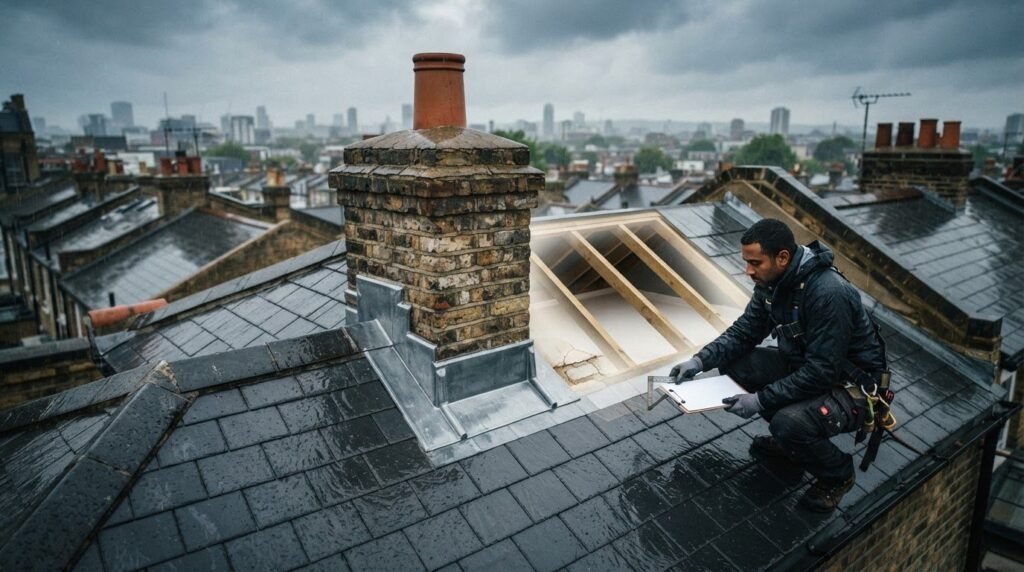
Every junction where a roof meets vertical masonry presents a natural vulnerability. Cover flashings lap over vertical upstands to stop rain blowing into structural cavities. Along raking rooflines, roofers cut step flashings into brick mortar joints, creating a tiered water barrier. Around stacks, chimney back gutters channel pooled rainwater safely down side valleys, whilst horizontal apron flashings seal the stack’s base across the lower tile face. Precision fitment ensures water sheds cleanly away without tracking inward.
Common Causes of Lead Fatigue and Weathering Failures
Lead expands under summer sun and contracts in winter freezes. If an installer fits continuous runs exceeding recommended lengths, the metal cannot breathe; thermal fatigue quickly tears splits across the sheet. Vibration and high winds also dislodge fixings when old mortar chases crumble. Additionally, unpatinated lead produces carbonate run-off in rain, causing unsightly white streaks across roof tiles and accelerating surface wear. Factoring these specific failure mechanisms into your lead flashing repair cost UK plans ensures you fund durable replacements rather than recurring patch repairs.
Primary Factors That Dictate Lead Flashing Repair Costs
Generic trade directories often publish broad national averages that leave homeowners confused when real quotes arrive. In practice, calculating a lead flashing repair cost UK estimate requires evaluating several structural variables rather than applying a flat rate. Total linear meterage provides the starting baseline, but chimney geometry, roof intersections, and material weight shape the final project scope.
Every roof presents distinct physical challenges. A straightforward lean-to abutment requires far less technical labour than a four-sided chimney stack flanked by complex valleys. Reliable contractors evaluate four primary variables during an on-site assessment:
- Linear meterage and profile complexity across abutments and hips
- Specified lead thickness codes matched to the installation type
- Safe working access and height management requirements
- The structural stability of adjoining mortar joints and brickwork
Lead Thickness Codes: Code 3 vs Code 4 vs Code 5
Lead sheet comes categorised into distinct numerical codes indicating thickness and weight per square metre. Code 3 represents a lightweight material strictly reserved for concealed soakers beneath slates. For exposed cover flashings and step details, British Standard BS 6915 requires Code 4. High-exposure valleys, wide parapet gutters, and chimney back gutters demand heavy-duty Code 5 lead to resist pooling water. Specifying higher codes increases the initial raw material investment, but it delivers decades of resilience against thermal tearing.
Roof Accessibility and Height Safety Considerations
Safe access fundamentally alters project organisation. Working on a low single-storey rear extension involves straightforward ladder placement and personal fall restraint. Conversely, replacing flashings around a chimney stack on a three-storey Victorian terrace demands dedicated access platforms or edge protection. Conscientious contractors adhere strictly to Health and Safety Executive (HSE) regulations regarding working at height and toxic material handling, ensuring these necessary safety provisions appear transparently in your written quote.
Underlying Masonry and Timber Substrate Preparation
Flashing cannot protect a structure if the host masonry is crumbling. Raking out old mortar requires mechanical diamond blades to cut a clean 25mm deep chase into brick courses. If historic frost damage has eroded the surrounding stack, replacing the metal alone won’t keep you dry. Coordinating leadwork with professional chimney repair London services ensures decaying brickwork and fractured pointing get repointed properly before new lead is secured with stainless steel clips.
If you’re unsure which lead code or substrate repairs your property requires, booking a free site assessment through Atlas Roofing Solutions Ltd helps clarify your actual repair requirements without any guesswork.
Temporary Patching vs Professional Lead Replacement
When ceiling water stains appear, quick-fix rolls of bitumen tape or tubes of silicone sealant from local builders’ merchants look tempting. Many property owners turn to these temporary solutions to curb upfront expenses. Unfortunately, chemical band-aids create a false sense of security. Calculating your real lead flashing repair cost UK investment requires looking beyond the initial weekend fix to the multi-year lifecycle of your roof.
Adhesive tapes and silicone mastics degrade rapidly when exposed to British climate extremes. While a tube of sealant costs very little, relying on it to bridge shifting masonry joints inevitably leads to repeated call-outs, internal redecorating costs, and eventual timber remediation. Choosing between temporary repairs and proper sheet renewals comes down to understanding the lifespan of each approach:
- Bituminous flashband tapes: typically fail within 12 to 24 months due to solar heat and frost cycles
- Silicone roof sealants: usually lose surface adhesion within 2 to 3 years under ultraviolet light exposure
- BS EN 12588 milled lead sheet: engineered to deliver over 50 years of continuous weather protection
- Mechanical mortar joint fixings: provide lifetime anchorage without relying on temporary chemical glues
The Limitations of Flashing Tapes and Mastic Fixes
Roofing substrates move continuously. Daily temperature fluctuations cause roof tiles, brickwork, and timber rafters to expand and contract at completely different rates. Self-adhesive bituminous tapes lack the elastic tolerance to handle these shifts; the carrier film shears, tearing open fresh pathways for driving rain. Even worse, peeling tape traps migrating condensation against underlying timber battens, quietly rotting structural wood while remaining hidden from ground view. Reserve adhesive tapes strictly for temporary emergency dry-ins while awaiting scheduled, permanent roof repairs.
Long-Term Value of Code-Compliant Leadwork
Investing in genuine milled sheet replacement provides permanent peace of mind. Fitted in accordance with BS 6915, correctly sized lead sections move independently on stainless steel clips without buckling or splitting under thermal stress. Professional application of patination oil directly after installation prevents the development of powdery white carbonate streaks, keeping adjoining slates and tiles pristine. Atlas Roofing Solutions backs this enduring standard with a comprehensive 15-year workmanship guarantee, ensuring your investment protects your property for decades without unexpected maintenance cycles.
How Professional Roofers Scope and Quote Lead Repairs
Aerial satellite imagery and rough smartphone photos cannot replace hands-on diagnostic expertise. When compiling a reliable lead flashing repair cost UK estimate, a seasoned roofer must physically inspect the roof junctions. Subtle structural shifts, hidden capillary draw, and rotted timber battens remain completely invisible from a street-level glance or an automated online pricing tool.
A methodical physical survey separates dependable craftsmen from rogue operators who inflate prices mid-job. Avoid contractors who issue hasty verbal figures from their van or push for cash-in-hand deals without written technical documentation. Legitimate tradespeople welcome close scrutiny, evaluating projects through a rigorous diagnostic checklist:
- Measuring lap depths to verify they meet strict British Standards
- Testing fixing clips for mechanical stability and wind uplift resistance
- Inspecting adjacent brickwork chases for mortar decay and frost spalling
- Checking internal roof spaces to confirm active damp pathways
The On-Site Roof Inspection Process
A proper diagnostic check begins by checking overlap dimensions. Under BS EN 12588 guidelines, lead steps must overlap by at least 100mm to prevent wind-driven rain crawling backwards through capillary action. The roofer checks whether copper or lead fixing clips remain firmly anchored against storm suction. They will also inspect the loft space directly beneath the problem joint; tracking moisture along rafter lines pinpoints whether water enters via the brick chase or a cracked tile above. Pairing this structural survey with broader seasonal roof maintenance London schedules catches secondary roof defects before winter downpours arrive.
Anatomy of a Comprehensive, Transparent Quote
Never sign off on an estimate that lists ambiguous phrases like “fix leadwork”. A transparent written proposal specifies exact lead codes, confirming whether you are receiving Code 4 cover flashing or heavy-duty Code 5 valley detailing. The schedule of work should clearly itemise grinding out the 25mm chase, fitting lead chocks, applying low-modulus silicone lead sealant, and dressing the finished sheet with patination oil. Crucially, verify that waste disposal and site clearance appear within the total sum so you aren’t left handling heavy metal scrap yourself.
To eliminate quote guesswork on your property, request a free, no-obligation site survey from Atlas Roofing Solutions and receive a transparent, fully itemised repair proposal.
Protecting Your Home: Selecting a Qualified Roofing Partner
Choosing who works on your roof matters just as much as the materials installed. When comparing any lead flashing repair cost UK estimates you receive, look closely at the tradespeople behind the tools. Third-party quote directories often pair homeowners with transient subcontractors who lack local accountability. In contrast, an established, family-operated business relies on hard-won community reputation, treating your property with thorough care and personal attention.
A dependable contractor eliminates project stress through clear communication and fixed-price transparency. Free on-site visits allow roofers to assess structural quirks in person, ensuring your written quote covers the entire scope without nasty mid-job surprises.
Questions to Ask Your Contractor Before Signing
Protecting your property begins with asking direct, practical questions. Before signing an agreement or handing over a deposit, verify these essential project standards:
- Which specific lead code will be installed on my junctions and gutters?
- Will you strip away defective materials completely rather than overlaying them on damp substrates?
- Does your written warranty cover both physical materials and installation labour?
- Do you carry valid public liability insurance that explicitly covers roofing and hot-works?
Any trustworthy craftsman will answer these straightforward queries clearly and provide policy certificates on request.
The Atlas Roofing Solutions Standard
Atlas Roofing Solutions brings over 20 years of hands-on roofing experience across Greater London. As a dedicated, family-run team, we refuse to cut corners with quick mastic fixes, focusing instead on robust, weather-resistant installations. Addressing flashing failures promptly through professional roof repairs London homeowners rely on prevents minor leaks from turning into catastrophic ceiling collapses and structural timber decay.
Every lead flashing replacement we undertake comes backed by an industry-leading 15-year workmanship guarantee, delivering genuine long-term security against harsh British weather. If you want clear, straight-talking advice and fixed-price certainty for your lead flashing repair cost UK budget, get in touch with our team today to arrange your free, no-obligation site survey.
Take the Uncertainty Out of Your Roof Repairs
Protecting your property against relentless seasonal weather doesn’t have to be a stressful guessing game. While temporary mastics and adhesive tapes offer a tempting quick fix, true roof security relies on code-compliant milled lead installed to strict British Standards. By understanding the structural details that shape your genuine lead flashing repair cost UK quotes, you can sidestep false economies and invest in protection built to endure.
With over 20 years of hands-on roofing experience across London, Atlas Roofing Solutions takes pride in straight-talking craftsmanship. We eliminate guesswork by offering free site visits accompanied by transparent, itemised quotations. Every replacement comes backed by a comprehensive 15-year workmanship guarantee, ensuring your roof joints remain impervious to driving rain year after year.
Don’t wait for damp patches to spread across your ceilings. Book your free, no-obligation roof survey with Atlas Roofing Solutions Ltd today, and protect your home with lasting confidence.
Frequently Asked Questions
How much does lead flashing repair typically cost in the UK?
Your total lead flashing repair cost UK quote depends on linear meterage, safe roof access, material code thickness, and the condition of the host masonry. Because every roof profile differs, reputable London roofers don’t rely on generic phone estimates. Instead, they conduct a physical on-site inspection to assess joint movement and chase depth before issuing a fixed, itemised quotation tailored specifically to your property.
Can I repair leaking lead flashing with sealant or flashband tape?
Flashband tapes and silicone sealants only serve as temporary emergency bandages. Daily temperature swings cause roof joints to expand and contract, quickly tearing adhesive tapes and breaking silicone seals. These short-term fixes often trap moisture against structural roof timbers, accelerating rot behind the scenes. For lasting weatherproofing, replacing split sections with properly coded milled lead sheet is always the safest, most cost-effective choice.
How long should properly installed lead flashing last on a UK roof?
Properly installed milled lead flashing manufactured to BS EN 12588 standards should easily last over 50 years. When fitted in appropriate lengths with adequate expansion laps, the metal accommodates seasonal thermal cycling without tearing. Treating the finished sheet with patination oil directly after installation prevents environmental surface oxidation, ensuring your flashing junctions remain structurally sound and watertight across decades of British downpours.
What is the difference between Code 4 and Code 5 lead flashing?
The primary difference lies in sheet thickness and overall density. Code 4 lead measures approximately 1.80mm thick and represents the standard requirement under BS 6915 for cover flashings and raking step details. Code 5 lead measures around 2.24mm thick, providing superior resilience. Roofers specify Code 5 for high-exposure locations, wide chimney back gutters, and valleys subject to heavy rainwater runoff.
Does cracked lead flashing always require complete replacement?
Not every defect demands a full overhaul. If fatigue cracking is confined to an isolated, accessible section while adjoining step details remain sound, a specialist roofer can lead-weld a localized repair or renew just that specific piece. However, if the sheet exhibits widespread thermal tearing, thinning, or crumbling mortar chases across multiple metres, full replacement proves far more dependable and cost-effective over time.
How do I know if damp on my bedroom ceiling is caused by flashing?
Flashing leaks typically produce telltale water stains along external walls, party wall junctions, or around chimney breasts directly following heavy, wind-driven rainfall. If the staining worsens during storms rather than remaining constant, failed abutment flashing or cracked chimney steps are often the culprits. An experienced roofer will inspect your loft timbers and roof junctions to pinpoint the exact moisture route.
Do roofers provide guarantees on lead flashing repairs?
Reputable roofing contractors always back major lead flashing repairs and complete replacements with comprehensive written warranties. For instance, Atlas Roofing Solutions provides an industry-leading 15-year workmanship guarantee across Greater London. This warranty covers installation integrity and durable weatherproofing, giving you total reassurance that your lead flashing repair cost UK investment delivers long-term protection against harsh seasonal weather.