A roof doesn’t need to be brand new to secure a buyer; it simply needs to be survey-proof. In the competitive 2026 property market, getting a roof ready to sell a house in London is less about total replacement and more about strategic maintenance that protects your asking price. We understand the anxiety that comes with a surveyor’s visit, especially when you’re worried about old Victorian chimney stacks or aging flat roof extensions devaluing your home. It’s a common fear that a few loose tiles might lead to a five-figure price renegotiation at the eleventh hour.
This guide will show you how to survey-proof your property, boost its kerb appeal with simple uPVC upgrades, and stop buyers from haggling over repair costs. You’ll learn which London-specific issues to fix first and how to secure a clean survey report that keeps your sale on track. We’ll walk you through the essential checks for chimney stacks, gutters, and fibreglass roofs to ensure a fast, hassle-free transition to your next home. By addressing these details now, you can maximise your property value and move forward with quiet confidence.
Key Takeaways
- Identify common “surveyor traps” that stall London property sales and learn how to address them before a RICS report is commissioned.
- Follow a practical checklist for getting a roof ready to sell a house London, focusing on slipped tiles, lead flashing, and the often-overlooked chimney stack.
- Discover how simple upgrades to uPVC fascias and soffits can disproportionately increase your home’s kerb appeal and buyer confidence.
- Evaluate the ROI of roof repairs versus a full replacement to ensure you aren’t overspending while still protecting your final asking price.
- Learn how a professional roof health check can serve as a “sale-saver” by providing a transparent account of your roof’s condition for potential buyers.
Why Your Roof is the Ultimate Deal-Breaker in London Property Sales
In London’s fast-paced property market, the roof often dictates whether a sale crosses the finish line or collapses at the last minute. Most London homes are older Victorian or Edwardian terraces. These properties come with character, but they also carry a reputation for hidden roofing issues that make modern buyers nervous. When you are getting a roof ready to sell a house London homeowners must realise that a surveyor’s report is the ultimate hurdle. It’s the point where a minor leak becomes a major financial liability.
The “Surveyor Trap” occurs when a RICS Level 2 or 3 report identifies significant defects. It isn’t just about the cost of the fix; it’s about the “down-valuation” that follows. A buyer might see a £2,000 repair flagged in a report and immediately demand a £10,000 reduction to cover the perceived risk and hassle. Establishing buyer confidence through transparent maintenance records is the best way to prevent these last-minute renegotiations. A well-documented roof is a sign of a well-cared-for home.
Understanding the RICS HomeBuyer Report Categories
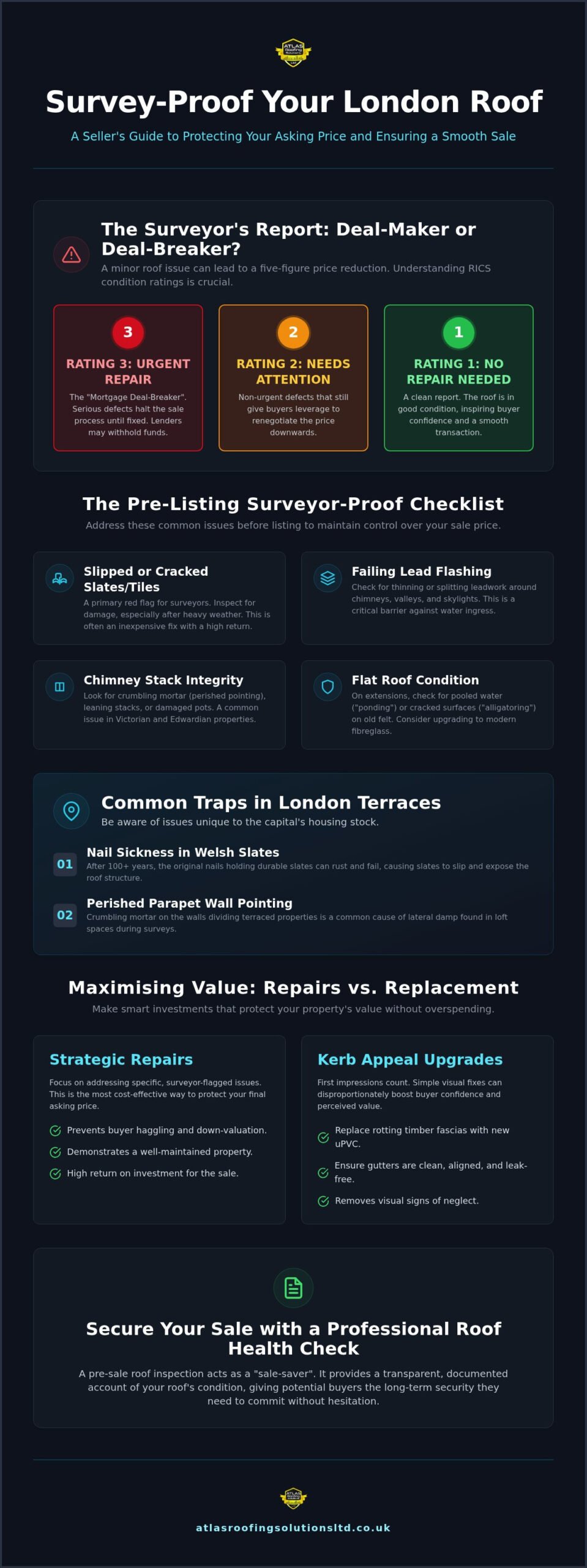
Surveyors use a traffic light system to grade the condition of a roof. Understanding these ratings is essential for The Surveyor-Proof Checklist and your overall sales strategy. Condition Rating 1 means no repair is currently needed. Rating 2 indicates a defect that isn’t urgent but will need attention eventually. Rating 3 is the “mortgage deal-breaker.” This signifies serious defects that require urgent repair or further investigation. It effectively halts the mortgage process.
A Rating 3 often causes lenders to withhold funds until the work is completed or a specialist quote is obtained. You can move your roof from a Rating 3 to a Rating 1 before the surveyor even arrives by addressing visible issues like slipped slates or failing leadwork now. It is a simple case of being proactive rather than reactive. Clear evidence of recent repairs can turn a potential “red” rating into a “green” one.
The Psychology of the London Buyer
First impressions matter. If a prospective buyer sees a leaking gutter or a rotting fascia board during a viewing, they immediately suspect general property neglect. They start wondering what else has been ignored behind the walls. Capital buyers, especially first-timers, are often financially stretched. They have no appetite for “unknown” costs. Providing a “clean” survey report removes that fear. We have seen how a 15-year guarantee on workmanship provides the grounded, long-term security buyers need to commit. It transforms your roof from a liability into a genuine selling point.
The Surveyor-Proof Checklist: Essential Repairs Before You List
Getting a roof ready to sell a house London means looking beyond the surface. It’s about spotting the small faults before they become expensive deal-breakers in a survey. A proactive approach is always better than a reactive one. By identifying issues now, you maintain control over the repair process and the final sale price. We’ve seen how simple maintenance can prevent a buyer from walking away or demanding a massive discount.
Start with the basics after any period of heavy weather. London winter storms are notorious for dislodging tiles. Check for any slipped, cracked, or missing slates. Inspect the lead flashing around chimneys and valleys. If the lead is thinning or splitting, water will eventually find a path into the structure. These are high-priority areas for any RICS surveyor. They will check these joints with a keen eye for detail.
London Terrace Specifics: Slates and Parapet Walls
London’s Victorian and Edwardian terraces often still feature original Welsh slates. These are incredibly durable but can become brittle after a century of exposure. Look for “nail sickness,” where the nails holding the slates have rusted away. This causes slates to slip out of alignment. Parapet walls are another local challenge. Perished pointing on these walls often leads to lateral damp in the loft space. Ensuring the firewall integrity between you and your neighbour is also essential for a clean report. It’s a common survey fail in terraced properties.
Flat Roof Vulnerabilities in Modern Extensions
Old bitumen felt roofs on kitchen extensions are a major red flag for surveyors. They look for “ponding,” where water sits in pools, or “alligatoring,” which is a pattern of cracks that looks like reptile skin. If your felt is more than 15 years old, it’s likely reaching the end of its life. Upgrading to a fiberglass roof before you list the property can be a brilliant strategic move. It replaces a potential liability with a modern, durable solution that carries a long-term guarantee. This gives buyers the peace of mind they need to proceed.
Don’t forget to check the interior ceilings for yellow staining or damp patches. These slow leaks are often invisible from the ground but obvious to a surveyor. Before you list your home, consult the Professional London Roof Health Check guidelines provided by Citizens Advice to understand your disclosure obligations. A quick, professional inspection from a trusted local authority can identify these issues early, ensuring your sale stays on track without any last-minute surprises.
Maximising Kerb Appeal with Roofline and Chimney Maintenance
First impressions start before a buyer even steps through the front door. Whilst most sellers spend weeks painting fences or tidying gardens, the roofline is often left to fend for itself. This is a mistake. When you are getting a roof ready to sell a house London properties need to look impeccable from every angle. A roofline with peeling paint or visible rot suggests a lack of general maintenance. It makes buyers wonder what else has been ignored. Clean, functional guttering is a silent salesman. It proves the house is weather-tight and well-cared for. Refreshing the “face” of your home with modern materials isn’t just about aesthetics; it’s about building trust from the pavement.
The Power of uPVC Fascias, Soffits, and Guttering
Many London sellers focus on the garden, but a grey, rotting roofline is an immediate turn-off. It’s the frame of the property. Replacing old timber with uPVC fascias and soffits provides a crisp, maintenance-free look that reassures buyers. Durable. Simple. Effective. Sagging gutters are another visual red flag. They create an unsightly “waterfall” effect during rainy viewings that suggests drainage failure. We always recommend matching the guttering style to the property’s era. A square-profile gutter might look great on a 1990s build, but a classic half-round or Ogee style is usually better for a Victorian terrace.
Chimney Stack Repointing and Pot Securing
Chimney stacks are arguably the most overlooked element when getting a roof ready to sell a house London homeowners often find. Because they are difficult to see clearly from the street, issues like “blown” bricks or perished mortar go unnoticed until a surveyor arrives with a drone or binoculars. Professional chimney repair London is essential for period homes to pass modern safety inspections. Identifying perished mortar at height and securing loose chimney pots prevents water ingress and ensures the structure is sound. It’s a straightforward fix that prevents your property from being flagged for “urgent structural attention” in a RICS report.
Taking care of these details shows you are a responsible owner. Buyers in the capital are increasingly savvy. They know that a chimney stack in poor condition can lead to damp in the bedrooms below. By repointing the stack and ensuring the pots are secure, you remove a potential point of negotiation. You aren’t just selling a house; you’re selling a “hassle-free” transition. This quiet confidence is exactly what’s needed to close a sale in a competitive market.
The ROI Debate: Should You Replace Your Roof Before Selling?
Deciding whether to invest in a full replacement or opt for targeted repairs is a critical financial crossroad. When you are getting a roof ready to sell a house London homeowners must weigh “sale-ability” against “value-add.” A new roof doesn’t always increase the asking price by its exact cost; however, it often makes the property sellable in the first place. Without it, your home might sit on the market whilst buyers move toward “move-in ready” alternatives. A professional repair is often more strategic than a full replacement if the structural integrity remains sound.
The “Price Reduction Trap” is a real danger for London sellers. Buyers often lack technical knowledge and tend to overestimate repair costs by 300%. A minor leak that costs hundreds to fix can lead to a buyer demanding thousands off the price because they fear the unknown. Using a professional quote as a negotiating tool during the conveyancing process stops this speculation. It provides a grounded, transparent figure that keeps the conversation realistic and the sale on track.
When a Full Replacement is Necessary
There are times when a patch-up job simply won’t suffice. “End-of-life” roofs will fail any RICS mortgage survey, effectively blocking your buyer’s funding. In these cases, a new roof installation is the only way forward. It can even trigger a bidding war. The marketing power of “Brand New Roof with 15-Year Guarantee” in your Rightmove listing is immense. It removes the single biggest anxiety for capital buyers, allowing them to bid with total confidence and peace of mind.
Strategic Repairs: The Middle Ground
Most sellers find their solution in the middle ground. Targeted repairs can remove survey “red lights” for a much smaller outlay than a full replacement. Focus your attention on the “wet trades” like pointing, flashing, and guttering, as these are the areas surveyors scrutinise most heavily. Survey-proofing is the act of addressing any item likely to trigger a Condition Rating 3. By fixing these specific vulnerabilities, you ensure a “clean” report that satisfies both the buyer and their lender. It’s about being thorough without overspending.
If you’re unsure whether your property needs a minor touch-up or a complete overhaul, we can help you decide. Our team provides the honest, straight-talking advice you need to protect your investment. To ensure your sale proceeds without a hitch, book a professional pre-sale roof assessment today and get a clear plan for your property.
Securing Your Sale with a Professional London Roof Health Check
A successful sale in London’s property market often hinges on the very last document signed; the surveyor’s report. By the time the surveyor arrives, you want to be certain there are no surprises hidden above the gutter line. A professional pre-sale roof health check is the ultimate “sale-saver.” It allows you to address any vulnerabilities on your own terms rather than under the pressure of a ticking clock. Getting a roof ready to sell a house London homeowners should view this as an investment in a smooth transaction. It transforms a potential point of failure into a genuine selling point that justifies your asking price.
Our approach is built on transparency and accountability. We don’t just identify faults; we provide clear, methodical solutions that satisfy both you and your buyer’s lender. By turning roofing “problems” into “solutions” with documented repairs, you remove the fear of the unknown. This proactive strategy prevents last-minute price renegotiations. It ensures your sale moves forward with momentum and quiet confidence.
Why Choose Atlas for Your Pre-Sale Prep?
We take pride in being a family-owned business with deep roots in the community. Our “straight-talking” approach is simple. We only suggest repairs that are truly necessary to protect your sale and the structural integrity of the home. We avoid high-pressure tactics in favour of honesty and integrity. With over 20 years of experience getting a roof ready to sell a house London, we understand the specific quirks of Victorian chimney stacks and modern flat roof extensions alike. We are seasoned local authorities who know exactly what surveyors look for in the capital’s unique property landscape. Leveraging our 15-year workmanship guarantee is a powerful way to secure your asking price. It provides the emotional atmosphere of safety and long-term security that modern buyers crave.
Your Next Steps to a Successful Sale
Taking action now prevents stress later. We recommend organising a seasonal roof maintenance check today to ensure your property is in peak condition before it hits the market. During our free site visit, we conduct a thorough and methodical inspection of your roof, gutters, and leadwork. You can expect a transparent, no-obligation quote that breaks down exactly what is needed to “survey-proof” your home. No dense jargon. No hidden costs. Just a clear plan from a dependable partner. Contacting Atlas Roofing Solutions ensures a hassle-free experience from the initial visit to the final sign-off. We handle the technical details with care and precision so you can focus on your next move.
Secure Your Asking Price and Move with Confidence
Selling in London’s competitive market requires a proactive approach. We have explored how addressing “red light” survey issues and refreshing your roofline with uPVC can prevent buyers from haggling. A small investment in maintenance often protects your full asking price by removing the fear of the unknown. By survey-proofing your property now, you ensure the conveyancing process remains steady and predictable. It is about transparency and pride in your home.
When you are getting a roof ready to sell a house London homeowners need a partner they can trust. With over 20 years of London roofing experience, our family-run team provides the honest, straight-talking guidance you need. We offer a 15-year workmanship guarantee on all repairs and installations to give your buyer total peace of mind. Book your free pre-sale roof health check with Atlas Roofing Solutions today for a transparent quote and a hassle-free site visit. It’s the simplest way to turn your roof from a potential deal-breaker into a powerful selling point. You’ve worked hard to prepare your home; let us help you get it across the finish line.
Frequently Asked Questions
Will a bad roof stop me from selling my house in London?
A roof in poor condition can effectively halt a property sale or cause a mortgage lender to decline a buyer’s application. Surveyors often flag structural issues or significant leaks as “Condition Rating 3” defects, which require urgent attention. This usually forces the buyer to renegotiate the price or pull out entirely. Addressing these faults early ensures the sale proceeds with momentum rather than stalling during the final legal stages.
How much does it cost to get a roof ready for sale?
The investment required depends entirely on the current state of your property and the specific architectural features involved. Factors such as the type of tiles, the condition of the chimney stacks, and the state of your guttering all influence the final quote. We focus on providing transparent, no-obligation assessments during a free site visit. This allows you to understand exactly what is needed to survey-proof your home without any hidden financial surprises.
Should I tell my estate agent about roof repairs I’ve carried out?
You should definitely inform your estate agent about any professional roofing work you have completed. Highlighting recent repairs or a full installation makes the property much more attractive to cautious buyers. When getting a roof ready to sell a house London sellers find that providing proof of a 15-year workmanship guarantee builds immediate trust. It positions your home as a low-risk, move-in-ready option compared to other aging terraces in the capital.
What are the most common roof issues found in London property surveys?
London surveyors frequently flag issues related to the capital’s aging Victorian and Edwardian housing stock. The most common problems include slipped or brittle Welsh slates, perished lead flashing around chimneys, and failing mortar on parapet walls. In modern extensions, surveyors often look for “ponding” or cracks in old bitumen felt roofs. Identifying these specific vulnerabilities before you list the property allows you to secure a clean survey report and maintain your asking price.
Is it better to lower the house price or fix the roof myself?
It is almost always more strategic to fix the roof yourself before listing the property. Buyers tend to overestimate repair costs by a significant margin and may demand a price reduction that far exceeds the actual cost of the work. By addressing the repairs now, you remove the “fear of the unknown” that often kills deals. A fixed roof ensures a hassle-free transition and prevents last-minute haggling over the survey results.
Can I sell a house with a leaking flat roof?
Whilst you can sell a house with a leaking flat roof, it will likely lead to a failed mortgage survey or a heavy down-valuation. Most buyers view a leak as a sign of potential structural rot in the timber joists below. Upgrading a failing extension to a durable fiberglass roof before selling is a smart move. It replaces a major liability with a guaranteed solution, giving your buyer the long-term security they need to proceed.
How long does a typical pre-sale roof repair take to complete?
Minor pre-sale repairs, such as replacing slipped tiles or clearing blocked guttering, can often be completed in a single day. More complex tasks like chimney repointing or installing new uPVC fascias might take two to three days depending on the property size. We aim for a simple, methodical progression that minimises disruption to your daily life. Our 20 years of experience helps us handle these tasks with precision and speed to meet your listing deadline.
Does a new roof come with a guarantee that I can transfer to the buyer?
A professional roof installation from a reputable company should always come with a transferable guarantee. At Atlas, our 15-year workmanship guarantee is a powerful asset when getting a roof ready to sell a house London homeowners can pass directly to the new owner. This document provides the grounded reassurance that the home is protected against the elements. It is often the final piece of evidence a buyer needs to commit to the purchase.