How much of your home’s heat is escaping through a roof that looks perfectly fine from the street? It is easy to ignore what is happening above your head until a damp patch suddenly appears on the bedroom ceiling. By then, the damage is often deep. Identifying the early signs your roof needs replacing is about more than just kerb appeal. It is about protecting your family and your biggest investment from structural water damage and the rising energy costs associated with older, poorly insulated structures.
We understand the anxiety that comes with home maintenance. You want honest, straight-talking advice without the high-pressure sales tactics often associated with the industry. With the 2026 Future Homes Standard now mandating stricter thermal efficiency for residential properties, your roof needs to do more than just keep the rain out. This guide will give you a clear understanding of what terminal damage looks like and help you navigate the repair versus replacement debate. We will walk you through five critical warning signs, from daylight in the rafters to the latest building regulations that could impact your next project.
Key Takeaways
- Learn why your loft is the first place you should check for early warning signs like daylight or damp patches before they cause structural harm.
- Identify the external visual signs your roof needs replacing, such as sagging lines or slipped slates, which you can often spot safely from the pavement.
- Understand the critical role of chimney repointing and uPVC roofline maintenance in preventing water ingress and protecting your home’s masonry.
- Discover how the 2026 Future Homes Standard impacts your choice of materials and why modern insulation is a vital part of any new installation.
- Master the “Rule of Three” to decide once and for all if a quick repair is a false economy compared to a full replacement with a 15-year guarantee.
Spotting the Clues Inside: Attic and Ceiling Warning Signs
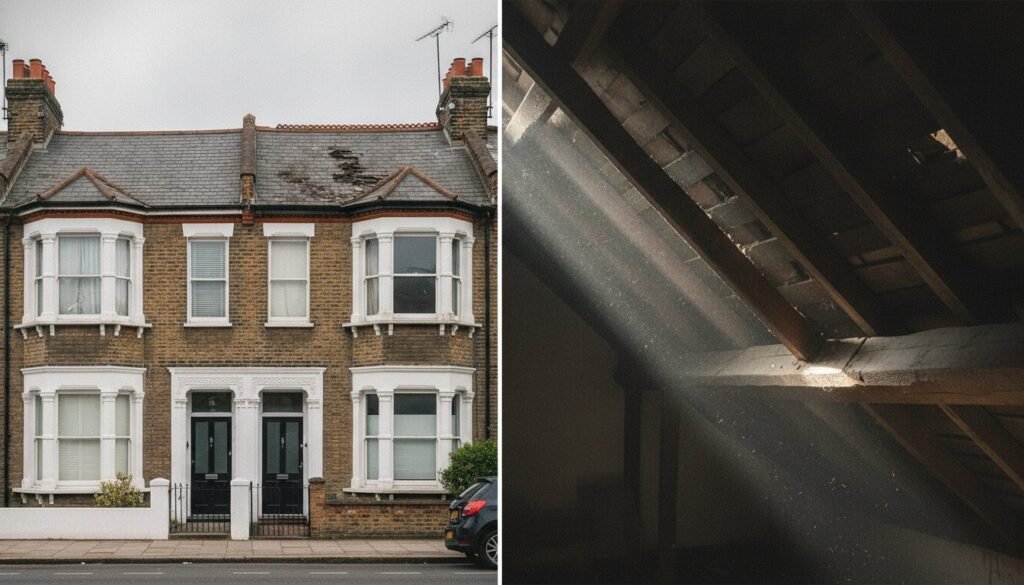
Your attic is the most honest part of your home. It doesn’t hide secrets behind fresh paint or decorative wallpaper. Think of it as an early warning system for the rest of the property. If you want to know the true state of your roof, you need to climb up there with a torch. A quick look around the loft can reveal the most common signs your roof needs replacing before they turn into a full-scale emergency in your living room. We always recommend checking this space at least twice a year, especially after a heavy London downpour.
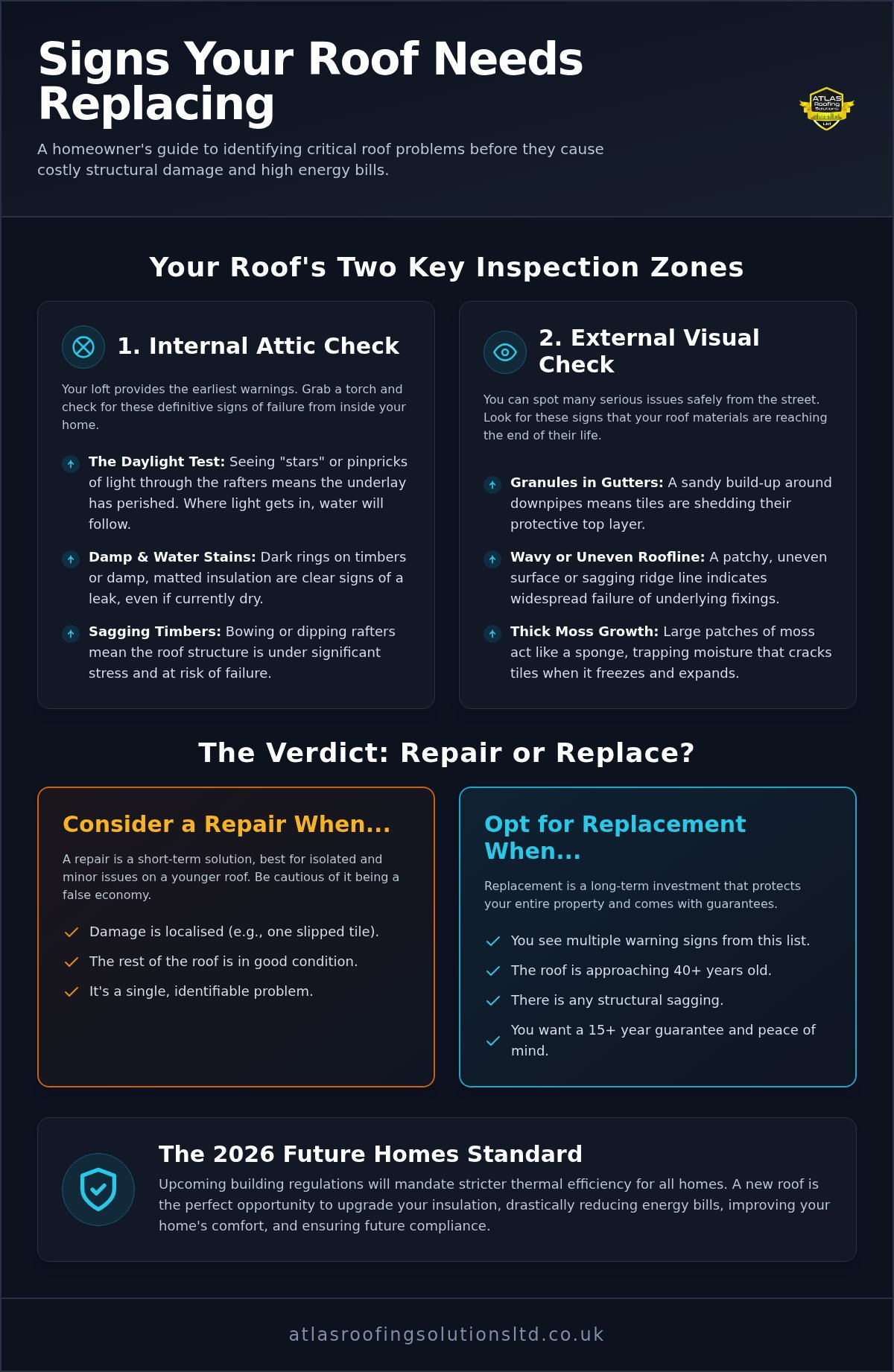
Safety is the priority when you are inspecting the loft. Always walk on the sturdy ceiling joists and never step on the plasterboard between them, as you could easily fall through. Once you are safely positioned, turn off your torch for a moment. This is the “Daylight Test.” If you can see pinpricks of light or “stars” through the rafters, you have a problem. Where light gets in, water follows. Whilst a single slipped tile might cause a small leak, seeing multiple points of light across the pitch suggests the underlay has perished and the entire structure is vulnerable.
It is also vital to distinguish between condensation and a genuine leak. Condensation often looks like a uniform misting or dampness across all the timbers, usually caused by blocked vents or poor airflow. A roof leak is more specific. It creates concentrated wet patches or active drips that follow a specific path. If you see dampness localised to one area, it is time to look closer at the external tiles.
Identifying Water Stains and Damp Patches
Water rarely travels in a straight line. It might enter through a cracked ridge tile and run down a rafter for several metres before dripping onto your insulation. Look for dark, discoloured rings on the wooden beams or the underside of the roof deck. Even if a stain feels bone-dry to the touch, it is still a major red flag. It tells us that water has breached the outer layer in the past and likely will again. Damp or matted insulation is another giveaway; once mineral wool gets wet, it loses its ability to trap heat, leading to the chilly rooms and rising energy bills many homeowners dread.
Sagging Roof Timbers and Internal Structure
A healthy roof should have straight, crisp lines. If you notice the horizontal beams or the rafters are bowing or dipping, the structure is under significant stress. This often happens in older London terraces where heavy concrete tiles were installed over a frame originally designed for lighter slate. By understanding your roof’s construction, you can see that these timbers are the backbone of your home. If they are rotting amongst the joints or showing signs of “saddleback” sagging, these are definitive signs your roof needs replacing. Ignoring structural movement can lead to a partial collapse, which is a far more complex and expensive issue than a planned replacement project.
External Visual Indicators: What Your Tiles and Slate are Telling You
You don’t always need a ladder to spot trouble. A simple visual health check from the pavement can reveal the most common signs your roof needs replacing before a major storm hits. Take a walk around your property and look up. Are the lines of the roof crisp and straight, or do they look “wavy”? In many London terraces, decades of weather can cause the materials to shift. Whilst a single slipped tile is usually a quick fix, a roof that looks patchy or uneven across its entire surface suggests the underlying fixings have reached the end of their natural life.
One of the most reliable ways to gauge degradation is the “Granule Test.” Check your gutters or the area around your downpipes. If you find a build-up of sandy granules or small stone chips, your tiles are literally shedding their protective layer. This is common with concrete tiles as they approach the 40-year mark. Once this coating is gone, the tile becomes porous. It absorbs water, becomes heavy, and eventually cracks during a frost. If your gutters are frequently filled with this debris, it is a clear indicator that the material is failing.
Don’t be fooled by moss. Whilst a small amount of green growth might look charming on a period property, thick blankets of moss are destructive. They act like a sponge, holding moisture against the tiles and preventing the roof from drying out. In winter, this trapped water freezes and expands, causing tiles to “spall” or flake away. If you are unsure whether your growth is harmless or hazardous, getting a no-obligation quote from a local expert can provide the clarity you need.
Slipped, Cracked, or Curling Tiles
Victorian slates are famous for their longevity, often lasting over 100 years. However, they eventually suffer from “nail sickness,” where the iron nails holding them in place rust away. This leads to slates sliding out of position. If you see slates delaminating, which looks like the stone is splitting into thin layers, they cannot be repaired. On modern bitumen or felt roofs, look for curling edges. When the corners of the shingles turn upwards, they are no longer watertight and are easily caught by the wind.
The State of Your Flat Roof: GRP vs Felt
Flat roofs on extensions or garages often fail silently. Look for “alligatoring,” which is a pattern of cracks that looks like reptile skin. This happens when the bitumen becomes brittle from UV exposure. You should also check for “ponding,” where water sits in deep puddles long after the rain has stopped. This weight creates a dip in the structure, leading to rapid failure. For many London homeowners, replacing these failing systems with a GRP fiberglass roof is the best long-term solution. It creates a seamless, durable membrane that eliminates the common leak points found in traditional felt.
Beyond the Tiles: Why Your Chimney and Gutters Matter
Your roof is far more than just a collection of slates or tiles. It is a complete system where every component, from the chimney pot to the guttering, must work in harmony to keep your home dry. Identifying the signs your roof needs replacing often starts at the edges rather than the centre. If your fascias are rotting or your chimney is crumbling, the most expensive tiles in the world won’t prevent water from entering your structure. In many London properties, these peripheral issues are actually the primary cause of internal damp.
London’s unique architecture, particularly the rows of Victorian and Edwardian terraces, presents specific challenges. Shared chimney stacks and parapet walls are common leak points that many general guides overlook. When these areas fail, water often tracks along the rafters, making it look like a tile has slipped when the masonry is actually at fault. Upgrading to modern uPVC fascias and soffits acts as a preventative shield, protecting the vulnerable ends of your roof timbers from the driving rain we often see in the capital.
Chimney Repointing and Flashing Failures
The chimney stack is the most exposed part of your home. Over decades, the mortar between the bricks can crumble away, a process known as de-pointing. If you notice small bits of mortar on your garden path or see plants growing out of the stack, the masonry is failing. We also pay close attention to the lead flashing at the base of the chimney. This lead creates a watertight seal between the bricks and the tiles. If it is cracked or pulling away, it becomes the weakest point of your roof. During our London terrace surveys, Atlas Roofing Solutions Ltd prioritises chimney maintenance because a failing stack can saturate the internal breast, leading to costly plaster repairs in your bedrooms.
Fascias, Soffits, and Guttering Health
Your fascias and soffits do the heavy lifting of supporting your guttering and protecting the roof’s eaves. Traditional timber boards eventually rot, especially if gutters are blocked and overflowing. If you see paint peeling or wood that looks soft and spongy, the rot can quickly spread to the rafter feet. We recommend uPVC upgrades because they are completely maintenance-free and won’t decay. Watch out for the Drip Test during a rainstorm. If water is trickling behind the gutter or running down the wall, your roofline system has failed. Sagging gutters are another warning; they often indicate that the fascia board is no longer strong enough to hold the weight of the water, which is one of the subtle signs your roof needs replacing or at least a significant overhaul of its protective edges.
The Age Factor: Understanding UK Roofing Life Cycles
While a visual check is helpful, the calendar is often your most honest guide. If your London home hasn’t seen a roofer since the early 2000s, you are likely living under a ticking time bomb. According to industry data from March 2026, most roofs last around 20 years before needing significant work. Beyond this point, materials begin to lose their structural integrity, even if they appear intact from the street. London’s unique mix of high humidity and urban pollution accelerates this process, particularly for porous materials like concrete or older felt. These are the invisible signs your roof needs replacing that many homeowners miss until the first major leak occurs.
Finding out when your roof was last replaced is essential for your maintenance plan. You can often find this information in your property’s survey or by checking the local planning portal for previous building regulations approvals. If you are still unsure, looking at the roofs of your neighbours in the same terrace can provide a clue. If several houses on your street have recently had new installations, it is a strong indicator that the original materials used for the entire row have reached the end of their natural life.
Average Lifespans of Common UK Roofing Materials
The lifespan of your roof depends entirely on what it is made of. We see a massive difference between traditional and modern materials in the London market. Based on verified 2026 data, here are the typical lifespans you can expect:
- Natural Slate: 80 to 150 years (the gold standard for longevity)
- Clay Tiles: 60 to 100 years
- Concrete Tiles: 40 to 60 years
- GRP Fibreglass (Flat Roofs): 25 to 30 years
- Felt (Flat Roofs): 15 to 20 years
It is worth noting that timber roofline elements, such as fascias and soffits, often fail decades before the tiles themselves. If your timber is rotting, it can compromise the entire structure long before the slates reach their 100th birthday. For a detailed breakdown of how long does a roof last UK wide across every major material type, our dedicated guide covers everything from natural slate to modern GRP systems.
When to Pre-emptively Replace Your Roof
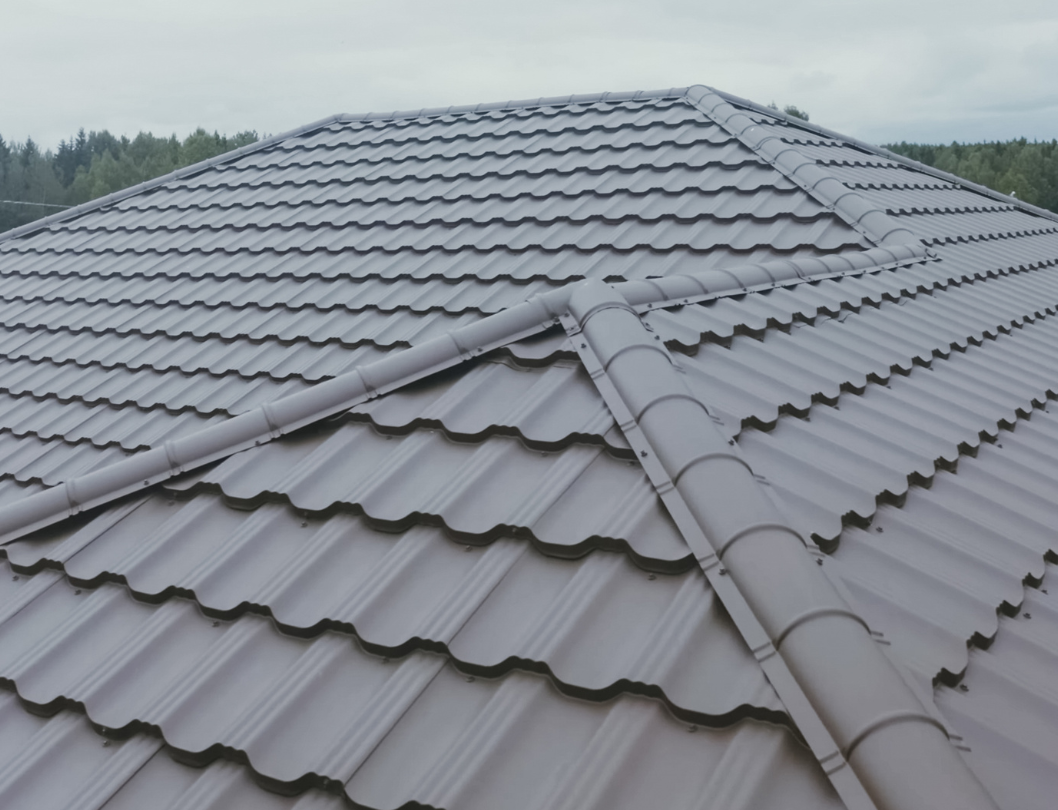
Waiting for a leak is a risky strategy. A pre-emptive replacement is often more cost-effective because it prevents expensive internal damage to your ceilings and electrics. With the 2026 Future Homes Standard now in effect, modern installations focus heavily on thermal efficiency. Upgrading an aged roof can significantly reduce your energy bills and increase your property value in the competitive London market. If your roof is approaching the 20-year mark, 2026 is the ideal time to assess its condition. You can request a professional roof installation quote to understand how modern GRP or high-performance tiles can protect your home for the next generation.
The Verdict: Should You Repair or Replace Your London Roof?
Deciding between a quick fix and a total overhaul is often the most stressful part of property ownership. We use a simple benchmark called the “Rule of Three.” If you have needed three separate repairs in the last 18 months, or if the cost of the next repair is more than 25 per cent of a total replacement, your roof has likely reached its limit. These recurring leaks are the most definitive signs your roof needs replacing. Patching a failing system is often a false economy that leads to higher long-term costs and potential structural damage to your masonry.
If you suspect your roof is failing, the first step is to stay calm and avoid contractors who pressure you into immediate decisions. A reliable guardian of your home will provide a transparent assessment of the damage. We recommend getting a professional survey to identify whether the issue is a localised leak or a terminal failure of the underlay and fixings. Taking action now prevents the anxiety of the next big London storm and ensures your home remains a safe, dry environment for your family.
Calculating the Cost-Benefit Ratio
Patching a roof that is over 30 years old is often throwing money away. While a repair might stop a single drip, it cannot fix the natural degradation of the tiles or the perishing of the felt underneath. Modern roofing solutions offer benefits that a simple repair cannot match. For instance, the 2026 Future Homes Standard now mandates much higher thermal efficiency. Since around 25 per cent of a home’s heat can be lost through an uninsulated roof, a full replacement allows you to install high-performance insulation that slashes your energy bills. You aren’t just buying a new cover; you are investing in a more comfortable and cheaper-to-run home. Before committing to any project, understanding how much does a new roof cost UK wide, including materials, scaffolding, and waste disposal, will help you budget accurately and avoid being overcharged.
Finding a Trusted London Roofing Partner
When you are ready to move forward, choosing a local, family-owned business with over 20 years of experience is vital. You need a partner who values their reputation in the community over a quick win. A professional quote should be detailed and include everything from scaffolding to the removal of old materials. Avoid any contractor who refuses to provide a written guarantee or asks for the full payment upfront. At Atlas Roofing Solutions Ltd, we provide a 15-year guarantee on all workmanship, giving you the long-term security you deserve. Our straight-talking approach ensures you know exactly what the job involves from start to finish.
Book your free London roof survey with Atlas Roofing Solutions Ltd today
Securing Your Home for the Next Generation
Taking the time to walk through this checklist ensures you are never caught off guard by a sudden leak or structural failure. We have explored how everything from the daylight test in your loft to the state of your chimney stack reveals the true condition of your property. Recognising these signs your roof needs replacing is the first step toward securing your home’s future and improving its energy efficiency under the new 2026 standards. By addressing these issues before they become emergencies, you protect both your budget and your peace of mind.
Home maintenance doesn’t have to be a source of anxiety when you have a dependable partner by your side. With over 20 years of London experience, our family-owned team understands the unique challenges of the capital’s housing stock. We provide honest, transparent advice and back every new installation with a 15-year workmanship guarantee. If you are ready to move from uncertainty to total security, Get a Free, No-Obligation Roofing Quote from Atlas Roofing Solutions Ltd today. Let’s make sure your home stays protected, warm, and dry for the next generation.
Frequently Asked Questions
How much does a new roof cost in London in 2026?
The average cost for a roof replacement in the UK is approximately £8,000, with projects typically ranging from £4,000 to £19,000. These figures vary based on the materials used, such as natural slate or concrete tiles, and the complexity of the roof’s shape. For London properties, specific access requirements for scaffolding and waste disposal can also play a role in the final investment required for a project. For a full breakdown of pricing by material and roof type, our dedicated guide on how much does a new roof cost UK wide covers everything you need to budget with confidence.
Can I just repair one section of my roof instead of replacing the whole thing?
You can often repair a localised area if the rest of the structure is sound and the materials haven’t reached the end of their lifespan. However, if you are noticing multiple signs your roof needs replacing across different sections, a full installation is usually more cost-effective. We use the “Rule of Three” to help homeowners decide; if you’ve had three repairs in 18 months, a replacement is likely the safer long-term choice.
How long does a typical roof replacement take for a London terrace?
A standard roof replacement for a terrace property usually takes between 5 and 10 working days to complete. This timeline includes the initial scaffolding setup, the removal of old materials, and the final installation of the new system. Weather conditions and the complexity of the chimney stack or roofline can affect the duration, but we always aim for a hassle-free experience with minimal disruption to your daily routine.
What is the best roofing material for a flat roof in the UK?
GRP fiberglass is widely considered the superior choice for modern flat roofs due to its seamless, watertight finish and impressive durability. Unlike traditional felt, which has a lifespan of 15 to 20 years, a GRP system typically lasts 25 to 30 years and is much more resistant to UV damage. It is a particularly popular solution for London extensions because it requires virtually no maintenance once the installation is finished.
Do I need planning permission to replace my roof in London?
Planning permission is generally not required for a roof replacement unless your property is a listed building or located within a conservation area. However, you must obtain Building Regulations approval if you are replacing more than 25 percent of the roof area. This ensures the new structure meets modern safety and thermal efficiency standards, including the 2026 insulation requirements that focus on reducing carbon emissions.
Will a new roof stop the damp problems in my upstairs bedrooms?
A new roof will eliminate damp problems caused by water ingress from slipped tiles, perished underlay, or failing leadwork. If your bedroom ceilings show dark rings or active drips, a replacement provides an immediate and permanent solution. If the damp is caused by condensation, we ensure the new installation includes proper ventilation through the soffits to allow air to circulate and keep the internal structure dry.
What is the difference between a fascia and a soffit?
The fascia is the long, straight board that runs along the lower edge of the roof, providing the primary support for your guttering. The soffit is the board tucked underneath the fascia, which is what you see when looking up from the ground. Both are essential parts of the roofline system, protecting the timber rafters from rot and providing vital ventilation to the loft space to prevent damp.
How often should I have my chimney repointed?
Chimney stacks in London terraces typically need repointing every 10 to 15 years to prevent water from seeping into the masonry joints. Because the chimney is the most exposed part of your home, the mortar faces the brunt of the wind and rain. Regular maintenance of the stack and lead flashing prevents the saturation of the internal chimney breast, which is a common cause of mysterious damp patches in bedrooms.