Is your roof a silent protector or a ticking time bomb waiting for the next London downpour? It’s the most expensive part of your home to ignore. Yet many people only think about it once a patch of damp appears on the ceiling. You likely want to know exactly how long does a roof last UK wide, especially when faced with conflicting advice and the fear of rogue traders. We understand that the thought of a full replacement is stressful and confusing.
You deserve a straight-talking guide that cuts through the jargon. In this article, we’ll reveal the typical lifespan of every major UK roofing material, from 150-year natural slate to modern GRP fibreglass. Durable materials. Expert skill. Total protection. You’ll learn how to spot early warning signs of failure before they become a financial crisis. We’ll also explain how local weathering and professional maintenance can add decades to your home’s protection, ensuring your family stays dry and secure for the long haul.
Key Takeaways
- Compare the lifespans of heritage materials like natural slate with modern solutions to choose the best fit for your property.
- Discover exactly how long does a roof last UK wide based on material choice, from 25-year GRP to century-old clay tiles.
- Learn to spot internal and external red flags, such as daylight in the rafters or missing tiles, before they turn into costly leaks.
- Understand how London-specific factors like urban pollution and freeze-thaw weather cycles accelerate wear on your chimney and mortar.
- Find out why a 15-year workmanship guarantee and annual maintenance are essential for hassle-free, long-term protection.
Typical Lifespans of Common UK Roofing Materials
When you’re trying to figure out how long does a roof last UK weather is your biggest adversary. It isn’t just about the years on the calendar; it’s about the material’s ability to withstand relentless rain, wind, and frost. Material choice is the single most important factor for longevity. A roof in a sheltered London suburb faces different stresses than one on a coastal cliff, but the raw durability of your chosen tiles or membranes sets the baseline for your home’s security.
Pitched Roof Materials: Slate, Clay, and Concrete
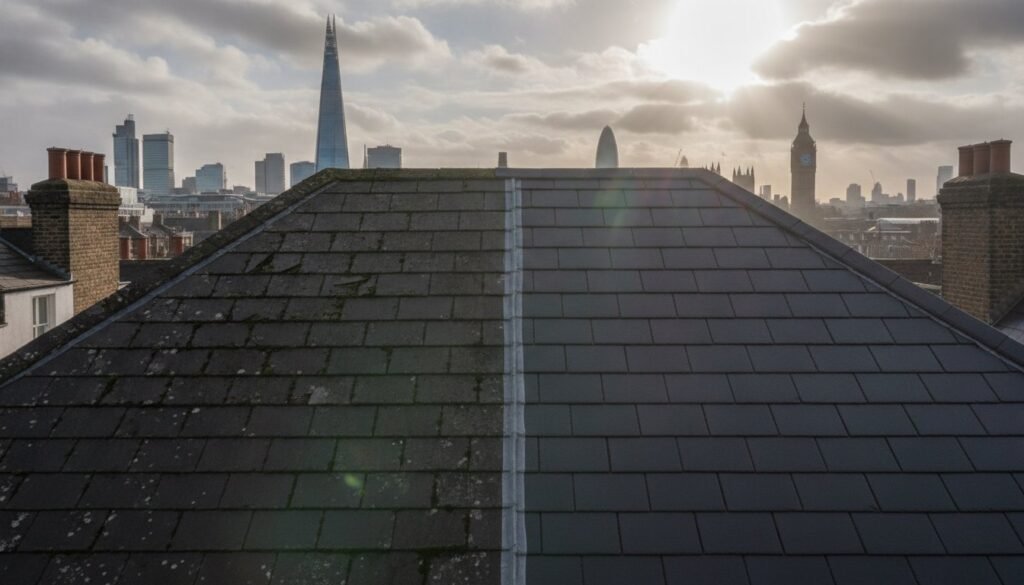
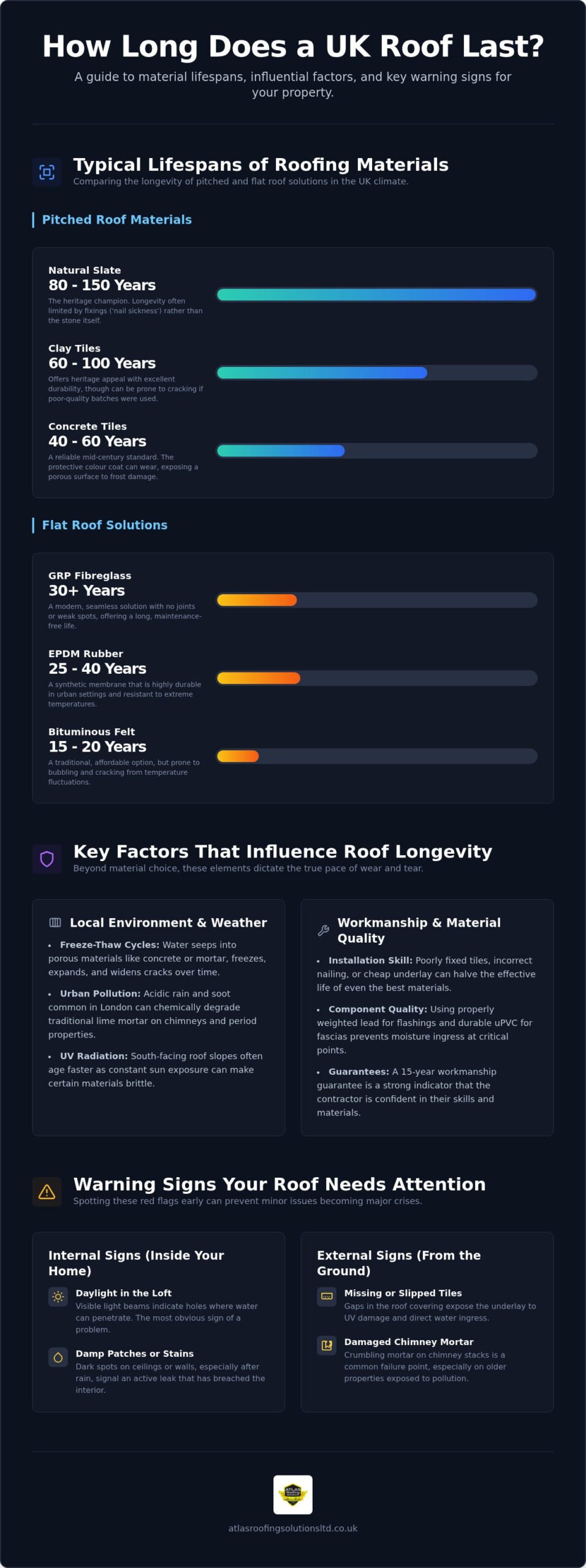
Natural slate is the undisputed heavyweight champion of the British skyline. It’s common to see London terraces with their original slate intact after a century. While the stone itself is almost indestructible, the timber batons or the nails holding them can eventually fail. This is often referred to as ‘nail sickness’ in general information on roofing materials. If the fixings stay sound and the roof is well-maintained, a slate roof can easily last between 80 and 150 years.
Clay tiles offer a similar heritage appeal and typically provide 60 to 100 years of service. They’re more breathable than concrete but can be prone to cracking if poor-quality batches were used in the past. Concrete tiles became the go-to during the mid-century building boom. They’re heavy and reliable but have a shorter life cycle of 40 to 60 years. Over time, the protective colour coating on concrete wears away. This leaves the porous surface exposed to moss and frost damage, which can lead to the tiles becoming brittle.
Flat Roof Solutions: GRP Fiberglass vs Felt
Flat roofs once had a reputation for leaking, but that was usually down to outdated materials. Traditional bituminous felt was the standard for decades. It’s affordable, but it often fails after just 15 to 20 years. The UK’s temperature swings cause the layers to expand and contract. This leads to ‘bubbling’ or cracks where water eventually finds a way into the structure below.
We often recommend GRP fiberglass as a superior, modern alternative. It’s a single, seamless sheet of glass-reinforced plastic. Because there are no joins, there are no weak spots. When considering how long does a roof last UK homeowners find that a professionally installed GRP roof offers a maintenance-free life of 30 years or more. EPDM rubber is another durable choice. These synthetic membranes are incredibly hardy in urban settings and usually last between 25 and 40 years, provided they are kept clear of debris.
Factors That Influence How Long a Roof Lasts in the UK
Time isn’t the only thing ticking away at your roof’s lifespan. While material choice provides the baseline, your local environment dictates the true pace of wear. When asking how long does a roof last UK homeowners often forget that London presents its own unique set of challenges. From the urban heat island effect to the grit of city pollution, your roof is under constant pressure from the moment the last tile is laid.
The Impact of Local Weather and Pollution
The freeze-thaw cycle is particularly brutal on porous materials like older concrete tiles and mortar. Rainwater seeps into tiny fissures during a typical London autumn. When the temperature drops in winter, that water expands as ice, physically prying the material apart. Over decades, this process turns microscopic cracks into structural failures. Wind-driven rain also tests the integrity of chimney stacks, which are often the most exposed part of a terraced house.
London’s history is etched into its rooftops. For period properties, urban soot and acidic rain are more than just an aesthetic issue; they chemically degrade traditional lime mortar. This is why chimney stacks on older terraces often require repointing long before the main roof fails. Interestingly, south-facing roof slopes often age faster. Constant exposure to UV radiation can make certain materials brittle, whilst the shaded north side might remain supple but struggle with moss growth.
Workmanship and Material Quality
Installation quality is the silent factor that determines if your investment lasts 40 years or 15. Poorly fixed tiles or cheap, thin underlay can halve the life of even the best materials. We always recommend checking credentials through NFRC, the UK’s largest roofing trade association, to ensure standards are met. A 15-year workmanship guarantee should be your baseline for long-term security. It shows the contractor is confident their skill matches the material’s durability.
Protection starts at the edges. We insist on high-quality uPVC for fascias and soffits because timber alternatives often rot, allowing moisture to creep into the rafters. Similarly, using the correct weight of lead for flashings and valleys is non-negotiable. If the lead is too thin, it will eventually crack under the heat of the sun. If it’s too thick, it can place unnecessary stress on the roof structure. Getting these technical details right is what keeps a home dry for decades.
Don’t ignore what’s happening underneath the tiles. Poor loft ventilation leads to ‘sweating’, where warm air from the house condenses on the cold underside of the roof. This trapped moisture can rot timber rafters from the inside out, effectively killing a roof that looks perfectly fine from the street. If you are worried about damp in your attic, getting a professional roof assessment can identify these hidden issues before they become a financial crisis.
Warning Signs Your Roof Is Reaching the End of Its Life
A roof rarely fails in a single afternoon. It usually sends out subtle distress signals long before a major leak forces your hand. Understanding these cues helps you decide how long does a roof last UK homes specifically, as our damp climate accelerates certain types of decay. Ignoring a small damp patch today often leads to an expensive structural repair tomorrow. We believe in catching these issues early to protect your home and your budget.
Start your inspection in the loft. If you can see pinpricks of daylight through the rafters, your underlay or tiles have failed. This is a critical red flag. Damp patches on the ceiling or mould growth on the timber beams suggest moisture is already trapped. Another simple check is the ‘Gutter Test’. If you find a build-up of sand or grit in your gutters, your concrete or clay tiles are likely ‘spalling’. This means the protective outer layer is shedding, leaving the porous core exposed to frost damage.
Identifying Structural Issues Early
Take a walk across the street and look back at your property. A sagging roofline is a serious visual cue that the internal timber frame is struggling under the weight of the tiles. This often happens when moisture has compromised the rafters over several years. You should also look for slipped or missing tiles. While a single slipped tile is a simple repair, multiple slips on a slate roof often point to ‘nail sickness’. This is where the fixings have rusted away, meaning the entire surface is no longer secure. Understanding whether these structural warning signs call for targeted work or a full overhaul is exactly the kind of decision covered in our detailed guide to roof repair vs replacement for London homeowners.
On flat roofs, look for ‘bald’ spots on asphalt or bubbling on traditional felt. These are signs that UV degradation has made the material brittle. Once the surface cracks, water will seep into the decking below, leading to rot that remains hidden until the ceiling starts to bow. Honest assessments. Clear solutions. Long-term security.
The Role of Fascias, Soffits, and Guttering
Your roofline is the first line of defence against the British weather. Rotting timber fascias are more than just an eyesore; they allow water to penetrate the ends of your rafters. This creates a ‘wicking’ effect where moisture is pulled deep into the roof structure. Blocked or sagging gutters exacerbate this by keeping water in constant contact with the roof edge.
We often find that upgrading to uPVC fascias and soffits provides a permanent solution to these issues. Unlike timber, uPVC doesn’t rot, warp, or require painting. It creates a watertight seal that protects the vulnerable junction where your roof meets the walls. Maintaining a healthy roofline is one of the simplest ways to extend the overall life of your roof and avoid the high costs of a full timber replacement.
Extending the Life of Your Roof: Maintenance and Repairs
A well-maintained roof is a quiet roof. Whilst the question of how long does a roof last UK homeowners ask often depends on the elements, your proactive care is the only factor you can truly control. We operate on a ‘prevention vs cure’ philosophy. Identifying a loose flashing or a blocked downpipe today can save you thousands of pounds in structural timber repairs further down the line. It is about being a reliable guardian of your home’s most important layer of protection.
Strategic repairs are often the most cost-effective way to bridge the gap between a minor issue and a full replacement. If the majority of your tiles are sound but a few have slipped, a targeted repair is perfectly viable. However, if you are constantly patching a 25-year-old bituminous felt roof, you are likely throwing good money after bad. In those cases, we often suggest a transition to more durable solutions like GRP fiberglass to ensure long-term, hassle-free security. If you are unsure which path makes financial sense for your property, our in-depth comparison of roof repair vs replacement costs and structural warning signs can help you make a confident, informed decision. Before committing to any major work, it’s worth understanding how much does a new roof cost UK wide so you can budget accurately and compare your options with confidence.
The Annual Maintenance Checklist
Consistency is key to longevity. We recommend a simple inspection routine to keep your roof in peak condition:
- Bi-annual gutter cleaning: Clear your gutters every autumn and spring. When water backs up, it seeps under the eaves and rots the ends of your rafters.
- Moss and lichen removal: These plants act like sponges, trapping moisture against your tiles. During a frost, this trapped water expands and can cause tiles to crack or ‘spall’.
- Post-storm checks: After heavy winds, use binoculars to check for shifted lead flashings around chimneys or dormer windows.
Strategic Repairs for Longevity
London’s period properties require specific attention, particularly regarding chimney stacks. The mortar on a chimney is far more exposed than the mortar on your walls. Chimney repointing is a straightforward fix that prevents water from trickling down the stack into your bedrooms. Similarly, checking the leadwork in the valleys of your roof ensures that the areas of highest water flow remain watertight. When replacing isolated tiles, we ensure an exact material match. This isn’t just for aesthetics; different materials expand at different rates, and a mismatch can lead to further cracks during the summer heat.
If you have noticed damp patches or suspect your roofline needs attention, don’t wait for the next storm. You can book a professional roof repair assessment to catch these issues before they escalate into a full-scale replacement. Taking action now keeps your home secure and your long-term costs down.
Professional Roof Assessments and Replacement in London
Deciding whether to repair or replace is a significant choice for any homeowner. Whilst general data helps you understand how long does a roof last UK wide, every property has a unique story. London’s specific architectural heritage, from Victorian terraces to modern apartment blocks, requires a nuanced approach. You need a partner who prioritises the long-term security of your home over a quick sale. At Atlas Roofing Solutions Ltd, we bring over 20 years of practical experience to every site visit, ensuring you receive advice grounded in reality rather than sales targets.
The Atlas Roofing Solutions Ltd Standard
Our reputation is built on two decades of serving both residential and commercial clients across London. As a family-run business, we understand that our accountability to the community is our greatest asset. We take immense pride in our workmanship, treating every roof as if it were protecting our own family. Our approach is straightforward: if a repair can safely extend the life of your roof, that is exactly what we’ll recommend. We only suggest a full replacement when it’s the most cost-effective and secure path forward for your property. Our 15-year guarantee on all workmanship serves as a definitive promise that your new roof is built for lasting durability.
Getting Your Quote Organised
The first step toward a hassle-free experience is a thorough assessment. We conduct free site visits that go beyond a quick glance from the street. Our experts look for the hidden structural issues mentioned earlier, such as failing timber rafters or compromised ventilation. This methodical progression from initial contact to a detailed plan ensures there are no surprises once the work begins. We believe in absolute transparency, which is why our quotes include everything from the initial setup to the final waste removal. Knowing how long does a roof last UK weather cycles considered is one thing, but seeing the actual state of your rafters provides the clarity you need.
- Transparent quotes: We provide clear, itemised pricing with no hidden costs for scaffolding or skip hire.
- Expert assessment: We identify the root cause of leaks, not just the symptoms.
- Reliable timelines: We work efficiently to minimise disruption to your daily life.
- Quality materials: We only use industry-standard materials proven to withstand the urban London environment.
Finding a dependable local expert shouldn’t be a stressful ordeal. We’re here to provide the quiet confidence you need to make an informed decision about your home’s protection. Whether you’re dealing with a persistent chimney leak or considering a modern GRP fibreglass upgrade for your flat roof, our team is ready to help. Contact Atlas Roofing Solutions Ltd today for your free London roof survey and take the first step toward a secure, maintenance-free future for your home.
Secure Your Home’s Future Today
Your roof is more than just tiles and timber; it’s the primary shield for your biggest investment. We’ve explored how material choice, local pollution, and consistent maintenance dictate how long does a roof last UK homeowners can expect. Whether you’re managing a century-old slate terrace or a modern GRP flat roof, early intervention remains the key to avoiding high replacement costs. Taking action now prevents small leaks from becoming structural disasters.
As a family-run business with over 20 years of London roofing experience, we believe in honest, straight-talking advice. We provide transparent pricing and back all our work with a 15-year workmanship guarantee. This is our promise of durability and safety for your family. Don’t wait for the next heavy downpour to test your home’s integrity. Book your free, no-obligation London roof survey today to ensure your property remains dry and secure for decades to come. We’re ready to help you protect what matters most with the care it deserves.
Frequently Asked Questions
How long does a typical UK roof last before it needs replacing?
Most roofs in the UK last between 20 and 60 years, but the exact timing depends heavily on the material. Natural slate is the longest-lasting at over 100 years, whilst concrete tiles usually need attention after 40 to 60 years. When asking how long does a roof last UK homeowners must also consider that flat roofs typically have shorter lifecycles, ranging from 15 years for old felt to 30 plus years for modern fiberglass.
Can I repair just one section of my roof to save money?
You can often repair specific sections if the rest of the structure is sound. If a few tiles have slipped or a small area of flashing is loose, a targeted repair is a sensible, cost-effective choice. However, if the material has reached its natural porosity limit or the timber is rotting, patching one area won’t stop the rest from failing shortly after. We always provide an honest assessment of whether a repair is a viable long-term solution.
Does a 30-year-old roof always need to be replaced?
A 30-year-old roof doesn’t always need replacing, as many structures remain perfectly watertight well beyond three decades. A slate roof of this age is effectively still in its youth, whereas a bituminous felt roof is likely long overdue for a change. The need for a new roof is determined by the actual condition of the rafters and the integrity of the materials rather than just the number of years since installation.
How long does a GRP fiberglass flat roof last compared to felt?
A GRP fiberglass roof typically lasts 30 years or more, which is double the expected life of traditional felt. Whilst bituminous felt often starts bubbling or cracking after 15 years, the seamless nature of fiberglass eliminates the weak points where leaks usually start. It’s a durable, maintenance-free solution that offers much better long-term value for London properties, especially given our unpredictable weather cycles.
Is it worth repointing a chimney if the roof is old?
Repointing a chimney is almost always worth the investment because a failing stack is a major source of internal damp. Even if you plan to replace the main roof in a few years, a crumbling chimney can cause structural damage to the rafters and ceilings in the meantime. Keeping the masonry sound protects the house from water ingress that could lead to expensive timber rot and mould growth inside your home.
How much does a new roof cost for a London terrace house?
Costs vary significantly based on the house size and chosen materials, but the UK national average is roughly £8,000. For a London terrace, you must also consider the specific logistics of scaffolding and waste disposal in a busy urban environment. Because every property is different, we provide transparent quotes after a site visit to ensure you have an accurate figure for your specific project without any hidden surprises. For a detailed breakdown of what to expect, our guide on how much does a new roof cost UK homeowners should budget covers materials, labour, and hidden fees in full.
What are the first signs that my roof is starting to fail?
The earliest signs are often found in your gutters or your loft rather than on the tiles themselves. Look for grit or sand-like deposits in the guttering, which indicates that your tiles are shedding their protective layer. Inside the house, check for damp spots on the ceiling or any visible light coming through the roof boards in the attic, as these suggest the underlay has finally given way and moisture is entering the structure.
Does moss on a roof actually shorten its lifespan?
Heavy moss growth can significantly reduce how long does a roof last UK wide. Moss acts like a sponge, holding moisture against the tiles and preventing the surface from drying out after rain. In winter, this trapped water freezes and expands, which causes the surface of the tiles to crack and crumble. Over time, this leads to premature failure and water ingress that could have been avoided with simple cleaning.