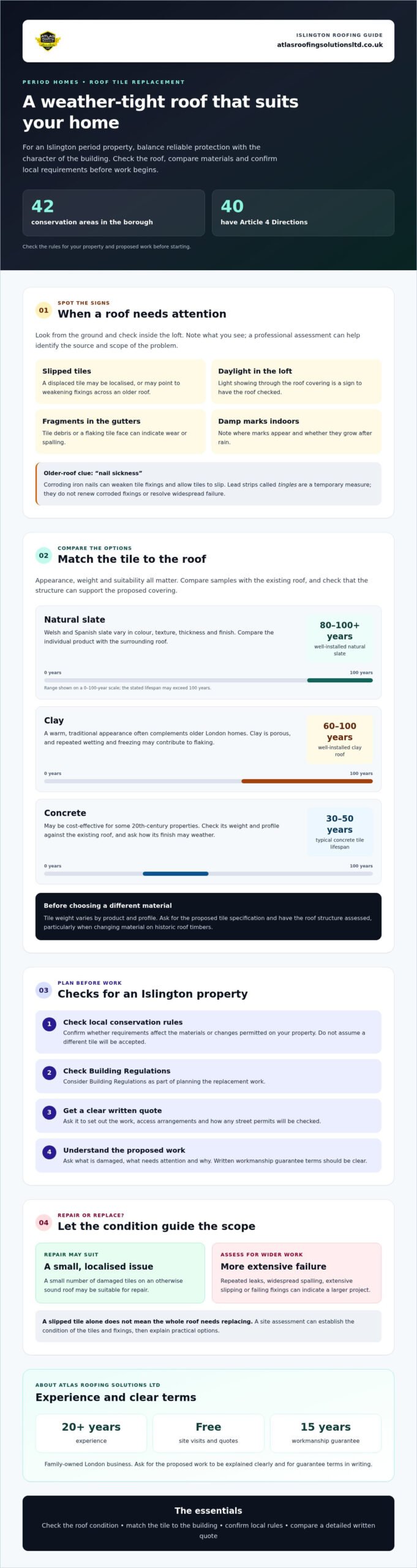
What if the right roof tile for your Islington home isn’t simply the newest or cheapest option? On a period property, a poor match can spoil its appearance, while changing roofing materials may bring planning requirements into play. Roof tile replacement Islington homeowners arrange needs to balance reliable weather protection with the character of the building.
It’s understandable to worry about unclear quotes, unreliable traders and whether Islington Council’s conservation rules apply. The borough has 42 conservation areas, and 40 have Article 4 Directions. Check the rules for your property and proposed work before starting.
This guide explains what can affect replacement costs, how to compare tile materials and what to consider when matching a historic roof. It also covers permissions and Building Regulations, plus what to look for in a clear, detailed quote. Atlas Roofing Solutions Ltd is a family-owned London business with over 20 years’ experience, free site visits and quotes, and a 15-year workmanship guarantee. Use the practical checks below to plan a weather-tight roof that suits your home.
Key Takeaways
- Look for warning signs such as slipped tiles, daylight in the loft or tile fragments in the gutters. Arrange an assessment before damage spreads.
- Compare slate, clay and concrete for appearance, weight and suitability, particularly on a period property.
- Before roof tile replacement, Islington homeowners should check whether conservation rules affect the materials or changes permitted on their property.
- Ask for a written quote that sets out the work, access arrangements and how any street permits will be checked.
- Choose a roofer who can explain the proposed work clearly and provide written workmanship guarantee terms.
Identifying the Need for Roof Tile Replacement in Islington
A slipped tile can look like an isolated problem, but on a Victorian or Georgian terrace it may signal wider wear. From the ground, look for gaps or uneven lines on the roof and tile fragments in the gutters. From inside the loft, check for daylight through the roof covering. Damp marks on a lath and plaster ceiling can also indicate water ingress, so don’t dismiss them as a minor stain.
Islington’s urban setting brings a mix of rain, frost and pollution. Traditional clay tiles are porous, and grime can make surface wear harder to assess. Repeated wetting and freezing may contribute to flaking. Materials vary across older roofs, so it helps to understand the differences between traditional roofing materials before deciding whether to repair or replace them.
Signs Your Period Property Needs Attention
Inspect visible rooflines from the ground, without climbing onto the roof. A sagging or dipping line on an older terrace may point to an issue beyond the tiles and needs a closer professional assessment. Look for spalling, where the tile face flakes or breaks away, as well as slipped tiles and fragments among gutter debris. If you find damp patches indoors, note where they appear and whether they grow after rain. These details can help a roofer trace the source rather than simply treat the visible mark.
The “Nail Sickness” Problem in Older Roofs
Some older roofs were fixed with iron nails. Corrosion can weaken these fixings over time, allowing tiles to slip. This is often called “nail sickness”. One displaced tile might be a localised problem, but if fixings across an ageing roof are failing, replacing a single tile may not address the cause.
Lead strips, known as tingles, can hold a slipped tile in place as a temporary measure. They don’t renew corroded fixings or resolve widespread failure. Ask for the roof to be assessed before relying on a patch as a lasting solution.
Repair or replacement? A small number of damaged tiles on an otherwise sound roof may be suitable for repair. More extensive slipping, repeated leaks, widespread spalling or failing fixings can indicate a larger project. A site assessment can establish the condition of the tiles and their fixings, then explain the practical options. For roof tile replacement, Islington homeowners should ask for a clear account of what is damaged, what needs attention and why. A slipped tile alone doesn’t mean the whole roof needs replacing.
Choosing the Right Materials: Slate, Clay, or Concrete?
For a period terrace, the right tile needs to suit the building as well as protect it from the weather. Colour, shape and texture all affect the roof’s appearance from the street. In a conservation area, planning requirements may also limit your options. Before settling on a material, check local rules rather than assuming a different tile will be accepted.
There’s no single best option for every roof. Natural Welsh and Spanish slate can vary in colour, texture, thickness and finish, so compare samples with the existing roof rather than choosing by country of origin alone. Traditional clay has a warm, established appearance that often complements older London homes. Concrete may be a cost-effective option for some 20th-century properties, particularly when its profile and colour suit the existing roof.
Natural Slate: A Long-Lasting Choice
Welsh and Spanish slate can both provide a natural finish, but the individual product matters more than a broad label. On a heritage property, compare the colour, size and texture with the surrounding roof. A well-installed natural slate roof can last 80–100 years or more. That service life may make it a worthwhile investment, provided the roof structure and proposed slate are suitable.
Clay or Concrete: Match the Roof, Not Just the Budget
Clay tiles are often chosen for period properties because their traditional appearance can sit comfortably with older architecture. Well-installed clay roofs can last 60–100 years, whilst concrete tiles typically last 30–50 years. Concrete can suit some later builds, but its weight and profile still need checking against the existing roof. Finishes also differ by product, so ask whether the colour is integral to the tile or applied as a coating, and how it may weather over time.
Check the structure before choosing. Tile weight varies by product and profile, so don’t assume a replacement will place the same load on an older roof. A roofer should assess the structure and confirm that the proposed covering is suitable. This matters particularly if you’re changing from one material to another. Historic roof timbers may need careful consideration before heavier tiles are selected.
Ask for the proposed tile’s specification, including its weight, dimensions, finish and fixing requirements. Compare these details with the existing covering and any planning conditions. This gives you a clearer basis for weighing appearance, durability and cost without overlooking structural suitability. To discuss options for your property, explore roof tile replacement services from Atlas Roofing Solutions Ltd.
The Roof Tile Replacement Process: What to Expect
A well-organised project should have clear stages, from the first inspection to the final checks. Atlas Roofing Solutions Ltd offers free site visits and quotes, allowing the roofer to assess the property before setting out the work. Ask what the quote includes, how unexpected issues will be handled and who to contact during the project. Clear answers make it easier to plan around the work.
Site Visit, Access and Street Logistics
On a close-set terrace, access needs planning as carefully as the roof work. Discuss where scaffolding may be positioned, whether it could affect a pavement or road, and who will check permit requirements with Islington Council. Confirm how access to your home and neighbouring properties will be maintained, and how the work area will be kept orderly.
Before the old covering is removed, agree how doors, paths, plants and other vulnerable areas will be protected from falling debris. Ask how waste will be collected and removed, and whether reusable tiles will be set aside. Disposal and recycling depend on the material and its condition, so the plan should be specific to your roof.
Strip-Back, Underlay and Battens
Once access and protection are in place, the old covering is removed in a controlled sequence. This exposes the roof structure for inspection. If the team finds damaged timber or another hidden issue, ask them to explain what they found, what work they recommend and whether it will affect the quote before proceeding. That gives you the information needed to make an informed decision.
The underlay and battens provide the base for the new covering. A suitable breathable membrane may help manage moisture within the roof build-up, whilst correctly spaced and aligned battens support an even tile layout. Products and installation details depend on the roof design. Ask what has been specified and how ventilation will be maintained to help limit condensation in the loft.
Finishing and handover matter. The tiles are laid to suit the roof’s layout, with details such as ridge pointing and leadwork completed where the job requires them. Before work starts, confirm which finishing tasks are included. At the end, ask for a walk-through of the completed work and any paperwork or care guidance relevant to your project.
For an assessment of the work involved, arrange a roof tile replacement site visit with Atlas Roofing Solutions Ltd.
Roof Tile Replacement Islington: Planning and Conservation Rules
Before agreeing to roof tile replacement, Islington homeowners should check whether the property is in a conservation area and which planning and Building Regulations requirements apply to the proposed work. Islington has 42 conservation areas, and 40 are covered by Article 4 Directions that remove most permitted development rights for external alterations. Treat a planning application as a possibility until the council confirms what applies.
Check the Rules for Your Property
Being in Barnsbury or Canonbury can make conservation controls especially relevant, but the rules depend on the property’s exact location and the work planned. Check Islington Council’s conservation-area information and ask its planning team whether the proposed changes need permission. In many Article 4 areas, roof alterations require a full planning application, and like-for-like materials may be requested to preserve the area’s character. Confirm the position before ordering tiles or starting work.
If you believe permission isn’t required, ask the council whether a Lawful Development Certificate is appropriate. The supplied 2026 information lists its fee as £86. Keep the council’s written decision and any approved plans with your property records. A roofer can discuss the materials and work involved, but the council confirms planning requirements.
Building Control and Insulation
Planning permission and Building Regulations are separate checks. Islington Council Building Control approval is required for most significant roofing projects, so confirm what applies before work begins. Under Approved Document L, replacing 25% or more of a roof means upgrading its insulation to the current standard. Ask Building Control or a qualified professional how this applies to your roof, what standard must be met and whether the proposed work needs approval.
Insulation options depend on the roof’s construction and available space. PIR boards may be suitable in some situations, but they aren’t a universal answer. Installation needs to be considered alongside ventilation and moisture control. Agree the specification before work starts, and ask who will arrange any required Building Control inspection and provide completion paperwork. Don’t assume a certificate will be issued automatically.
Keep the paperwork clear. Save the planning decision, approved drawings, Building Control correspondence and any completion documentation. Ask your roofer what information they can provide to support your application, but verify requirements directly with the council. Atlas Roofing Solutions offers free site visits and quotes, so you can discuss the proposed roof work and clarify its scope before deciding what to do.
To discuss your project, arrange a roof site visit with Atlas Roofing Solutions.
Why Atlas Roofing is Islington’s Trusted Choice
Choosing a roofer is about more than replacing damaged tiles. You need a team that explains the work plainly, respects the character of your home and stands behind its workmanship. Atlas Roofing Solutions Ltd is a family-owned business with over 20 years of experience serving London. Its roofing services include new installations and repairs, with experience across the varied roofs found in the capital.
Clear communication helps you understand what needs attention, what the proposed work involves and what to clarify before agreeing to proceed. Free site visits and quotes let you discuss your roof in person, rather than relying on a phone estimate that can’t account for its actual condition.
The Value of a 15-Year Workmanship Guarantee
Atlas Roofing Solutions Ltd provides a 15-year guarantee on workmanship. Before accepting a quote, check the written terms so you know what workmanship is covered, how to raise a concern and whether any conditions apply. Keep the guarantee and project paperwork with your home records. Ask separately about materials, as cover for materials may differ from a workmanship guarantee.
A Clear Quote and Relevant Roofing Services
A useful quote should describe the proposed work in enough detail for you to understand what you’re agreeing to. Ask for the work and relevant materials to be listed clearly, and check how potential additional repairs will be discussed before they proceed. This makes it easier to compare quotes and avoid assumptions about what is included. If the project also involves guttering or uPVC fascias and soffits, ask whether those items are part of the quotation or need separate attention.
Atlas Roofing Solutions Ltd also provides chimney maintenance. If a chimney is part of your roof concerns, explore its chimney repair and maintenance service and ask whether it should be assessed alongside the roof work.
For roof tile replacement, Islington homeowners can start with a site visit and a no-obligation quote, then review the proposed scope before deciding. A clear discussion upfront helps you understand the next steps without pressure.
Book your free Islington roof survey today and discuss your roof with Atlas Roofing Solutions Ltd.
Plan Your Islington Roof Work with Confidence
A lasting roof starts with identifying what’s failing and choosing tiles that suit both the property and its structure. For period homes, check conservation requirements before selecting materials or starting external work. A clear assessment can also distinguish a localised repair from wider problems that need attention.
For roof tile replacement, Islington homeowners need a roofer who explains the scope clearly and stands behind the workmanship. Atlas Roofing Solutions is family-owned and operated, with over 20 years of London experience and a 15-year workmanship guarantee. Free site visits and quotes offer a practical first step, with no obligation to proceed.
Ready to discuss your roof and understand the options for your home? Get your free, no-obligation roof survey in Islington. Clear advice and careful planning can help you move towards a weather-tight roof that respects your home’s character.
Frequently Asked Questions
Do I need planning permission to replace roof tiles in Islington?
You may need planning permission, particularly if your home is in a conservation area covered by an Article 4 Direction. Islington has 42 conservation areas, and 40 have Article 4 Directions that remove most permitted development rights for external alterations. Check your property’s status and the proposed work with Islington Council before starting. Like-for-like replacement may be expected, but don’t assume that means you can skip the check.
How much does roof tile replacement cost in London?
The cost depends on the roof’s size and condition, the tile material, access requirements and the work needed beneath the tiles. A site assessment is the best way to understand the scope, rather than relying on a broad estimate that may not reflect your property. Atlas Roofing Solutions offers free site visits and no-obligation quotes. Ask for a clear breakdown of the proposed work and any assumptions that could affect the final price.
How long does it take to replace a tiled roof on a terrace house?
There isn’t one reliable timescale for every terrace. Duration depends on the roof’s size and condition, the chosen materials, access arrangements and whether the roofer finds hidden damage to the underlying structure. Conservation or Building Control requirements may also affect when work can begin. Ask the roofer to explain the expected schedule, how weather could affect progress and how you’ll be told if the scope changes.
Can I replace just a few broken tiles, or do I need a full replacement?
A repair may be enough if only a small number of tiles are damaged and the surrounding covering and fixings remain sound. Repeated slipping, widespread tile deterioration or signs of failing fixings can point to a broader problem. A roofer should inspect the roof before recommending work, so you can understand whether a targeted repair is suitable or a larger replacement is justified. One slipped tile doesn’t automatically mean the whole roof needs replacing.
What is the best type of tile for a Victorian house in Islington?
The right choice depends on the existing roof, the building’s structure and any conservation requirements. Natural slate or clay may suit the appearance of a period property, but the profile, colour and weight need checking against the original covering and roof structure. If the home is in a conservation area, ask Islington Council whether the proposed material is acceptable before ordering tiles. Matching the building’s character matters as much as choosing a durable material.
Will I need scaffolding for a roof tile repair in Islington?
That depends on the roof, the location of the damage and how the roofer can carry out the work safely. Ask the contractor to explain the access plan and whether scaffolding is needed. If it may occupy a pavement or road, check with Islington Council whether a permit is required and what conditions apply. Scaffolding arrangements are part of planning the roofing work, not a standalone rental service from Atlas Roofing Solutions.
Does a new roof come with a guarantee?
Atlas Roofing Solutions provides a 15-year guarantee on workmanship. Before agreeing to a roofing project, read the terms and check which workmanship is covered, how to raise a concern and whether conditions apply. Ask separately about cover for materials, as this may differ from a workmanship guarantee. Keep the paperwork with your property records so you can refer to it after the work is complete.
Can you match the colour of my existing historic tiles?
A roofer can assess the existing tiles and discuss options that may blend with their colour, profile and finish. An exact match can be difficult, particularly if the original tiles have weathered or are no longer readily available. For a historic property, take a sample or clear photographs to the site visit and check whether conservation rules affect your choice. Agree on the proposed tile and any visible difference before work begins.