What if the longest-lasting roof covering isn’t the right choice for your extension? The best material for flat roof extension projects depends on more than durability. The roof’s design, the existing building and the installation details all matter.
It’s understandable to focus on leaks, maintenance and how the new roof will look beside your home. Felt, EPDM rubber, single-ply membranes and GRP fibreglass each have different strengths and trade-offs. Even a suitable material can let you down if drainage, edges or joints aren’t handled properly.
This guide compares the main flat roofing options in plain English, so you can see what may suit your extension and what to weigh up before deciding. It also covers design and site factors that influence the choice, why workmanship matters, and practical questions to ask a roofing contractor. Use these points to have a clearer conversation about a roof that fits your home and provides dependable protection.
Key Takeaways
- The best material for flat roof extension projects depends on the roof design, intended use and installation details, not on a single universal winner.
- Compare GRP, EPDM, felt and single-ply by considering how each system is installed, detailed and maintained.
- Check the full roof build-up, including the supporting deck, insulation, waterproof covering and drainage, before settling on a material.
- Decide how you’ll use the roof and what matters most visually, then use those priorities to guide discussions with a roofer.
- Ask for the proposed system and key installation details in writing, and have the extension assessed before confirming your choice.
Best material for a flat roof extension: how to choose?
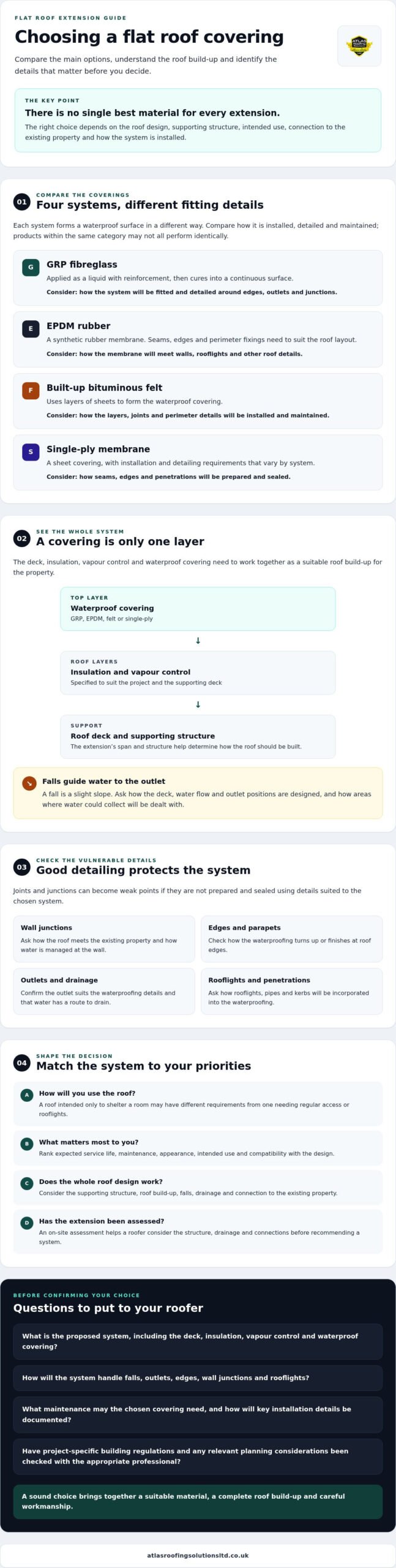
There’s no single winner for every project. The best material for a flat roof extension depends on its design, supporting structure, intended use and connection to the existing property. The covering needs to work as part of a complete roofing system, not just look good on its own.
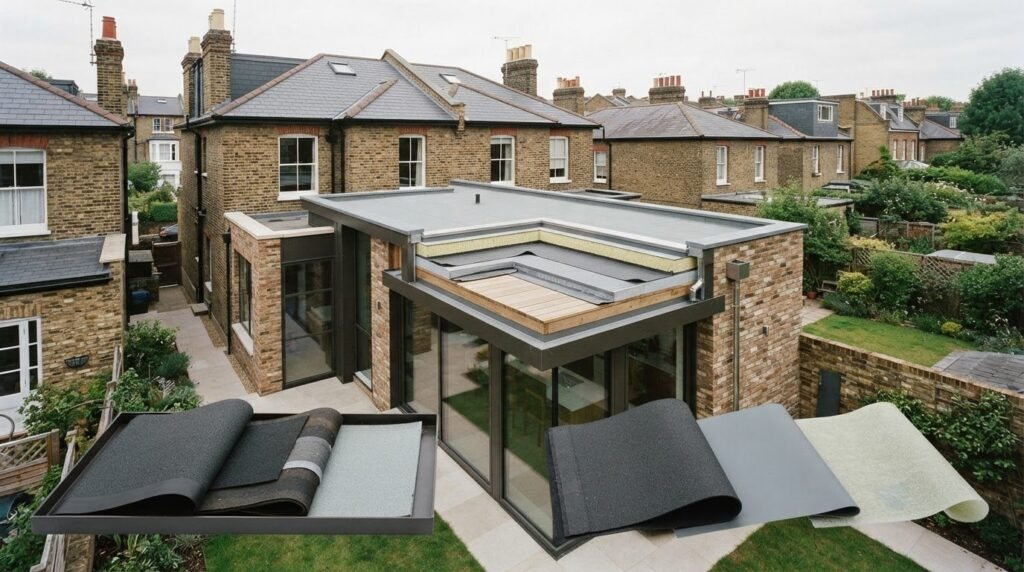
A flat roofing system includes the waterproof covering and the supporting layers beneath it, such as the roof deck and insulation. Construction varies, as the overview of Flat roof systems explains. Falls, the slight slopes that guide rainwater towards outlets, matter too. If water can’t drain properly, even a suitable covering may be put under unnecessary strain.
What makes a flat roof extension different?
The extension’s span and supporting structure help determine what the roof can carry and how it should be built. Its intended use matters as well. A roof designed only to shelter a room may have different requirements from one that needs regular access or must accommodate rooflights.
Pay close attention to the details. Abutments, where the extension roof meets a wall, parapets around the roof edge, rooflights and drainage outlets all need to be incorporated into the waterproofing. The junction with the existing property deserves particular attention. Ask how the proposed system will meet the wall and manage water at the edges, rather than judging the covering in isolation.
Which priorities should shape your material choice?
Start by ranking what matters most: expected service life, maintenance, appearance, intended roof use or compatibility with the design. There may be trade-offs. A material that suits a particular roof shape or finish may have different installation and upkeep needs from another option. The comparison later in this guide can help you prepare questions, but it can’t confirm suitability for your specific roof.
Separate the material’s properties from the quality of the finished work. Performance also depends on sound preparation, suitable supporting layers and careful installation around edges, outlets and junctions. Each system has its own fitting requirements, so ask the roofer to explain how they’ll handle these details and what maintenance the chosen covering may need.
Use this section to understand the main options, not as a final specification. Before choosing, note your priorities and how the new roof should look and function alongside the house. An on-site assessment lets a roofer consider the structure, drainage and connections before recommending a suitable system.
How flat roofing materials work: layers, falls and waterproofing
The visible covering is only one part of a flat roof. Beneath it, the supporting deck, insulation and vapour control layer must work together as a suitable build-up for the property. The exact arrangement depends on the roof design and chosen covering, so a material name alone doesn’t tell you how the finished roof will perform.
What are the main flat roof covering options?
Each covering forms a waterproof surface in a different way. GRP fibreglass is applied as a liquid with reinforcement, then cures into a continuous surface. EPDM is a synthetic rubber membrane, and its seams, edges and perimeter fixings need to suit the roof layout. Built-up bituminous felt uses layers of sheets, while single-ply membranes are sheet coverings. Installation and detailing vary by system, so don’t assume that every product in a material category performs identically.
Joints need particular care. A roof may have seams between sheets, edges at its perimeter, upstands where the covering turns up a wall, and penetrations such as pipes or rooflight kerbs. Each can become a weak point if it isn’t prepared and sealed using details appropriate to that system.
Why do drainage and roof build-up matter?
A roof fall is a slight slope that guides rainwater towards an outlet. The roof doesn’t need to look visibly sloped, but the design should account for the deck, covering, water flow and outlet positions. Ask how water will drain and how the roofer will deal with areas where it could collect. The outlet itself must be compatible with the waterproofing details.
Insulation and vapour control also need to suit the project. The designer or contractor should assess the supporting deck and specify how the layers work together, rather than selecting a covering first and treating the rest as an afterthought. Thermal performance requirements can depend on the work being carried out, so confirm project-specific building regulations with a suitably qualified professional or building control before work starts. If the extension’s roof form may affect planning considerations, consult the official permitted development rights for householders guidance as well.
Good flat roof protection depends on suitable design, sound preparation and careful workmanship. That’s why the best material for flat roof extension projects is only part of the decision. Drainage and junctions need equal attention. If you’re planning work in London, you can arrange a flat roof site visit to discuss the roof’s layout and suitable options.
GRP, EPDM, felt or single-ply: compare flat roof extension materials
Each covering has different installation and detailing needs. The table offers a general comparison, not a guarantee of how a particular product will perform. The full specification, condition of the roof deck, installation quality and ongoing care all affect the finished roof. No one material is best for every extension.
| Material |
Typical installation |
Detailing to discuss |
Maintenance considerations |
| GRP fibreglass |
Liquid-applied with reinforcement to form a cured surface. |
Ask how the installer will prepare the deck and form edges, outlets and junctions. |
Check what routine inspections and care the specified system calls for. |
| EPDM |
A synthetic rubber membrane, fitted as a sheet system. |
Clarify how seams, perimeters, outlets and any penetrations will be sealed. |
Ask how to check the membrane and what repair methods suit the system. |
| Built-up felt |
Layers of bituminous roofing sheets are installed to form the covering. |
Ask how laps, edges and junctions will be completed, and what installation method is specified. |
Confirm what to inspect and how damage should be dealt with. |
| Single-ply |
A sheet membrane is laid and secured using the method specified for that product. |
Ask how joints, upstands, outlets and perimeter fixings will be detailed. |
Maintenance and repair requirements depend on the particular membrane system. |
When might GRP fibreglass suit an extension?
GRP can create a continuous-looking finished surface, which may suit a design where that appearance and its detailing work well together. The installer needs to prepare the deck correctly and follow the system’s requirements, including suitable working conditions. Careful installation helps manage risk, but no covering should be described as guaranteed leak-proof. For background on diagnosing roof problems, see this guide to flat roof repair guidance for London homes. Repair advice doesn’t replace choosing a suitable system for a new extension.
How do EPDM, felt and single-ply differ?
These options differ in sheet format, joints and fitting methods. The specific product matters, as systems within the same category can have different requirements. Ask the contractor to explain the proposed product, how seams and junctions will be finished, and what maintenance and repairs it may need. Compare the answers with your extension’s design and written specification, not with an unsupported “best” ranking.
For the best material for flat roof extension projects, compare complete systems, not just covering names. A clear specification should identify the proposed covering, deck and supporting layers, key junction details, drainage arrangements and expected maintenance. This gives you a practical basis for weighing options and checking what the installation includes.
How to choose a flat roof material for your extension in London
Use a simple process to narrow down the options before requesting quotes. In London, the design may need to account for close neighbouring buildings, restricted access to the property and how rainwater will drain. These site conditions can affect the practical specification, but they don’t make one covering the automatic choice.
What should you check before comparing quotes?
Start with the extension plans and the roof’s intended use. Then ask each contractor to assess the supporting deck, existing junctions, roof falls and outlets. A clear quote should explain the proposed system, preparation, insulation assumptions and important details. Compare like for like: a material name alone doesn’t show whether two quotes include the same roof build-up or work.
What questions should you ask a flat roofer?
Ask about their experience installing the specified system and how they’ll check the completed work. Request the workmanship guarantee terms in writing, including what it covers and any conditions. If your project includes broader roofing work, this new roof installation guide may help you understand the wider considerations.
Work through these steps with your designer and roofer:
- Set the design: Confirm the extension’s shape, span, rooflights and how the new roof will meet the existing property.
- Define its use: Decide whether the roof is purely protective or whether access, appearance or other planned uses will shape the design.
- Review the site: Discuss access for materials and installation, nearby buildings, the roof deck, junctions and drainage arrangements.
- Check project requirements: Ask the project team which planning and building-control requirements apply, including thermal performance. Confirm the current position using relevant official guidance rather than relying on assumptions.
- Get the specification in writing: Have the proposed covering, supporting layers, preparation, drainage details, installation approach and maintenance expectations set out clearly.
This gives you a fair basis for comparing options and asking follow-up questions. The best material for flat roof extension projects is the one that suits the design and can be installed as a complete, clearly specified system. If you’re planning an extension in London, arrange a site visit to discuss your flat roof and the options that may suit it.
Choose a suitable flat roof system and plan the next steps
The right choice depends on the whole project: extension design, supporting deck, drainage, junction details, likely maintenance and installation quality. An experienced roofer should inspect the roof and its connection to the existing property before confirming which system is suitable. That assessment turns a general material comparison into a practical plan for your extension.
What should a clear roofing proposal include?
Ask for the proposed roofing system and scope of work in writing. A useful proposal should make clear what preparation is included, which layers and covering are specified, and how key details such as edges, outlets and wall junctions will be handled. It should also identify any assumptions about the deck or insulation, so you can clarify them before work begins.
Check what’s excluded, what maintenance the chosen system may need and which guarantee terms apply. Request the terms in writing rather than relying on a verbal summary. Keep the specification, agreed scope and completion information with your project records. They’ll help you understand what was installed and provide a useful reference for future maintenance or repairs.
How can Atlas Roofing Solutions Ltd help?
Atlas Roofing Solutions Ltd is a family-owned roofing business serving London, with more than 20 years of experience. Its services include flat roofing and fibreglass roofing. Fibreglass may be one option to discuss, but it isn’t automatically the right choice for every extension. The roof’s design and site conditions should guide the recommendation.
Before choosing, make sure you understand why the proposed system suits your roof and what the installation includes. If you’re a London homeowner planning an extension, Atlas Roofing Solutions Ltd offers a free site visit and a no-obligation quote to discuss the project. Ask for the proposed scope and relevant guarantee terms so you can review them clearly.
Arrange a free site visit and no-obligation quote.
Make your next step a roof assessment
The best material for flat roof extension projects depends on how the roof is designed, supported and drained. GRP fibreglass, EPDM, felt and single-ply each have different installation and detailing needs, so compare complete systems rather than choosing by material name alone. A clear written specification helps you understand what’s proposed, how key junctions will be handled and what maintenance to expect.
An on-site assessment is a sensible next step. It gives a roofer the chance to consider the extension and its connection to your home before recommending a suitable option. Atlas Roofing Solutions Ltd is a family-owned London roofing business with more than 20 years of experience, including flat roofing and fibreglass work. If you discuss its 15-year workmanship guarantee, ask for the applicable terms and scope in writing.
For a free site visit and no-obligation quote, arrange a roof assessment with Atlas Roofing Solutions Ltd. With the design and details properly considered, you can move forward with greater confidence and a roof plan suited to your extension.
Frequently Asked Questions
Is GRP fibreglass the best material for a flat roof extension?
Not automatically. GRP fibreglass can create a continuous-looking surface, but it needs suitable preparation, installation conditions and detailing around edges, outlets and roof junctions. The best material for flat roof extension projects depends on the roof design, supporting deck, drainage and the homeowner’s priorities. Ask a roofer to assess the extension and explain why the proposed system suits it, rather than choosing GRP on appearance alone.
Can EPDM be used on a flat roof extension?
Yes, EPDM is a synthetic rubber membrane used on flat roofs, including extensions. Suitability depends on the roof’s size and shape, the supporting deck and the system’s installation requirements. Ask how the contractor will form and seal seams, edges, outlets and any penetrations, as these details are essential to the finished covering. Request the product and installation method in writing, along with the maintenance and repair guidance for that specific system.
Which is better for an extension roof: felt or fibreglass?
Neither is automatically better for every extension. Felt is installed in layers, while fibreglass is applied with reinforcement to form a cured surface. Their preparation, fitting methods and detailing differ, so compare the full specification rather than just the material names. Ask how the proposed system suits your roof deck and design, how junctions and drainage will be finished, and what maintenance it may need over time.
How long should a flat roof extension last?
There’s no single lifespan for every flat roof. As broad UK estimates, torch-on felt is often quoted at around 15 to 20 years, GRP fibreglass at 25 to 40 years, and EPDM at 30 to 50 years. These aren’t guarantees: the specific system, installation quality, roof design, drainage and ongoing care all affect service life. Ask your roofer what evidence supports the expected lifespan for the system they propose.
What should I check before choosing a flat roof material?
Check the extension’s intended use, roof design, supporting deck, drainage, insulation requirements and how the covering will meet the existing property. Compare the installation and maintenance needs of each proposed system, including details at edges, outlets and rooflights. Ask contractors for written, like-for-like specifications that explain preparation, included work and exclusions. For a London project, also discuss site access and neighbouring buildings if they affect delivery or installation.
Does a flat roof extension need building regulations approval?
A new extension generally needs to comply with Building Regulations, whether or not planning permission is required. Permitted development relates to planning and doesn’t remove the need to consider building requirements. The approval route and requirements depend on the project and location, so confirm them with your project team and the relevant London building control service before work begins. Ask specifically how the roof design will address structure, drainage, insulation and fire performance.
Can a new flat roof be installed over an existing roof covering?
Sometimes, but it shouldn’t be assumed suitable without an inspection. The roofer needs to check the existing covering, deck and supporting structure for damage, moisture, uneven areas and any added load or build-up concerns. Covering over a defect can leave the underlying problem unresolved. Ask the contractor to explain whether removal or an overlay is proposed, why it suits the roof, and how the new system will handle edges, outlets and junctions.