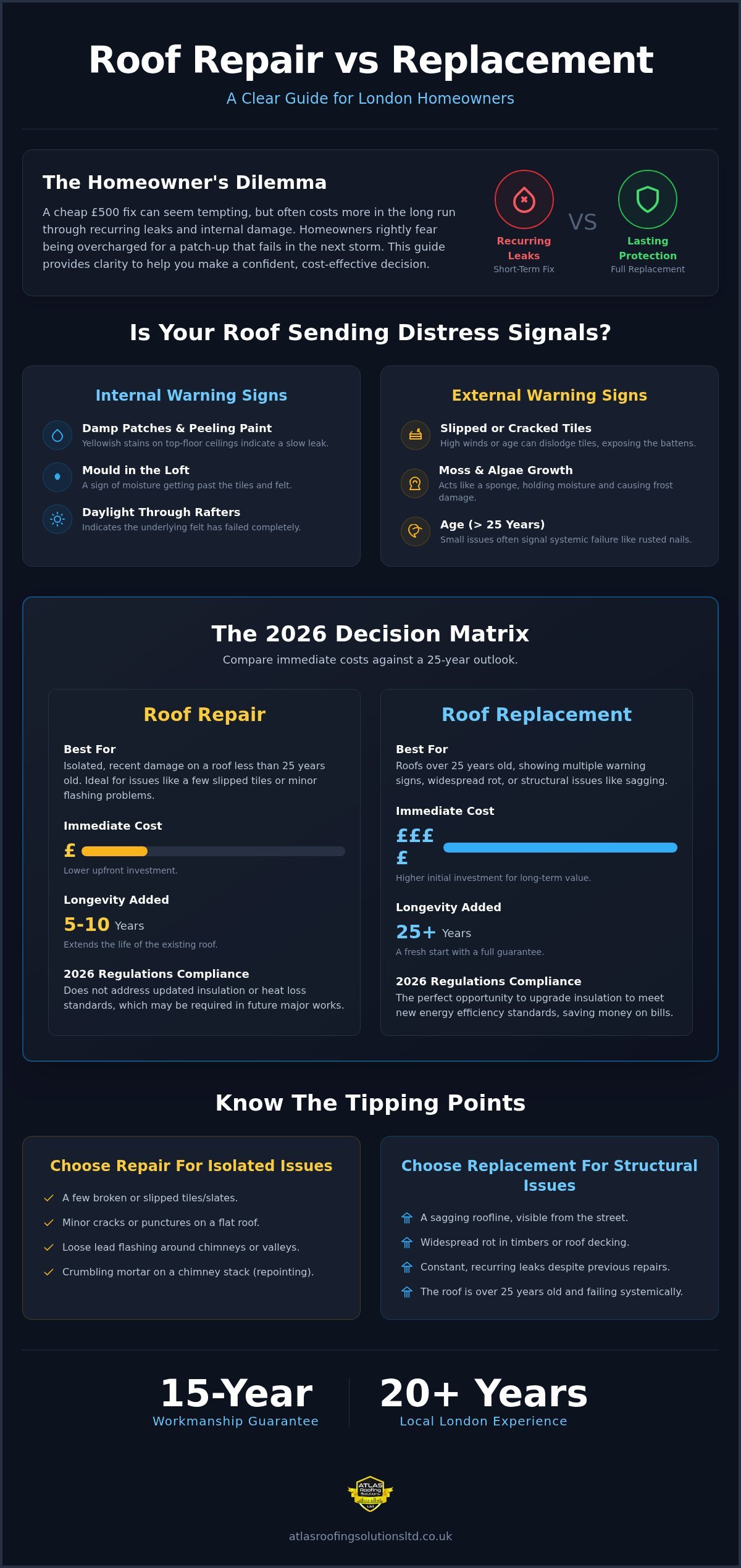
Spending £500 on a quick fix might actually be more expensive than investing in a full replacement when you consider the cost of recurring leaks and internal damage. It is frustrating to receive conflicting advice from different contractors; you just want to know if your home is truly protected. Most homeowners fear being overcharged by “cowboy” roofers or paying for a patch-up that fails the moment the next London storm hits.
This guide settles the roof repair vs replacement debate by providing a clear comparison of costs, longevity, and structural warning signs. We will help you understand when a repair is sufficient and when the health of your roofline suggests it is time to start fresh. You will also discover how the 2026 building regulations regarding insulation and heat loss impact your decision. We provide the clarity you need to find a reliable local expert who offers a solid guarantee. By the end, you will have the confidence to choose a path that ensures your home remains safe and dry for decades to come.
Key Takeaways
- Learn to spot the difference between minor surface issues like slipped slates and critical internal warning signs such as damp patches or mould in the loft.
- Discover the specific scenarios where isolated fixes are the most cost-effective choice to protect your home without the expense of a full overhaul.
- Use our expert 2026 decision matrix to settle the roof repair vs replacement debate by comparing immediate costs against a 25-year longevity outlook.
- Identify the structural tipping points, such as sagging rooflines or widespread rot, that indicate a patch-up will no longer provide adequate protection.
- Understand how a 15-year workmanship guarantee and two decades of local experience can eliminate the anxiety of recurring leaks and unreliable contractors.
Signs of Damage: Assessing Your London Roof Condition in 2026
London roofs face a unique set of challenges. Between the heavy, driving rain and the gusty winds that funnel through our urban streets, your home’s first line of defence takes a constant beating. Before you get caught in the roof repair vs replacement debate, you need a clear-eyed assessment of the current damage. It’s about looking past the surface to see what is happening underneath.
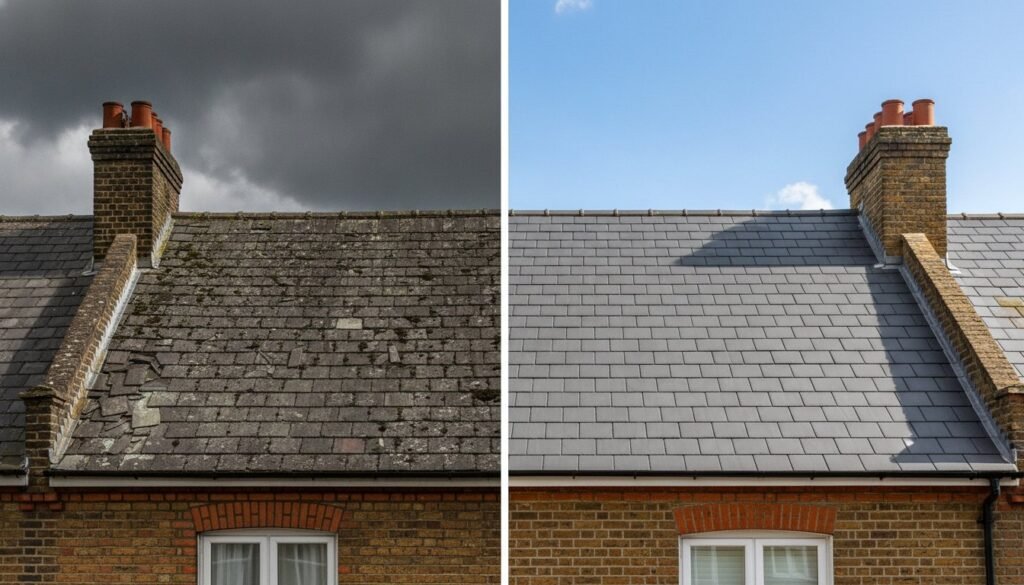
Start your inspection inside. Check your top-floor ceilings for yellowish damp patches or peeling paint. These are classic signs of a slow leak. Head into the loft with a torch during a rainstorm. If you spot mould on the timber or “daylight” peeking through the rafters, the underlying felt has likely reached its limit. Externally, look for slipped slates or cracked tiles. Moss growth might look charming on a postcard, but it acts like a sponge. It holds moisture against your roof tiles, which leads to frost damage and rot. This comprehensive overview of roofing construction shows how these layers should ideally work together to shed water.
Age is your most reliable metric. If your roof was installed over 25 years ago, these small issues often signal a systemic failure. A few missing tiles on a five-year-old roof is a simple fix. The same damage on a thirty-year-old structure usually means the nails have rusted through. At that point, patching up one area just shifts the pressure to another weak spot. It becomes a game of “whack-a-mole” that costs more in the long run.
The Role of the Roofline: Guttering and Fascias
Don’t ignore the edges of your home. Sometimes, what looks like a major roof failure is actually a problem with your guttering. Blocked or misaligned gutters cause water to back up and seep under the eaves. You should also check your uPVC fascias and soffits for signs of detachment or rot. These components protect the ends of your roof rafters. If the roofline is compromised, water can bypass your tiles entirely and rot the main structure from the side. Maintaining these elements can often buy you several more years of life for the main roof.
Chimney Stacks and Urban Pollution
London’s history is built into its chimneys, but they are often the weakest link in our terraced housing. Urban soot and pollution are naturally acidic. Over decades, they eat away at traditional mortar. If you see crumbling joints or vegetation growing from the stack, you likely need chimney repointing. A leaning or unstable chimney stack is a serious safety hazard. It also allows water to run down the internal breast, creating damp patches that many homeowners mistake for a failing roof. Addressing the stack early prevents expensive internal renovations later.
The Case for Roof Repair: When a Fix is the Right Choice
Not every leak signals the end of your roof’s life. In many cases, a targeted repair is the most sensible and honest way forward. When the underlying structure remains sound, choosing a professional fix can save you thousands of pounds in the short term whilst effectively sealing your home against the elements. In the ongoing debate of roof repair vs replacement, the repair option is often the hero for homeowners dealing with isolated issues rather than systemic decay.
A well-executed repair can easily add another 5 to 10 years to your roof’s lifespan. This is particularly true for London’s period properties, where the original materials are often high-quality but simply need some focused attention. Effective moisture control in roofing relies on a continuous barrier. If that barrier is only broken in one or two spots, there is no need to tear everything down. We always aim to use matching materials, whether it is reclaimed Welsh slate or specific clay tiles, to ensure the repair is invisible and the character of your home is preserved.
Common Repair Scenarios for London Homes
- Broken or Slipped Tiles: High winds can dislodge even the sturdiest slates. Replacing these promptly prevents water from reaching the timber battens.
- Flat Roof Patches: Minor cracks in older felt or small punctures in a fiberglass roof can often be sealed using modern high-performance compounds.
- Lead Flashings: The lead around your chimney or in roof valleys can sometimes pull away. Re-dressing or replacing small sections of lead is a standard, effective fix.
- Chimney Repointing: As we mentioned previously, crumbling mortar can be addressed with targeted repointing to stop water ingress before it affects the main roof structure.
The Limitations of Patchwork Repairs
There is a tipping point where patching up becomes a poor investment. If you find yourself calling a roofer every time it rains, you are likely dealing with systemic failure rather than isolated damage. We follow a simple, “straight-talking” 20% rule: if the cost of the required repairs exceeds 20% of the price of a full replacement, it is usually more economical to start fresh. Repeatedly paying for small fixes on a roof that has reached its age limit is like trying to hold back the tide with a bucket. It’s better to invest that money into a long-term solution. If you’re unsure where your roof sits on this scale, you can always request a site visit to get a clear, professional assessment of the damage.
The Case for Roof Replacement: When to Start Fresh
Sometimes, the most transparent advice we can give a London homeowner is that their roof has simply done its job for long enough. Whilst we always look for a way to save an existing structure, there comes a point where the roof repair vs replacement calculation shifts firmly toward a fresh start. Most traditional tile or slate roofs in the capital have a natural lifespan of 25 to 30 years. Once you hit this milestone, the underlying components like the felt and timber battens often begin to perish simultaneously. It isn’t just about the tiles. It is about the entire system failing at once.
Investing in a new roof installation isn’t just a maintenance cost. It is a significant upgrade to your property’s value. In the competitive London housing market, a certified new roof with a long-term guarantee is a powerful selling point. It offers buyers immediate peace of mind and proves the home has been maintained with care. When you consider the rising costs of emergency call-outs and internal damp repairs, a full replacement often provides a much better return on investment over a five-year period.
Identifying Irreversible Structural Failure
Identifying the moment of structural failure is critical for your safety. If you notice a visible dip or “sagging” in the roofline, the timber rafters may have been weakened by long-term dampness or rot. This is often caused by a failure in the underlay, which serves as your secondary waterproof layer. When this fails, water ingress becomes widespread rather than isolated. If you are dealing with multiple leaks in different rooms, a patch-up is no longer a viable solution. For a deeper dive into these warning signs, read our guide on 5 signs your roof needs replacing. Even for older properties, this NPS Preservation Brief on Historic Roofing highlights that whilst preservation is key, replacing a failed system is often necessary to protect the building’s core.
Modern Roofing Standards and Insulation
A modern replacement offers benefits that a simple repair never can. Since March 2026, building regulations (Approved Document L) have set much stricter limits on heat loss. New maximum U-values for roofs are now set at 0.16 W/m²K. A full re-roof allows us to install high-performance insulation that slashes your energy bills and meets these mandatory efficiency standards. For flat roof areas, we often recommend transitioning to a fiberglass roof (GRP). Unlike traditional felt, GRP is a seamless, incredibly durable material that can easily last 30 years. It is a hassle-free solution that brings your home into the modern era whilst providing total security against the unpredictable British weather.
Roof Repair vs Replacement: A 2026 Decision Matrix
Deciding between roof repair vs replacement is often a choice between a short-term fix and a long-term investment. Whilst a repair addresses immediate leaks, it doesn’t reset the clock on your roof’s overall lifespan. A major repair might buy you another five years of protection, but a full replacement provides a fresh start for 25 years or more. You need to weigh the upfront cost against the reality of recurring maintenance bills. If your roof is already approaching the 25-year mark, the financial logic usually shifts toward starting fresh.
Project disruption is another factor to consider. Most repairs are completed within a day or two with minimal fuss. A full replacement is a larger undertaking that requires scaffolding and usually takes between one and two weeks depending on the size of your London home. However, the peace of mind that comes from knowing your home is structurally sound is often worth the temporary inconvenience. For a clear look at current market rates and what to expect, you can read our guide on how much a new roof costs in the UK.
Calculating the Real Return on Investment
A new roof installation offers financial benefits that go beyond simple leak prevention. Many home insurance providers offer lower premiums for properties with modern, certified roofing systems because the risk of internal water damage is significantly reduced. You can also save money by upgrading your uPVC fascias and soffits at the same time. Since labour accounts for 40-60% of the total cost of a project, it is much more efficient to handle these “roofline” elements whilst the scaffolding is already in place. This “do it once, do it right” approach prevents you from paying for separate access and labour costs a few years down the line.
Questions to Ask Your Roofing Contractor
Finding a reliable partner is essential to avoid the stress of “cowboy” roofers. Before you sign any contract, ask these direct questions:
- Is the quote all-inclusive? Ensure the price covers scaffolding, waste removal, and all materials to avoid hidden “extras” later.
- What is the guarantee? A reputable local authority should offer a solid guarantee. We provide a 15-year workmanship guarantee for total peace of mind.
- What is your local experience? Ask how long they have operated in London. With 20+ years of experience, we understand the specific challenges of the city’s terrace and period properties.
If you are still feeling unsure about the best path forward, you can request a no-obligation quote to get a transparent assessment of your roof’s condition.
Why Atlas Roofing Solutions is London’s Trusted Choice
Choosing between roof repair vs replacement is a significant decision that impacts both your home’s safety and your long-term finances. At Atlas Roofing Solutions, we take that responsibility seriously. We have spent over two decades building a reputation as a seasoned local authority across the London residential and commercial market. As a family-owned and operated business, we value our reputation in the community over quick wins. We don’t use high-pressure sales tactics. Instead, we provide the straight-talking, honest advice you need to make a choice that is right for your specific property.
Our team brings specialist expertise to every project we undertake. Whether you require intricate chimney repairs on a period terrace or a modern, high-performance fiberglass roof for an extension, we handle the task with precision. We take immense pride in our workmanship. This isn’t just a claim; it is a commitment backed by our 15-year workmanship guarantee. This level of accountability provides the long-term security you deserve. It ensures you won’t be left worrying about recurring leaks or the fallout from poor-quality “cowboy” repairs.
Our Transparent Process for London Homeowners
We believe in being an open book from the moment you first contact us. Every project begins with a free site visit to provide a thorough and honest assessment of your roof’s condition. We look at the health of the entire system, from the tiles down to the uPVC fascias and soffits. If a repair is the most sensible and cost-effective path, we will tell you. If a full replacement is necessary to meet 2026 building regulations and ensure your home’s thermal performance, we will explain exactly why. We use only high-quality materials designed for resilience against the unpredictable London weather. Our dedicated team treats your home with the same respect and care we would show our own, ensuring the entire experience is hassle-free.
Get Your Professional Roofing Assessment
Don’t let a small leak develop into a major structural headache. Finding a reliable partner is the first step toward a secure, dry home. Whether you need emergency repairs to address recent storm damage or you are ready to discuss a full new roof installation, our experts are ready to assist. Our process is simple, methodical, and designed to put you at ease. We provide clear, no-obligation quotes so you can move forward with total confidence in your investment.
Take the guesswork out of your home maintenance. Book your free London roof survey with Atlas Roofing Solutions today. Let our experienced team provide the clarity and protection your home needs.
Protect Your Home with a Professional Assessment
Navigating the roof repair vs replacement choice doesn’t have to be a source of anxiety. By focusing on the age of your structure and the 20% cost rule we’ve discussed, you can make a logical decision that protects your property and your wallet. Whether you need a simple tile fix or a complete transition to a modern fiberglass roof, the goal is always long-term security and a “hassle-free” experience. A modern roof does more than stop leaks; it improves your home’s energy efficiency and ensures you meet the latest 2026 building standards.
Our family-run team brings over 20 years of London roofing experience to every site visit. We pride ourselves on transparency and provide a 15-year workmanship guarantee to ensure you feel confident in your chosen path. You don’t have to guess about the health of your roofline or the stability of your chimney stacks when expert advice is just a click away.
Contact Atlas Roofing Solutions for a Free London Roof Assessment and let a trusted local authority help you secure your home. We look forward to helping you keep your property safe, dry, and energy-efficient for decades to come.
Frequently Asked Questions
Is it better to repair or replace a roof if it has a small leak?
A small leak is often a candidate for a simple repair if the damage is isolated and the rest of the structure is sound. However, if your roof is nearing its 30th year, that leak could be the first sign of a failing underlay or perishing battens. We provide an honest assessment to help you settle the roof repair vs replacement debate based on your home’s age and condition.
How long does a typical roof repair take compared to a full replacement?
Most roof repairs are completed within a single day or two with minimal disruption to your home life. In contrast, a full roof replacement is a more involved project that typically takes between one and two weeks. This timeline accounts for scaffolding setup, careful removal of old materials, and the installation of new insulation and tiles to meet current 2026 building standards.
Will a new roof installation increase the value of my London home?
Yes, a professionally installed new roof is a significant asset that can increase your property’s marketability and overall value. In London’s competitive housing market, buyers appreciate the security of a 15-year guarantee and the improved energy efficiency of modern materials. It eliminates the immediate fear of maintenance costs, making your home a much more attractive prospect for potential purchasers.
Do I need planning permission for a roof replacement in London?
You generally don’t need planning permission for a standard roof replacement because it falls under Permitted Development rules. However, restrictions are much stricter if you live in a conservation area or a listed building. You must also seek permission if you plan to change the roof’s height or shape significantly. We always recommend checking with your local London borough council before starting major works.
Can I just replace the damaged tiles instead of the whole roof?
Replacing individual damaged tiles is a standard and effective repair for isolated issues like storm damage. It is a cost-effective way to maintain water tightness without the expense of a full overhaul. This approach works best when the surrounding tiles and the underlying felt are still in good condition. If the tiles have become brittle due to age, replacing just a few may not be sufficient.
How much does a professional roof survey cost in London?
At Atlas Roofing Solutions, we provide free site visits and no-obligation quotes to give you a transparent assessment of your roof’s condition. While some independent surveyors may charge a fee for a formal written report, we focus on providing practical advice and clear pricing for the work required. This allows you to make an informed decision about your home without any upfront financial commitment.
What is the average lifespan of a slate roof vs a tile roof in the UK?
Natural slate roofs are incredibly durable and can last between 60 and 100 years with proper maintenance. Traditional clay or concrete tile roofs typically have a lifespan of 30 to 50 years before the materials begin to degrade. The choice often depends on the architectural style of your home and your budget. Both options provide excellent protection when installed correctly by experienced professionals.
Are fiberglass roofs better than traditional felt for flat roof repairs?
Fiberglass (GRP) roofing is generally superior to traditional felt because it is a seamless, cold-applied system that eliminates the risk of leaks at the joints. Whilst felt is a cost-effective option for short-term fixes, a fiberglass roof can last 30 years or more with virtually no maintenance. It is a tough, durable solution that is particularly well-suited to the variable and often heavy London rainfall.