Your roofline is the only thing standing between a dry, secure home and a rotting structural nightmare. It’s easy to ignore the boards tucked under your gutters, but these components do the heavy lifting in protecting your rafters from the unpredictable British weather. You likely already feel that a small leak can lead to a massive bill; yet it is often difficult to tell if a bit of peeling paint is just an eyesore or a genuine emergency.
In this guide, you will learn the specific signs you need new soffits and fascias to prevent expensive damp and timber decay before they take hold. We understand the anxiety that comes with hidden home repairs. It is why we have simplified the jargon around bargeboards and rooflines to give you total clarity. We will walk you through seven critical warning signs, from bubbling paint to uninvited pests, so you can decide with confidence whether to repair or replace. By the end, you will know exactly how to protect your London home and find a reliable local expert to secure your property for the long term.
Key Takeaways
- Identify the seven critical signs you need new soffits and fascias, from peeling paint to soft spots, before they lead to structural timber rot.
- Learn how failing rooflines provide entry points for pests like squirrels and birds, which can cause significant damage to your attic insulation and wiring.
- Understand the difference between capping and full replacement, and why covering up rot with uPVC is a short-term fix that leads to bigger problems.
- Discover the importance of inspecting rafter feet during installation to ensure your home remains dry and secure for decades.
- Gain the peace of mind that comes with a 15-year workmanship guarantee by choosing a professional, local London installer.
Understanding the Critical Role of Your Roofline
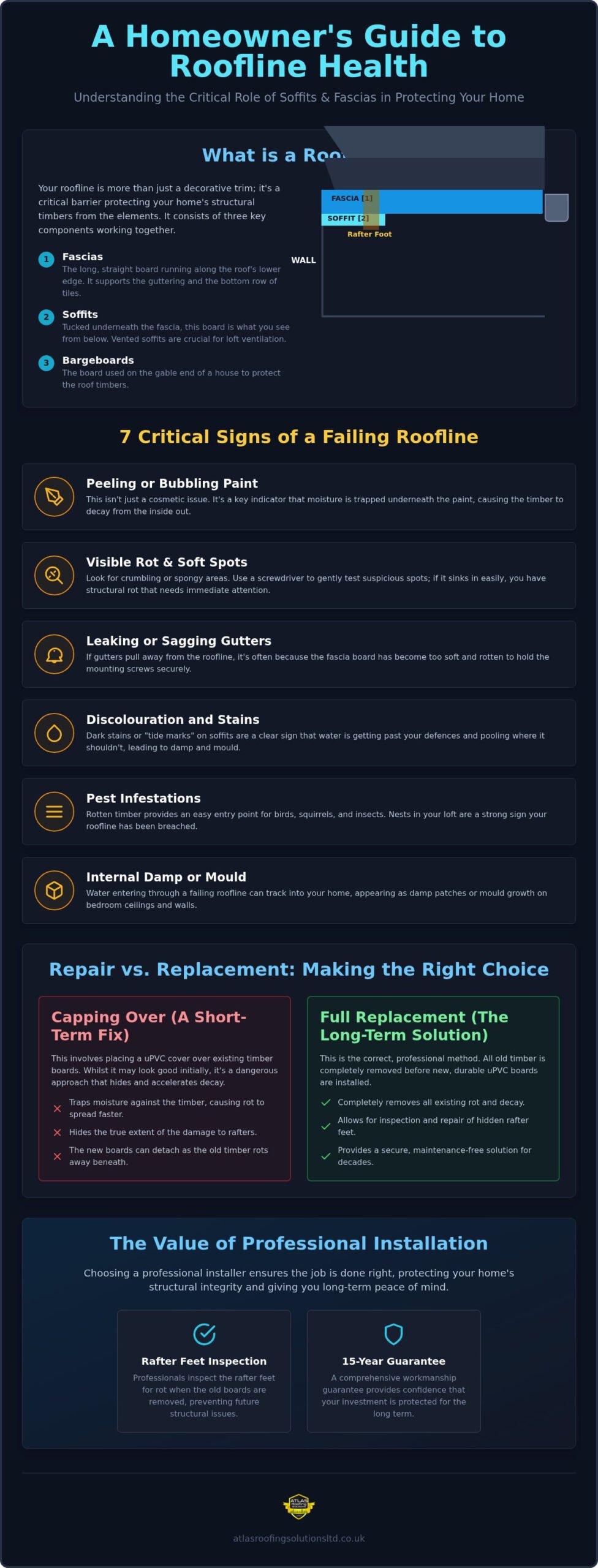
Many homeowners view their roofline as a purely decorative finish. In reality, your fascias and soffits are the primary defenders of your home’s structural integrity. The fascias are the long, straight boards that run along the lower edge of your roof, acting as the mounting point for your guttering. Tucked beneath them are the soffits. This architectural feature is what you see when looking up from the ground. Together, they create a sealed barrier that prevents rain, wind, and pests from reaching your roof timbers.
Beyond protection, your roofline serves a vital function: it allows your house to breathe. Modern soffits often include built-in vents. These vents facilitate a constant flow of air into the loft space, which is essential for whisking away moisture. Without this airflow, condensation builds up on the underside of your roof tiles, eventually leading to timber decay. Recognising the signs you need new soffits and fascias early is the best way to avoid these hidden complications.
Why Timber Rooflines Eventually Fail
Traditional timber boards are beautiful but vulnerable. The British weather puts wood through a brutal cycle of soaking and drying. Over time, even the best-maintained timber begins to absorb moisture. This leads to “wet rot,” a condition where the wood becomes spongy and loses its strength. Many people try to fix this with a fresh coat of gloss. However, paint often only masks the internal decay whilst trapping moisture inside the wood, accelerating the rot from within.
The Consequences of Ignoring Roofline Damage
Ignoring a failing roofline is a gamble with your home’s structure. When fascias fail, water often tracks back along the rafter feet. These are the ends of the main beams supporting your roof. If these rot, the repair costs move from hundreds into thousands of pounds. There are also several other knock-on effects:
- Internal Damp: Water ingress through the eaves often presents as damp patches on bedroom ceilings or mould growth in the corners of walls.
- Increased Energy Bills: Damaged boards can create drafts and allow heat to escape from your loft, making your home harder to keep warm in winter.
- Structural Risk: Weakened boards may eventually fail to support the weight of your gutters, especially during heavy downpours or snow.
Watching for the early signs you need new soffits and fascias ensures you can address these issues before they impact your living space or your bank balance. Taking action now protects the long-term security of your property.
5 Visible Signs You Need New Soffits and Fascias
Spotting the early signs you need new soffits and fascias is often a matter of knowing where to look. You don’t always need a ladder to notice the most obvious red flags. A simple walk around your garden on a bright day can reveal whether your roofline is still protecting your home or if it has started to fail. These are the five most common signs you need new soffits and fascias that every homeowner should watch for:
- Peeling or Bubbling Paint: On timber boards, this is more than just an eyesore. It indicates that moisture is trapped beneath the surface, which eventually leads to internal decay.
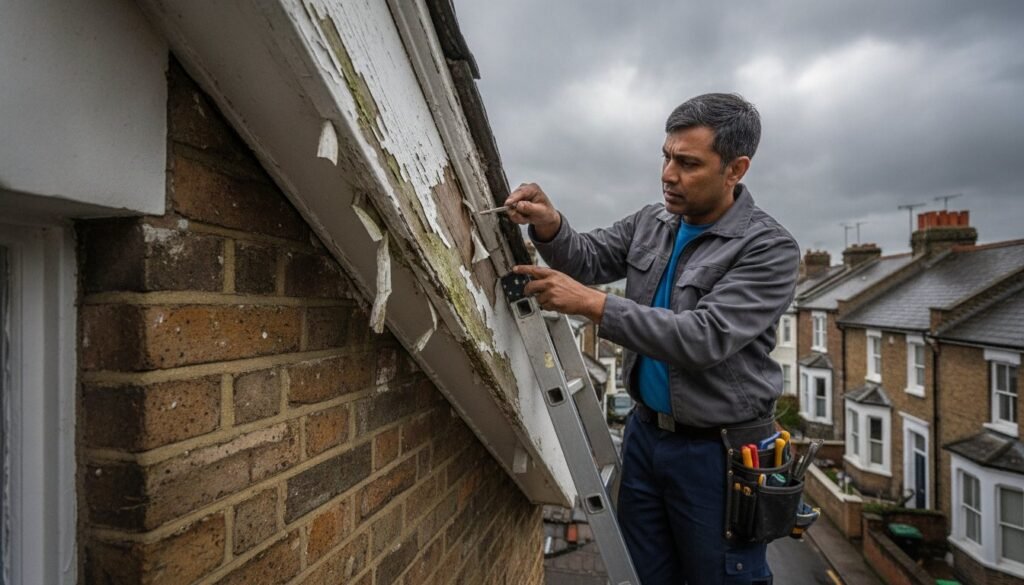
- Visible Rot: Look for “soft spots” or areas where the wood appears to be crumbling or disintegrating. This is a clear indicator that the timber’s structural integrity is gone.
- Leaking or Sagging Gutters: If your gutters have pulled away from the house, the fascia boards behind them are likely too soft to hold the mounting screws securely.
- Discolouration and Tide Marks: Dark stains on the underside of your soffits suggest that water is penetrating the roofline and pooling where it shouldn’t.
- Bowed or Warped Boards: Boards that no longer sit flush against the wall have likely been compromised by heat or moisture, breaking the protective seal of your eaves.
Identifying Timber Rot and Decay
Timber rot is a progressive issue that won’t go away with a fresh coat of gloss. You can perform a simple “screwdriver test” to check the health of your boards. Carefully press a flat-head screwdriver against any area that looks suspicious. If the tool sinks easily into the wood, you have deep structural rot. Surface mould can often be cleaned, but rot means the fibres of the wood have broken down. We often see homeowners try to patch these areas with wood filler. This is a temporary and risky fix; it merely hides the problem whilst the decay continues to spread to your rafters. For a long-term solution, a professional site visit is always the safest route.
Guttering Issues Linked to Fascia Failure
London rain is relentless and puts immense pressure on your roofline. During a heavy downpour, your gutters carry a significant weight of water. If your fascia boards are healthy, they support this weight easily. However, if the timber is decaying, the brackets will loosen. This causes the gutters to sag or tilt. When this happens, water overflows and pours directly down your external walls, leading to damp. Often, what looks like a simple case of leaking gutter repair London is actually a symptom of total fascia failure. Even if your original installation followed strict building codes, time and pollution in the city will eventually take their toll on traditional materials.
The Hidden Dangers: Pest Infestation and Attic Damp
While peeling paint is a visual nuisance, the most serious signs you need new soffits and fascias often hide within your roof void. When your roofline components begin to rot or warp, they create small openings. These gaps may seem insignificant, but they are large enough for nature to take hold. A failing roofline isn’t just an aesthetic issue. It is a breach in your home’s security.
Birds and squirrels are opportunistic. They search for warm, dry places to nest during the colder months. A soft spot in a timber fascia is easily chewed through by a determined squirrel. Once inside, they can wreak havoc. In the summer, failing eaves become prime real estate for wasps and bees. Then there is the issue of moisture. If you notice a musty smell on your landing or in the bedrooms, it often indicates that the ventilation in your roof is failing. Blocked or sagging soffits prevent the necessary airflow that keeps your loft dry.
Unwanted Guests in Your Roof Space
Listen for scratching or scurrying noises above your ceiling, especially at dawn or dusk. You might also see nesting debris like twigs or straw poking out from the eaves. These uninvited guests don’t just make a mess. They often chew through electrical wiring and flatten your insulation, which significantly reduces your home’s thermal efficiency. Upgrading to uPVC fascias and soffits creates a seamless, durable barrier. It is a simple way to pest-proof your home for decades. Peace of mind. Long-term security.
Condensation and Mould Growth
Your roof needs constant airflow to stay healthy. Many experts suggest following a regular University of Georgia Extension home maintenance checklist to ensure your eaves and soffits remain clear of obstructions. When soffit vents are blocked by debris or failing timber, warm air from your home hits the cold roof tiles and turns into water. This leads to “black mould” on your attic timbers. It spreads quickly. If left unaddressed, the signs you need new soffits and fascias you ignored can turn into a full roof replacement. Dealing with the roofline now is a fraction of that cost. It is a smart, preventative measure for any London homeowner.
Repair vs. Replacement: Making the Right Decision
Deciding whether to patch up your roofline or invest in a total overhaul is a significant choice for any homeowner. If you have noticed the signs you need new soffits and fascias, the next step is determining the extent of the damage. A small, isolated crack from a one-off impact might only require a localised repair. However, if you are seeing widespread soft spots or multiple areas of peeling paint, the decay is almost certainly systemic. Patching rot is like putting a plaster on a sinking ship; it won’t stop the inevitable.
The most critical part of this assessment happens behind the boards. When we remove the old materials, we conduct a thorough inspection of the rafter feet. These are the ends of the main structural beams of your roof. If the signs you need new soffits and fascias were caught early, these timbers should be dry and solid. If the rot has spread from the boards to the beams, these rafters must be repaired or treated before any new boards are fitted. This ensures your home remains structurally sound for decades to come.
The Problem with Capping Over Old Fascias
Capping is a common “shortcut” where a thin uPVC board is simply nailed over the existing timber. While it looks clean from the ground, it is a recipe for disaster. This method effectively “sweats” the existing rot by trapping moisture between the old wood and the new plastic. Without airflow, the timber decays at an accelerated rate, eventually affecting your roof’s main rafters. At Atlas Roofing Solutions Ltd, we don’t believe in masking problems. We provide a full replacement service to ensure your home is protected for the long term. No shortcuts. No hidden rot.
Choosing Materials: Why uPVC Wins in 2026
In 2026, uPVC has become the standard for high-quality rooflines, and for good reason. Unlike traditional timber, uPVC is entirely weather-resistant. It won’t warp, crack, or rot, regardless of how much rain falls on your London property. The greatest benefit for most homeowners is the lack of maintenance. You can say goodbye to the days of climbing ladders to sand and paint every few years. Modern uPVC also comes in a vast array of colours and styles, allowing you to maintain the character of a period home or add a sleek finish to a modern build.
Choosing a full replacement isn’t just about aesthetics; it’s about security. Because we believe in the durability of our materials and our methods, we provide a 15-year workmanship guarantee on all our installations. If you’re unsure about the state of your roofline, book a free site visit with our expert team today for a transparent, honest assessment of your home.
Professional Installation: Protecting Your London Home
Once you’ve identified the signs you need new soffits and fascias, the quality of the installation becomes the most important factor in your home’s protection. A DIY approach or a “quick fix” from an unvetted builder often leaves hidden problems unaddressed. At Atlas Roofing Solutions Ltd, we bring over 20 years of local London experience to every project. We’re a family-run business that values reputation over quick wins. This means we don’t just swap boards; we secure your roofline for the next generation. Our team understands the specific challenges London properties face, from urban pollution to the relentless driving rain of a British winter.
Professional installation is the only way to ensure your 15-year workmanship guarantee remains valid. We take full accountability for every nail and seal. This level of security is something a temporary repair simply cannot offer. We believe in doing the job right the first time. It is a philosophy that has made us a dependable partner for homeowners across the city for two decades. We aim for a “hassle-free” experience from the moment you call us to the final site tidy-up. Simple. Reliable. Effective.
What to Expect During Your Roofline Upgrade
Our process is methodical, linear, and transparent. We begin by removing all existing timber boards. We never cap over old rot because we know it leads to structural failure. Once the eaves are clear, we perform a vital check of the rafter feet. These beams are the backbone of your roof. If we find any decay, we treat or repair it before the new uPVC is fitted. We also ensure your guttering has the correct “fall.” This means the water flows efficiently toward the downpipes rather than pooling in the middle. You can learn more about expert roof repairs London to see how we handle these critical structural issues with care and precision.
Securing Your Peace of Mind
We want you to feel confident in your decision. It starts with a free site visit. We’ll inspect your roofline and provide a transparent, no-obligation quote with no hidden costs. Our “straight-talking” approach means you get honest advice on whether you truly need a full replacement or if a repair will suffice. Because we use high-quality uPVC that doesn’t rot, warp, or crack, we’re proud to offer a 15-year guarantee on our workmanship. This isn’t just a piece of paper; it’s our promise of long-term security for your home. Don’t wait for a small leak to become a major structural bill. Protect your home today with Atlas Roofing Solutions Ltd.
Take Control of Your Home’s Protection
Your roofline is the quiet guardian of your home’s structure. As we have explored, failing boards do more than just look untidy; they invite damp and structural decay into your rafters. By staying vigilant for the signs you need new soffits and fascias, you can prevent minor issues from spiralling into major expenses. Transitioning to durable uPVC ensures that your eaves remain breathable and pest-proof for the long term.
Atlas Roofing Solutions Ltd is here to help you navigate these repairs with confidence. As a family-owned and operated business with over 20 years of experience across London, we understand the importance of a job done right. Our 15-year workmanship guarantee reflects our commitment to long-term security rather than quick fixes. Don’t let hidden rot compromise your property. Book Your Free Roofline Inspection & Quote today for an honest, transparent assessment. We look forward to protecting your home.
Frequently Asked Questions
How long do uPVC soffits and fascias last compared to timber?
High-quality uPVC systems can easily last 20 to 30 years with minimal maintenance. In contrast, traditional timber requires sanding and repainting every few years to stay weather-resistant. Without this constant care, timber often begins to rot within 10 to 15 years. Choosing uPVC eliminates the risk of warping or cracking, providing a durable solution that survives the London climate much longer than wood.
Can I just paint over my old fascias if they look a bit worn?
You should only paint your fascias if the underlying timber is completely healthy. If you notice soft spots or peeling paint, these are often signs you need new soffits and fascias rather than a quick cosmetic fix. Painting over decayed wood traps moisture inside, which accelerates structural rot. We recommend a thorough inspection to ensure you aren’t simply masking a problem that will eventually reach your roof rafters.
What is the average cost to replace soffits and fascias in London?
The investment for a roofline upgrade varies based on your property type, the total linear metres required, and the complexity of the installation. Factors like the height of the building and the need for safe access also influence the final figure. Rather than relying on generic estimates, we provide free site visits across London. This allows us to offer a transparent, no-obligation quote tailored specifically to your home’s unique requirements.
Do I need to replace my gutters at the same time as my fascias?
While not mandatory, it is highly efficient to replace your guttering at the same time as your fascias. Since the old gutters must be removed to access the fascia boards, installing a new system adds very little to the labour time. This ensures your entire roofline is refreshed simultaneously, preventing old, leaky gutters from damaging your brand-new boards and maintaining your home’s aesthetic appeal.
How long does it take to replace the soffits and fascias on a standard house?
For a standard semi-detached property in London, the replacement process typically takes between one and three days. This timeline includes the safe removal of old materials, a thorough inspection of the rafter feet, and the precise installation of your new uPVC system. While complex roof shapes or severe weather can occasionally extend the project, our experienced team works methodically to ensure a hassle-free experience with minimal disruption to your daily routine.
Will new soffits and fascias help prevent damp in my attic?
Recognising the signs you need new soffits and fascias is the first step in preventing attic damp. Modern uPVC soffits feature built-in ventilation that allows air to circulate through your loft space, whisking away the moisture that causes condensation. By creating a watertight seal at the eaves, they also stop rain from being blown into your roof void. This dual action protects your insulation and prevents the growth of black mould.
What is the difference between capping and a full roofline replacement?
Capping involves nailing a thin uPVC board over your existing timber, whereas full replacement means removing all old wood entirely. We strongly advise against capping because it traps moisture against the old timber, causing it to rot even faster out of sight. A full replacement allows us to inspect and repair the rafter feet, ensuring the structural backbone of your roof is sound before the new boards are fitted.
Does Atlas Roofing Solutions provide a guarantee for roofline work?
Yes, Atlas Roofing Solutions provides a comprehensive 15-year guarantee on all our roofline workmanship. We are a family-run business with over 20 years of experience, and we stand behind the quality of our labour and the durability of the materials we use. This long-term guarantee offers you total peace of mind, ensuring your home remains protected against the elements without the need for additional repairs or maintenance.