You wake up on a Tuesday morning after a night of howling winds and find a damp patch spreading across your bedroom ceiling. It’s a sinking feeling every London homeowner dreads. Dealing with storm damage roof repair London is about more than just stopping a leak. It’s about protecting your home from long-term decay and ensuring your family stays dry. We understand the anxiety that follows a major weather event. You might worry about rogue traders taking advantage of the situation or feel confused by the complex requirements of your insurance policy.
In 2025, UK insurers paid out £244 million for storm damage claims. This was a 32% increase from the previous year. This guide provides a step-by-step recovery checklist to help you secure your property and get the professional documentation required for a successful claim. We’ll walk you through how to identify hidden structural issues, manage the insurance process, and choose a trusted, family-run local specialist who provides transparent, no-obligation quotes. You deserve a hassle-free experience and a repair that comes with a 15-year guarantee on workmanship. Let’s get your home back to its best and ensure it stays watertight for years to come.
Key Takeaways
- Prioritise safety by staying clear of sagging structures and identifying internal leaks whilst it’s still raining to pinpoint the source.
- Conduct a thorough ground-level inspection using binoculars to check for displaced tiles, damaged fascias, or misaligned guttering.
- Understand the specific risks for your property, from wind-uplift on pitched roofs to water ponding on flat roofs, to expedite your storm damage roof repair London.
- Document all damage with high-resolution photographs and notes to provide the professional evidence required for a successful insurance claim.
- Partner with a family-owned local expert to ensure your home is protected by a 15-year guarantee and a transparent, no-obligation quote.
The immediate aftermath of a severe weather event is often a blur of adrenaline and worry. Your first instinct is likely to seek out storm damage roof repair London as quickly as possible. However, the initial hour after the clouds clear is the most critical time for establishing a safe environment. Before you worry about the cost or the timeline, you must ensure the structural integrity of your property remains intact. Understanding what is a storm in a meteorological sense helps explain why London roofs face such specific pressures, from high-velocity gusts to sudden, heavy downpours that can overwhelm older drainage systems.
Safety First: Assessing the Danger
Look up before you look down. Check for fallen power lines or unstable masonry around the chimney stack. These are high-risk areas that often bear the brunt of high winds. Prioritise safety by staying well away from any areas where you see visible structural sagging. This is a sign of serious weakness that requires immediate professional attention. Keep children and pets away from the perimeter of the house to avoid injury from falling debris like loose slates or fragments of mortar. If water has entered your home, identify if internal electrical fittings have been affected. If you see water dripping from a light fixture, turn off the electricity at the mains immediately. Never take risks with damp electrics.
Temporary Measures to Prevent Further Damage
Whilst you wait for a professional assessment, there are simple ways to mitigate the impact. Check for internal signs of ingress whilst it is still raining. This is the best time to pinpoint the exact entry point before the water tracks along beams and becomes harder to trace. Place buckets under active leaks to protect your flooring and furniture from secondary water damage. It’s much easier to dry out a loft than it is to replace a warped hardwood floor. Clear your ground-level drains to ensure water can flow away from the foundations. This prevents pooling which can lead to damp issues in the lower levels of your home.
Avoid the temptation to climb onto the roof yourself. Wet tiles are incredibly slippery; a compromised structure may not support your weight. If the damage is severe, such as a large hole or a collapsed section, contact a specialist for a professional “make-safe” solution. This usually involves high-grade tarpaulin or temporary boarding to prevent further ingress. This is a vital first step in your journey toward storm damage roof repair London. By securing the property quickly, you prevent a bad situation from becoming a total loss. Documenting this immediate response also shows your insurance provider that you took reasonable steps to protect your home.
The Comprehensive Storm Damage Inspection Checklist
A professional inspection is essential for long-term security, but you can gather vital evidence from the safety of the ground. This initial survey helps you understand the scale of the task and provides a clear starting point for your insurance claim. Grab a pair of binoculars if you have them. They’re the safest way to spot high-level issues without risking a fall. Taking this proactive approach ensures that when you eventually book a storm damage roof repair London, you can point the contractor directly to the problem areas. It saves time and ensures nothing is overlooked during the initial assessment.
Ground-Level Exterior Inspection
Begin by walking the perimeter of your garden. Search for slipped slates or broken clay tiles that may have been thrown clear by the wind. Check for dented or hanging sections of guttering. High winds often pull these away from the uPVC fascias and soffits, creating gaps where water can pour directly onto your walls. This misalignment isn’t just an eyesore; it can lead to serious foundation issues if water isn’t channelled away correctly. Look at the “roofline” itself. Any bowing or sagging here often indicates structural movement or failed fixings that require immediate attention. Pay close attention to the gutter outlets. If you find “shingle grit” or small fragments of tile, it’s a sign that your roof’s protective layer is deteriorating. Check the lead flashing around dormers and valleys. These metal strips are prone to lifting during a gale. If they’re out of place, water will find its way into your home during the next downpour.
The Internal Attic Check
Once you’ve surveyed the outside, head into the loft space. Turn off the lights and wait for your eyes to adjust. Look for “pinpricks of light” coming through the roof deck. These tiny spots signify missing tiles or holes that aren’t always visible from the street. Even a hole the size of a five-pence piece can cause significant internal damage over time by rotting the timber frame. Inspect the rafters and insulation material for dark stains or dampness. These are clear indicators of water ingress. Feel for dampness around the chimney breast and internal walls, as these are common failure points where flashing often gives way. If the insulation feels heavy or sodden, it has likely been absorbing water for some time, which can lead to mould growth and poor thermal performance. If you find moisture, it’s a sign that you need a professional to assess the damage and provide a transparent quote. Early detection is your best defence against the long-term decay caused by London’s unpredictable weather.
London’s architecture is a diverse mix of Victorian terraces and modern apartments. This means a single weather event can cause a wide variety of issues across the city. Identifying the specific nature of the damage is the first step toward a permanent fix. Whether you have a traditional slate roof or a modern flat extension, understanding how the weather affects these structures helps you communicate better with your contractor. It also ensures that your storm damage roof repair London addresses the root cause rather than just the visible symptoms.
Pitched Roof and Tile Damage
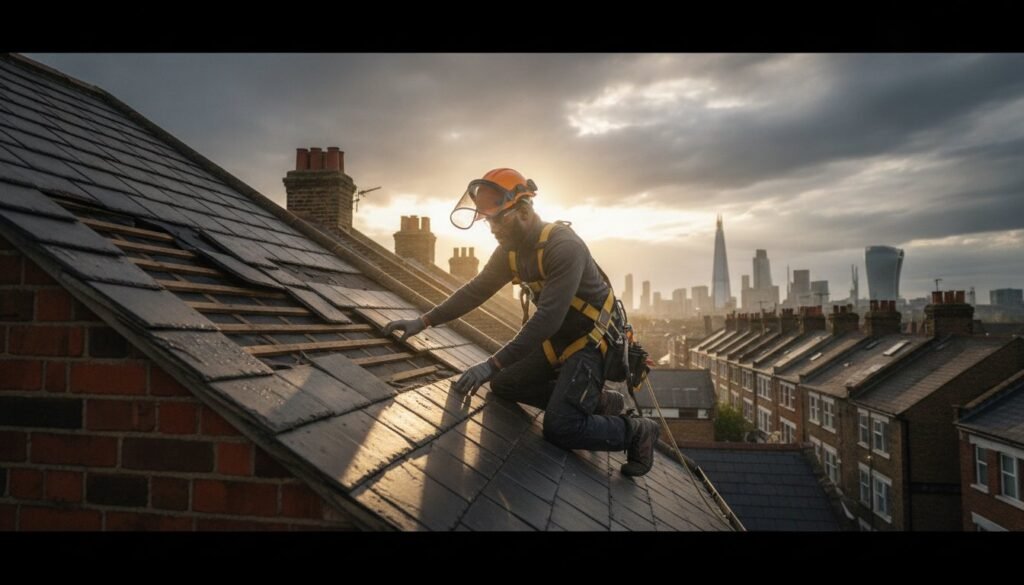
Pitched roofs are engineered to shed water quickly, but they are particularly vulnerable to wind-uplift. This occurs when high-velocity gusts create a vacuum effect that pulls tiles or slates away from the wooden battens. There is a significant difference between a simple slipped tile and structural timber damage. A slipped tile is often a quick fix. If the underlying rafters are cracked or rotting due to long-term exposure, the repair becomes more complex. One missing tile can lead to a cascading failure. This is where the wind enters the newly created gap and strips away surrounding tiles with ease. Seeking expert roof repairs London ensures that these issues are caught before they escalate. It also protects your home under our 15-year guarantee on all workmanship.
Flat Roof Punctures and Chimney Issues
Flat roofs face a different set of challenges during a storm. They are highly susceptible to ponding, where heavy rain collects in stagnant pools. The sheer weight of this water can cause the roof deck to bow or even fail if the drainage is blocked. Debris like falling branches can easily puncture traditional felt membranes, leading to immediate internal leaks. We often find that fiberglass (GRP) roofs offer far superior storm resistance because they are seamless and incredibly durable. Chimney stacks are another common casualty of London gales. They sit high above the roofline and catch the full force of the wind. Look for signs of stack movement or cracked flaunching, which is the mortar at the base of the chimney pots. We specialise in chimney repair London for properties where the stack has become unstable or the mortar has failed due to age and weather stress.
Guttering systems often fail during the intense rainfall that accompanies a London storm. The weight of the water, combined with trapped leaves or silt, can cause brackets to snap or pull away from the wall. This often leads to water overflowing into the uPVC fascias and soffits, eventually rotting the roof edge. It’s a simple problem that leads to expensive repairs if ignored. Checking your gutters after a storm is a vital part of your recovery checklist.
Navigating Insurance Claims and Professional Assessments
Dealing with insurance companies after a storm is often more stressful than the weather itself. You need a solid paper trail to ensure your claim isn’t rejected. Professional documentation is the bridge between a damaged home and a successful storm damage roof repair London. Insurers are under increased pressure; they now scrutinise weather evidence and pre-storm maintenance records more closely than ever. Providing them with a clear, professional assessment from the start reduces friction and speeds up your recovery.
Gathering Evidence for Your Claim
Start your record-keeping immediately. Note the exact date and time the damage occurred. Insurance adjusters compare your report against local meteorological data to verify the “storm” conditions. Take high-resolution photos from multiple angles, but stay on the ground. If you find slipped slates or broken tiles in the garden, keep them as physical evidence. These fragments tell a story about the impact force. Your roofer must provide a detailed, written breakdown of the necessary repairs. A vague “roof fix” description won’t suffice for a claim. You need a document that specifies materials, labour, and the exact areas of failure. This transparency makes it much harder for an insurer to dispute the costs.
Choosing a Trusted London Contractor
London is often targeted by “storm chasers” after a gale. These are contractors who travel to affected areas but vanish once the work is done. It’s a common trap. Look for a local, family-run business with a physical London office. This ensures long-term accountability and local knowledge of London’s specific building regulations. We’ve spent over 20 years building a reputation for honesty. We don’t believe in “hidden extras” or high-pressure tactics. Always verify a contractor’s insurance and workmanship guarantees before any work begins. If the damage is catastrophic and requires a new roof installation London, you should expect a 15-year guarantee as standard. This is your ultimate protection against future issues.
Be wary of anyone demanding full payment upfront. Reputable businesses use transparent pricing models and only take payment upon completion or at agreed milestones. A professional site visit should always result in a written, no-obligation quote. This document is your shield. It outlines exactly what you are paying for and provides the evidence your insurer needs to process your payout. If you’re ready to secure your property with an expert assessment, book your free site visit and transparent quote today. We’ll help you get your home back to a watertight condition without the usual hassle.
Why Atlas Roofing Solutions is London’s Trusted Choice for Storm Repairs
When the clouds clear and you face the reality of a compromised home, you need more than just a contractor. You need a partner who understands the unique architectural landscape of the capital. Atlas Roofing Solutions is a family-owned and operated specialist. We’ve spent over 20 years protecting homes across the city. Unlike impersonal national franchises, we value our reputation in the local community over quick wins. This personal touch means we treat every storm damage roof repair London as if we were working on our own family home. You can expect honesty, integrity, and a commitment to quality that doesn’t end when the invoice is paid. We act as a reliable guardian for your property, focusing on long-term protection rather than temporary patches.
Our Commitment to Quality and Durability
We believe that a repair is only as good as the materials and the skill behind it. We select high-quality components specifically designed to withstand the volatile British weather. Our team specialises in both traditional clay tile repairs and modern fiberglass solutions. We ensure that every element of your roof is perfectly integrated. This includes making sure your soffit and fascia are aligned to provide maximum protection against wind-driven rain. Every job we undertake comes with a 15-year guarantee on workmanship. This is our promise of durability. It provides the ultimate peace of mind after the stress of a storm. We take pride in our “straight-talking” approach, ensuring you understand exactly how we are making your home watertight again.
The Atlas “Hassle-Free” Process
We’ve refined our recovery journey to be as simple and transparent as possible. We know you’re already dealing with the anxiety of internal water damage. Our methodical approach ensures a smooth transition from initial assessment to a completed repair. Our rhythm is steady and purposeful, designed to lead you toward a clear resolution without feeling rushed.
- Step 1: Rapid response site visit to assess the storm damage. We arrive promptly to identify both obvious leaks and hidden structural issues.
- Step 2: Transparent, no-pressure quote provided within 24 hours. We provide a clear breakdown of costs with no hidden extras or “storm chaser” tactics.
- Step 3: Expert repairs carried out with minimal disruption. Our seasoned team handles the work with care, precision, and respect for your property.
Choosing a local expert means choosing accountability. We are here for the long haul, providing free site visits and no-obligation quotes to reduce your financial anxiety. If you need professional support to secure your home, contact Atlas Roofing Solutions for a free storm damage assessment today. Let us help you restore your home’s safety with the quiet confidence that only 20 years of experience can provide.
Securing Your Home for the Long Term
Recovering from a major weather event is about acting quickly but thinking long term. By following a structured recovery checklist, you ensure that immediate safety issues are handled whilst building the professional evidence needed for a successful insurance claim. Remember that clear documentation and ground-level photos are your best tools during the initial assessment. It’s vital to avoid the stress of “storm chasers” by choosing a partner with deep roots in the community.
When you require storm damage roof repair London, you deserve a service that combines technical expertise with a transparent, no-obligation approach. As a family-run business with over 20 years of experience, Atlas Roofing Solutions provides the quiet confidence you need to move forward. Every repair we undertake is backed by our 15-year workmanship guarantee, ensuring your home remains a safe haven. Book Your Free Storm Damage Assessment with Atlas Roofing Solutions today. Let’s get your property back to its best and ensure it stays watertight for the future.
Frequently Asked Questions
Is storm damage to a roof covered by standard UK home insurance?
Standard UK buildings insurance usually covers storm damage to the roof structure. However, it won’t cover damage caused by lack of maintenance or simple wear and tear. Insurers typically define a storm as having wind speeds of at least 48mph or exceptionally heavy rain. It’s vital to maintain your roof in good condition before a storm hits to ensure your claim is accepted. Always document the damage with photos immediately to support your case.
How much does emergency storm damage roof repair cost in London?
The cost of storm damage roof repair London depends on the materials involved and the severity of the impact. Factors like the height of the building and the type of tiles, such as natural slate or clay, influence the final quote. Emergency temporary measures like tarping are often billed as a separate charge. We provide transparent, no-obligation quotes after a free site visit to ensure you know exactly what the work entails without hidden extras.
Can I repair a storm-damaged roof myself using a DIY kit?
Attempting a DIY repair after a storm is dangerous and often counterproductive. Roof surfaces are slippery when wet, and structural damage might not be visible to an untrained eye. A botched DIY fix can void your insurance policy or any existing warranties on your roof. It’s better to rely on a professional who can provide a long-term guarantee and ensures the work meets current UK Building Regulations for safety and thermal efficiency.
How quickly should I have my roof inspected after a severe storm?
You should arrange an inspection as soon as it’s safe to do so. Most insurance policies require you to notify them of damage “as soon as reasonably possible” after the event occurs. Delaying an inspection can allow water to seep into your home’s structure, leading to rot or mould. A prompt professional assessment provides the evidence you need to start your claim and prevents a small leak from becoming a major structural issue.
What are the signs of hidden storm damage that I might miss?
Hidden damage often shows up as “pinpricks of light” visible from inside your attic or damp patches on insulation. You might also notice granular grit or tile fragments in your gutter outlets. This indicates that the protective layer of your roof is failing. Lifted lead flashing or hair-line cracks in mortar are easy to miss from the ground but can lead to significant water ingress over time if they’re left unaddressed by a specialist.
Does Atlas Roofing Solutions provide a guarantee on storm repairs?
Yes, we provide a 15-year guarantee on all workmanship for our roofing services. This commitment reflects our confidence in the quality of our materials and the skill of our seasoned team. As a family-owned business with over 20 years of experience, we focus on providing durable, long-term protection for your home. This guarantee ensures your storm damage roof repair London is a permanent solution rather than a temporary fix to a recurring problem.
What happens if my chimney is damaged during a London storm?
Chimney stacks are highly exposed and often suffer from failing mortar or unstable pots during high winds. We offer specialised chimney repairs to restore the structural integrity of your stack. This includes repointing, pot replacement, and fixing lead flashing. If you notice any debris in your garden or a change in the chimney’s profile, it’s essential to have it secured quickly to prevent falling masonry from damaging your roof or causing an injury.
Should I replace my entire roof if a storm has removed several tiles?
A full replacement isn’t always necessary for minor tile loss. If the underlying structure is sound and the damage is localised, a professional repair is usually sufficient. However, if you replace more than 25% of the roof’s area, UK Building Regulations require you to upgrade the insulation to meet modern thermal efficiency standards. We assess the overall condition of your roof to help you decide on the most cost-effective and durable path forward.