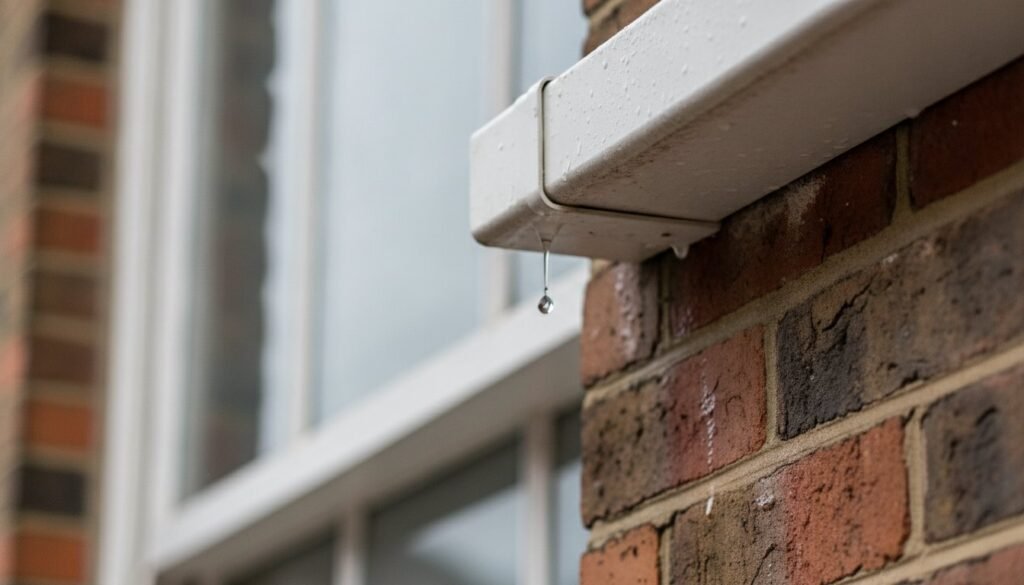
You’re lying in bed on a rainy Tuesday night in Dulwich when it starts. A persistent, rhythmic tap-tap-tap against the glass that isn’t the rain itself, but the overflow from a failed joint above. By morning, that annoying sound has left a dark, salt-stained damp patch on your exterior brickwork. It’s a common London story. Most homeowners feel a sense of dread when they spot a drip, especially whilst worrying about the safety of ladders or the confusing jargon surrounding fascias and soffits.
This guide simplifies leaking gutter repair London to help you reclaim your peace of mind. We’ll show you exactly how to identify the source of the problem and protect your property from the structural damage that damp can cause. You’ll learn how to safely inspect your own roofline, understand the costs involved in professional repairs, and discover why a permanent solution is always better than a temporary patch. From simple DIY checks to knowing when to call in a specialist with a 15-year guarantee, we have you covered.
Key Takeaways
- Identify the specific “hidden” leak points that often affect London’s unique Victorian and Edwardian terrace properties.
- Master the essential safety protocols and cleaning techniques required for a successful leaking gutter repair London project.
- Understand how urban factors like London plane tree debris and thermal expansion cause uPVC joints to fail.
- Recognise the early signs of penetrating damp to prevent the need for costly internal redecoration and structural maintenance.
- Learn when to transition from DIY fixes to professional repairs that provide a 15-year guarantee for long-term security.
Identifying the Source: How to Diagnose Gutter Leaks
Identifying a leak isn’t always as simple as looking for a waterfall. A gutter leak is essentially a breach in your home’s drainage path that allows water to bypass the downpipe. Your guttering acts as a critical component of a water discharge system, and any failure here puts your walls at risk. In London, this is a common headache. Many of the city’s Victorian and Edwardian terraces suffer from unique “hidden” leaks where water tracks along old brickwork before appearing as a damp patch inside your living room.
You can often find the culprit without waiting for the next storm. We recommend the “Dry Day Inspection” method. Use a garden hose to run water into the guttering at the highest point. Watch the flow carefully. If water escapes through a seam or joint, you’ve located the source. However, if the water simply sits still and eventually spills over the edge, you’re likely dealing with a pitch issue. This happens when the gutter sags over time, preventing gravity from doing its job.
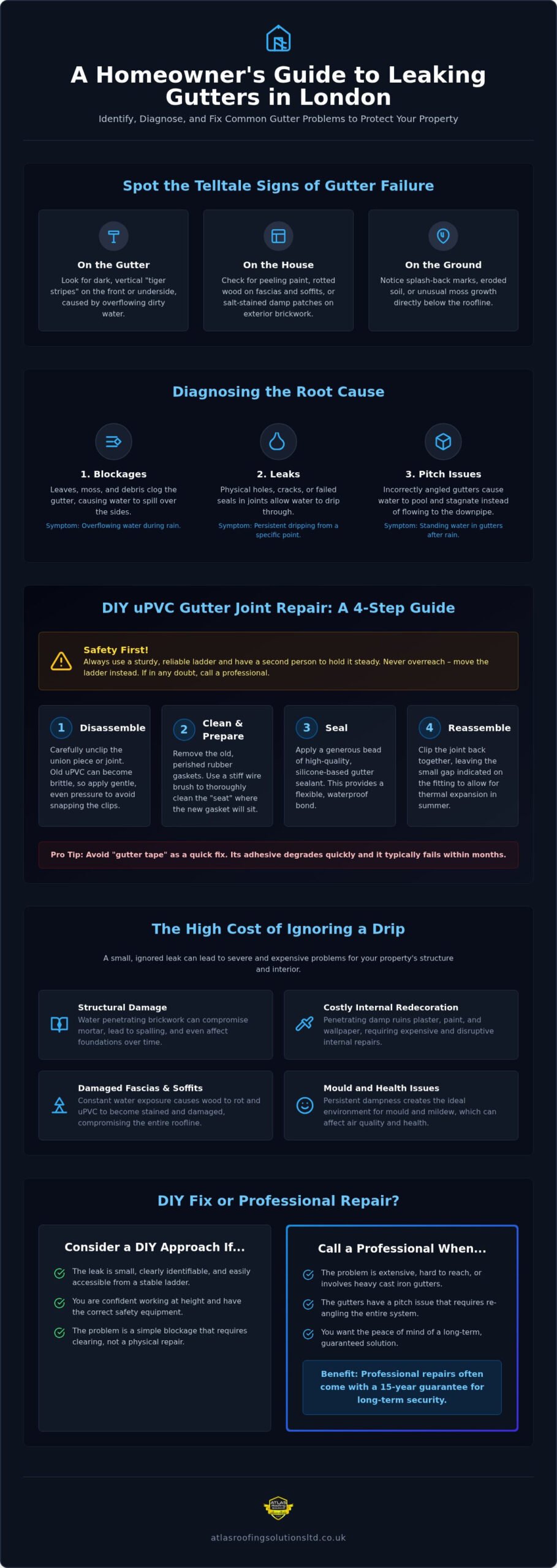
It’s vital to distinguish between three main problems:
- Blockages: Usually caused by leaves or debris, leading to overflows.
- Leaks: Physical holes or failed seals in the guttering joints.
- Pitch Issues: Incorrectly angled gutters that cause water to pool and stagnate.
Knowing the difference helps determine if you need a simple cleaning or professional leaking gutter repair London services.
Visual Indicators of Gutter Failure
Your home often leaves clues even when it’s dry. Walk around the perimeter and look for “tiger stripes”. These are dark, vertical streaks on the underside or front of the guttering, caused by dirty water constantly spilling over the edge. You should also check your fascias and soffits. If you notice peeling paint or rotted wood, it’s a primary sign that water is splashing back against the house rather than flowing away.
Don’t forget to look down. If you see splash-back marks, eroded soil, or unusual moss growth on the ground directly below the roofline, water is definitely escaping from above. These small signs are early warnings that shouldn’t be ignored.
The Rain Test: Spotting Leaks in Real-Time
The best time to see the truth is during a heavy London downpour. Safely observe the guttering from the ground to see exactly how the water behaves. Note where it escapes. Is it pouring over the top? That’s usually a blockage. Is it dripping steadily through a joint? That’s a clear leak. If you see water running down the wall behind the guttering, the seal against the fascia has likely failed. Correctly identifying these issues ensures that your leaking gutter repair London is targeted and effective.
How to Repair Leaking Gutter Joints: A Step-by-Step Guide
Safety is your first priority. Before you even touch a tool, ensure you have a sturdy, reliable ladder. Never work alone; always have a second person to foot the ladder whilst you are at height. It sounds simple, but most accidents happen when homeowners overreach. If you can’t reach the joint comfortably, move the ladder. Taking these precautions is the foundation of any successful leaking gutter repair London project.
Preparation is everything. You cannot seal a joint that is covered in silt and grime. Start by following a step-by-step guide to cleaning your gutters to ensure the surface is pristine. Use a stiff wire brush to scrub away stubborn debris. Avoid the temptation to use “gutter tape”. Whilst it looks like a quick fix, it’s notorious for failing within months as the adhesive degrades. You need professional-grade tools: high-quality silicone sealant, fresh replacement gaskets, and a steady hand.
Sealing Leaks in uPVC Guttering
Modern uPVC systems are common across London. Follow these four steps for a lasting fix:
- Step 1: Unclip the union piece or joint carefully. Old plastic becomes brittle; apply pressure gently to avoid snapping the clips.
- Step 2: Remove the perished rubber gaskets. These are usually the cause of the leak. Use your wire brush to clean the “seat” where the new gasket will sit.
- Step 3: Apply a bead of high-quality silicone-based gutter sealant. This provides a flexible, waterproof bond that moves with the house.
- Step 4: Re-assemble the joint. Leave a small gap, usually marked on the fitting, to allow for thermal expansion during the summer months.
Repairing Metal or Cast Iron Gutters
London’s heritage properties often feature heavy cast iron systems. These require a different approach. Use metal-specific fillers to bridge small holes and apply rust-inhibiting paints to stop corrosion in its tracks. However, cast iron is incredibly heavy. If you spot significant thinning or large holes, the metal has likely reached the end of its life. In these cases, a patch won’t hold. If the repair feels beyond your comfort level, seeking professional guttering expertise is a wise move to protect your home’s structural integrity.
Common Causes of Gutter Leaks in London Properties
Understanding why your drainage fails is the first step toward a permanent leaking gutter repair London solution. Whilst many homeowners assume a leak is just a hole, the reality in the capital is often more complex. London plane trees are a major culprit; their large, leathery leaves and sticky seeds create dense, mat-like blockages that standard rainfall can’t shift. This urban grime combines with city pollution to form a heavy sludge that puts immense strain on your guttering system.
Thermal expansion is another silent enemy. The UK’s shifting temperatures cause uPVC to expand and contract daily. Over time, this causes the plastic to “creep” out of its union joints. If the original installer didn’t leave enough room for this movement, the seals eventually fail. Similarly, improper pitch causes significant issues. Gutters must have a slight fall towards the downpipe to function. If they are level or sloping the wrong way, water pools and creates a weight that leads to bracket failure, especially during winter snow.
The Impact of Blocked Downpipes
A single blockage at the top of a downpipe can paralyse your entire system. When water has nowhere to go, it creates a “back-filling” effect. Instead of overflowing forward, the water seeps behind the fascia board and into your roof space. This is how “hidden” leaks start. You can often clear these yourself using a plumber’s snake or a high-pressure hose to dislodge the plug. Regular checks are vital, as highlighted in this Essential Guide To Gutter Maintenance, which explains how small preventative steps stop major damp issues.
Structural Sagging and Material Fatigue
Old gutters often begin to “belly” or sag in the middle. This material fatigue is common in uPVC systems that have reached the end of their typical lifespan. In a polluted urban environment, chemicals in the rain can accelerate this degradation. You might also find that the brackets have pulled away because the timber fascia behind them has started to rot. If your gutters are sagging, it’s rarely just a loose screw. It’s usually a sign that the underlying structure needs attention before you can successfully complete a leaking gutter repair London.
Protecting Your Home: The Consequences of Ignoring a Leak
Ignoring a leak is a gamble with your property’s value. When water bypasses the downpipe, it doesn’t just disappear. It runs down your external walls, leading to penetrating damp. This moisture eventually migrates through the brickwork and appears as unsightly patches on your interior wallpaper or paint. The cost of internal redecoration and professional damp-proofing far outweighs the relatively low cost of a timely leaking gutter repair London. Acting quickly prevents a minor drip from becoming a major renovation project.
The danger extends deeper than the surface. If your home has cavity walls, constant water flow can saturate the insulation within. Wet insulation loses its thermal properties. This makes your home harder to heat and prone to mould growth. Don’t overlook the base of your house, either. “Splash-back” occurs when water falls from height and hits the ground, bouncing back against the lower brickwork. This can mimic or even cause rising damp, potentially leading to foundation issues over several years. It’s a slow process, but the damage is often permanent.
The Link Between Gutter Leaks and Fascia Rot
Water leaking from the back of a gutter is particularly destructive. It sits against the timber fascia board, causing it to rot from the inside out. This isn’t just an aesthetic problem. Your soffit and fascia are essential for maintaining proper roof ventilation. If these components decay, you risk timber rot in the rafters themselves. Replacing gutters whilst ignoring rotted fascias is a wasted investment. The new brackets won’t have a secure hold, and the underlying decay will continue to spread. If you’re concerned about the condition of your boards, understanding the full process of uPVC fascia board installation can help you distinguish between a superficial capping job and a proper, rot-free replacement.
Structural Damage to Brickwork and Mortar
London’s weather can be harsh on masonry. When water saturates bricks, they become vulnerable to “spalling”. This happens during the winter frost when trapped moisture expands, causing the brick faces to crumble and flake away. Similarly, the concentrated flow of a leak can erode mortar joints. Over time, this “pointing” washes away, weakening the wall’s structural integrity. Addressing these issues early via a professional leaking gutter repair London protects your home’s long-term resale value and keeps the exterior looking sharp.
If you’ve noticed damp patches or peeling paint on your roofline, it’s time to secure your home with professional guttering services.
Professional Gutter Repair in London: When to Call Atlas
Choosing to handle a leaking gutter repair London yourself is often a matter of scale. A single-storey extension is a manageable DIY task, but the capital’s iconic three-storey townhouses and tall Victorian terraces require more than just a standard ladder. Working at height on narrow London streets is a specialist job. Atlas Roofing Solutions Ltd uses professional towers and high-level access equipment to reach those difficult spots safely and efficiently. This isn’t just about convenience; it’s about safety. DIY gutter fixes are a leading cause of domestic ladder accidents, often because homeowners overreach or use unsuitable equipment on uneven pavement.
At Atlas Roofing Solutions Ltd, we take a “Full Roofline” approach. A leaking joint is often a symptom of a larger issue, such as a failing fascia or a blocked valley. Our team doesn’t just apply a patch and leave. We conduct a thorough assessment of your entire roofline to spot potential emergencies before they happen. This proactive care is backed by our 15-year guarantee on all workmanship. You aren’t just paying for a repair; you are investing in long-term security for your home. We arrive. We assess. We fix. It’s that simple.
High-Level Access and Specialist Equipment
Accessing complex London rooflines requires precision. Whether your property is a shared terrace or a standalone townhouse, Atlas Roofing Solutions Ltd ensures that all equipment is positioned safely without damaging your garden or blocking public footpaths. Our process includes a complete site clearance. We remove all debris, old gaskets, and sludge from your property, leaving the site as clean as we found it. This hassle-free experience is why Londoners have trusted us for over two decades. We handle the heights so you don’t have to.
The Atlas Roofing Solutions Ltd Difference
We are a family-run roof repairs London specialist with over 20 years of local experience. Atlas Roofing Solutions Ltd understands the specific materials and architectural quirks of this city, from cast iron heritage systems to modern uPVC. Our pricing is transparent and grounded in honesty. We provide free, no-obligation site visits to assess the damage accurately before any work begins. If a simple repair isn’t enough, we can integrate a full guttering installation London with fascia and soffit upgrades. This ensures your home remains dry, protected, and looking its best for years to come.
Secure Your Home Against the Elements
Addressing a drip today prevents a damp living room tomorrow. You now know how to spot the early warning signs of failure and why temporary patches often fall short. Maintaining your roofline is the best way to ensure long-term protection for your property’s value. It’s about more than just drainage; it’s about safeguarding your home’s structure from the top down.
For many residents, the height and complexity of local properties make DIY work a significant risk. That’s where we help. As a family-run business with over 20 years of local experience, we provide a transparent, straight-talking service. We don’t just patch leaks; we offer a 15-year guarantee on all workmanship to ensure your home remains dry and secure. If you’re ready to resolve your leaking gutter repair London needs for good, get a free quote for professional gutter repair in London today.
Don’t let a minor drip become a major headache. Take action now and enjoy a dry, protected home regardless of what the London weather throws your way.
Frequently Asked Questions
How much does it cost to repair a leaking gutter in London?
Costs for leaking gutter repair London vary based on the property’s height and the materials involved. A simple joint fix on a ground-floor extension is naturally more affordable than work on a three-storey townhouse requiring specialist access. Factors such as the extent of the corrosion in metal systems or the number of perished gaskets will influence the final quote. We always recommend a site visit for an accurate assessment.
Can I fix a leaking gutter joint from the inside?
Fixing a joint from the inside is generally a temporary measure that fails under pressure. Guttering is designed to be watertight at the point where the sections meet. Applying sealant to the interior often traps moisture against the joint, which can accelerate rot in the fascia boards behind it. For a lasting solution, the joint should be dismantled, cleaned, and properly resealed from the exterior contact point.
What is the best sealant for leaking gutters?
High-grade silicone sealants are the industry standard for most residential systems. These products offer the flexibility needed to handle thermal expansion whilst maintaining a waterproof bond. You should avoid using “gutter tape” or bitumen-based patches. These materials tend to become brittle in the cold and melt in the sun, leading to a recurring leak within just a few months of application. Professional sealants provide much better longevity.
How do I know if my gutters need repairing or replacing?
Repairs are suitable for isolated issues like a single failed seal or a loose bracket. However, if your uPVC is brittle, cracked, or severely sun-bleached, it has likely reached the end of its lifespan. For cast iron, significant thinning or large areas of rust usually indicate that replacement is the safer, more cost-effective long-term option. We can help determine the best route during a leaking gutter repair London inspection.
Why is water leaking behind my gutter and down the wall?
Water leaking behind the gutter usually indicates that the system is blocked or the pitch is incorrect. When water cannot flow toward the downpipe quickly enough, it pools and spills over the back edge. This is particularly dangerous as it directs moisture straight onto your timber fascias and into the cavity wall. It is often a sign that the gutter needs to be realigned or cleared of debris immediately.
Do leaking gutters cause damp inside the house?
Yes, failed drainage is a primary cause of penetrating damp. When water consistently runs down your exterior walls, the brickwork becomes saturated. Over time, this moisture migrates through the wall to the interior. You’ll notice peeling wallpaper, damp patches on the ceiling, or a musty smell. Resolving the leaking gutter repair London issue is the first step in drying out your home and preventing structural decay.
How often should gutters be cleaned and inspected in London?
We recommend a professional inspection and clean at least twice a year. Late autumn is the most critical time to clear fallen leaves before winter storms arrive. A second check in the spring ensures that winter grit and moss haven’t caused new blockages. If your property is located near large trees, you might need more frequent maintenance to prevent heavy debris accumulation and potential water damage.
Is gutter repair covered by home insurance in the UK?
Home insurance in the UK typically excludes gutter repairs because they are considered routine maintenance. Most policies cover sudden events, such as a storm blowing the guttering off the house, rather than gradual wear and tear or leaks caused by blockages. It is always worth checking your specific policy wording, but regular maintenance is usually the homeowner’s responsibility to prevent larger claims for internal damp or rot.